Will Jacks leads England to 89-run victory over Sri Lanka
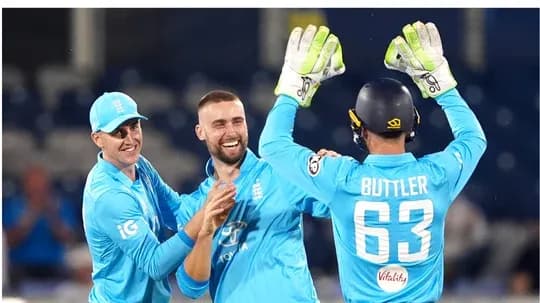
This was the kind of one-day performance England have been searching for: not flawless, not explosive from ball one, but hard-edged, disciplined and ruthless when it mattered. At Chester-le-Street, they beat Sri Lanka by 89 runs, and the scoreline felt every bit as emphatic as it looks.
It belonged to Will Jacks. With bat and ball.
Brook leads, Root rewrites history
Put in after winning the toss and choosing to bat, England’s innings never quite became the runaway they threatened, but it had a solid spine.
Harry Brook, given the captaincy and the No. 3 role, played the innings around which everything else revolved. His 67 from 69 balls was brisk without being reckless, busy without ever looking hurried. He picked gaps, punished anything even slightly overpitched and repeatedly dragged England back on top whenever Sri Lanka’s seamers sniffed an opening.
Around him, familiar class. Joe Root, who has made milestones look routine for a decade, slipped to another one: past 23,000 international runs across formats. His 44 was not his most flamboyant work, but it was vital. Early on, he absorbed pressure; later, he nudged and steered England into a position from which they could aim higher.
Ben Duckett’s 32 set the tempo at the top. Jos Buttler, so often the finisher, played a more measured hand this time, his 31 helping to shore up the middle overs as Sri Lanka’s bowlers chipped away. The total never felt out of reach, but it never felt flimsy either.
The innings, though, kept stalling just as it looked ready to surge. Every time England eyed 300, Sri Lanka dragged them back.
Sri Lanka’s attack refuses to go away
Sri Lanka’s bowlers never allowed England to disappear into the distance. All five used by Kusal Mendis took a wicket, and they earned every one.
On debut, Sachindu Colombage looked anything but overawed. His legspin brought 3 for 44, but the figures only tell part of the story: he challenged both edges, teased with flight and forced England to think twice about attacking through the middle overs.
Asitha Fernando matched that impact with 3 for 53, hitting the pitch hard and finding just enough movement to keep England honest. Dilshan Madushanka, Dushmantha Chameera and Dunith Wellalage each chipped in with a wicket, collectively ensuring England were bowled out with 11 balls unused, for 265 in 48.1 overs.
A defendable score. Not a crushing one. The game was open.
Then Jacks took over.
Jacks the finisher with the bat…
Before he wrecked Sri Lanka’s chase, Jacks had already done something quietly important with the bat. Walking in as England’s innings threatened to tail away, he refused to let it fizzle out.
His unbeaten 46 from 47 balls wasn’t a blaze of sixes, but it was exactly what the situation demanded. He ran hard, found the gaps, and turned what could have been a limp 230–240 into something far more awkward to chase. Those extra 20–30 runs he squeezed out changed the mood.
They looked even bigger once he had the ball in his hand.
…and the destroyer with the ball
Chasing 266, Sri Lanka needed one thing above all: partnerships. They never really got them.
Pathum Nissanka, as so often, was the early anchor. His 27 from 37 balls included the personal landmark of 3,000 ODI runs, a significant achievement for a player rapidly becoming the backbone of their top order. But his dismissal cut off the flow just as he seemed ready to push on.
From 84 for 2 in the 20th over, Sri Lanka were still very much in the contest. Mendis, with a composed 42, tried to hold the chase together from the middle order. He read the situation well, picked off singles, and looked the one batter capable of stretching England deep into the evening.
Then came the squeeze.
Jacks, operating with the confidence of a man who had already contributed heavily with the bat, began to rip through the heart of the innings. His offspin was tight, attacking, and relentless. He varied pace, used the angles, and never allowed Sri Lanka to settle into any kind of rhythm.
The wickets began to tumble. Middle order, then lower order. Plans unravelled, footwork faltered. Jacks kept hammering away, and Sri Lanka kept walking back.
By the time he was done, his figures were scarcely believable: 5 for 22 in seven overs. A maiden five-wicket haul in ODIs, and one that arrived with a sense of inevitability once he found his groove.
Overton lights the fuse, Wellalage fights back
If Jacks was the headline act, Jamie Overton supplied the turning point. His twin strikes in quick succession shattered what remained of Sri Lanka’s composure. From a platform that looked stable, the chase lurched suddenly into crisis.
Wickets began to cluster, the required rate grew teeth, and panic crept in.
Only Dunith Wellalage refused to accept the script. Coming in with the game slipping away, he counter-attacked with clarity and courage. His 45 off 36 balls was the most fluent innings of the Sri Lankan reply, full of clean strikes and bold intent.
For a brief spell, he dragged the contest back to life. If someone had stayed with him, if one partnership had held, the chase might have taken on a very different shape.
No one did. England’s bowlers kept striking, the fielders stayed sharp, and the pressure never eased. Sri Lanka were eventually bowled out for 176 in 37 overs, well short and well beaten.
A template England will want to bottle
This was not a day of outrageous hitting or freakish collapses. It was a day when England built a total, protected it with discipline, and then crushed a chase with smart, targeted aggression.
Brook’s authority, Root’s landmark, Buttler’s composure, Jacks’ all-round brilliance, Overton’s burst: all of it combined into a performance that looked, at last, like a side finding its one-day identity again.
If this is their baseline for the series, the real question now is simple: how much higher can they push it?