Varun Chakravarthy’s Second Act: Late Bloomer in Cricket
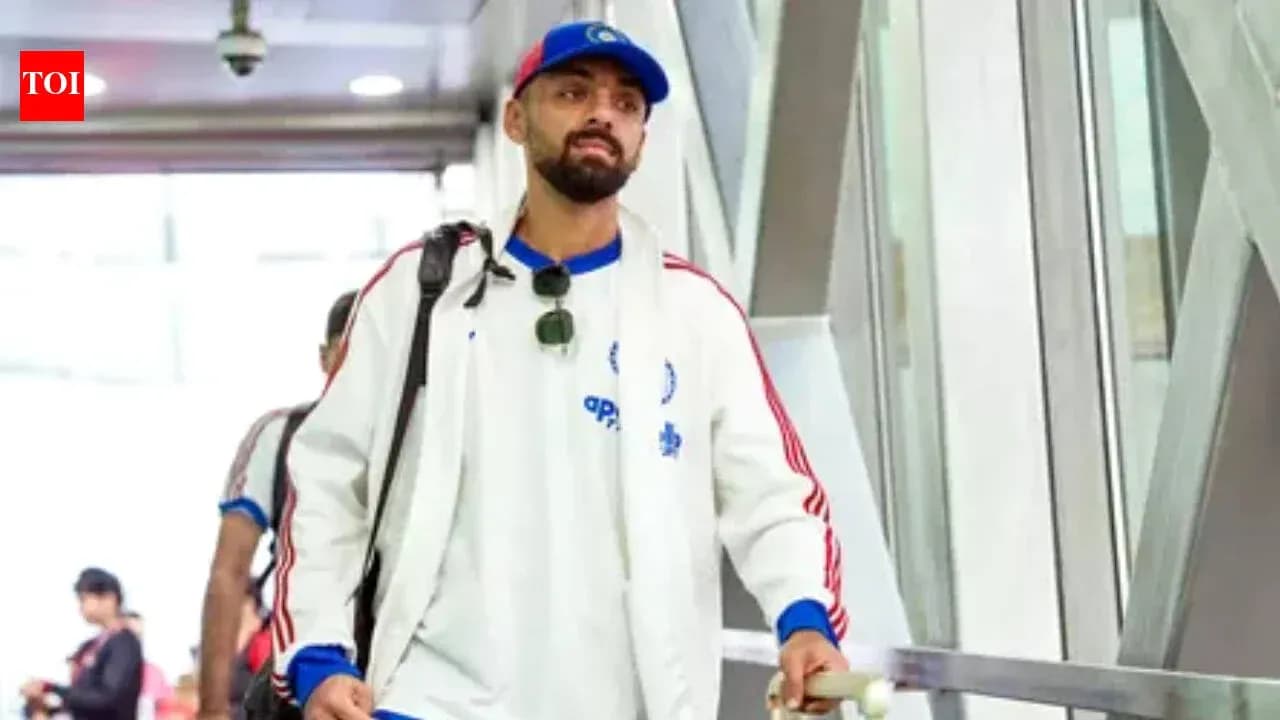
NEW DELHI: Varun Chakravarthy has never moved to cricket’s clock. He was 29 when he first walked out in India colours. At 35, most cricketers are quietly planning exits. He is talking about a “first half”.
“At this stage of my career, I still feel I'm in my first half of my career because I started cricket very late. So I still feel there's a long way to go,” he told TimesofIndia.com in an interaction facilitated by equipment manufacturer ASICS.
On paper, the last year reads like a career crammed into twelve months. A T20 World Cup win on home soil, where he finished as India’s joint-highest wicket-taker with 14. An IPL season played through hairline fractures in his left hand and toe. Then, the first muscle injury of his life, a Grade 2 hamstring strain that halted everything.
For most, that’s a warning from the body. For Chakravarthy, it’s data.
He has never been one for grand career manifestos or five-year targets. In a format as unforgiving as T20, he chases the next small upgrade – a tighter line, a new variation, a more stable landing – rather than the next milestone. That mindset shapes his return now, as he re-enters a packed schedule: three T20Is against Afghanistan, a one-off international against Japan, and the Asian Games in Aichi-Nagoya, where India, as defending champions, start straight from the quarterfinals.
Learning to Trust a Torn Muscle
Until this summer, Chakravarthy’s pain had always been blunt and visible – collisions, impact blows, freak on-field accidents. A muscle tear was a different language.
“This is actually my first ever muscle injury. So all of my injuries have been impact injuries and other accidents that have happened on field,” he said.
The BCCI Centre of Excellence in Bengaluru became his temporary home. Recovery was not just about scans and strength tests; it was about rebuilding belief in a body that had, for the first time, betrayed him from within.
“The expertise at CoE helped me and people helped me to gain my confidence. Every person working there helped me,” he explained. “Definitely, I spent a lot of time there and did a lot of running and did a lot of strength training, which helped me.”
For a mystery spinner, fitness is not simply binary – fit or unfit. His art leans heavily on rhythm, repetition, and the courage to try something a batter has never seen before. A hesitant body makes for a conservative bowler.
“Yeah, it will take some time to gain confidence. But once you gain confidence, you just start becoming more expressive and that's how it is,” he said.
So he treated the lay-off as a workshop, not a void. No flights, no match days, no tactical meetings – just time to sharpen skills that get neglected in the churn of continuous cricket.
“When you're away, you can start sharpening your skills. You can upskill yourself, which you don't get much time to do when you're playing continuously,” he pointed out.
The goal now is clear: walk back into an India dressing room not merely fit, but better.
The Spinner Who Starts From the Ground Up
Mystery spin usually gets explained with slow-motion replays of wrists and fingers. Chakravarthy starts lower.
“For a bowler, shoes are the biggest equipment they can have. Batters, they have many other equipments, but for a bowler, it's the shoes only,” he said.
His association with ASICS might sit in the commercial column, but the choice of footwear came earlier. He switched to their shoes around 2022 and only later formalised the partnership in January 2026. The way he breaks down what he needs from a pair of spikes could be straight out of his old life as an architect – precise, functional, obsessed with structure.
“As a spinner, your feet start becoming little broader as in it starts changing shape once you pivot because the spinners have to pivot more after landing. So broad shoes in the toe area that is very important,” he said.
A strong heel counter. Lighter weight. Space for a foot that has been twisted, braced and slammed into the turf thousands of times. It is all part of the same logic: if the base is wrong, the mystery at the top never appears.
It’s a small window into how he thinks. Analytical. Process-driven. Less romance, more rigour. Every marginal gain matters when your job is to stay one ball ahead of the batter.
A Curious Traveller in a Packed Calendar
The Asian Games, starting September 19, offer something Chakravarthy has never experienced, even after a World Cup win: a true multi-sport village.
“It's my first time in Japan. I've never been to Japan and any games also. So all I've played is ICC tournaments and ACC tournaments,” he said, the excitement obvious.
For once, the attraction is not just about new opponents or conditions. It’s about proximity to other elite athletes, people who peak for seconds or minutes, not overs and sessions.
“I'm very much looking forward to meeting other athletes also from other different sports and all those things,” he said. “I want to see how a 100-metre athlete prepares himself, how a badminton professional prepares himself or herself.”
In a cricket calendar that barely leaves room to breathe, let alone learn from others, that curiosity stands out. He wants to watch, compare, borrow. How does a sprinter handle the 10 seconds that define a four-year cycle? How does a badminton player structure recovery between matches? Somewhere in those routines, he believes, there are lessons for a 35-year-old spinner still intent on stretching his “first half”.
On the field, Japan will bring its own unknowns. The pitches at Korogi Sports Park are expected to behave differently from Indian surfaces, and Chakravarthy knows adaptability will matter more than any pre-written script. It suits him. His entire career has been an exercise in adaptation – from architect to IPL surprise package, from late debutant to World Cup winner, from impact injuries to his first real muscle tear.
Now he walks into another new environment, another new challenge, still convinced that his story is only halfway told.