Steve Smith's Return to South Africa: Facing the Burden of Sandpapergate
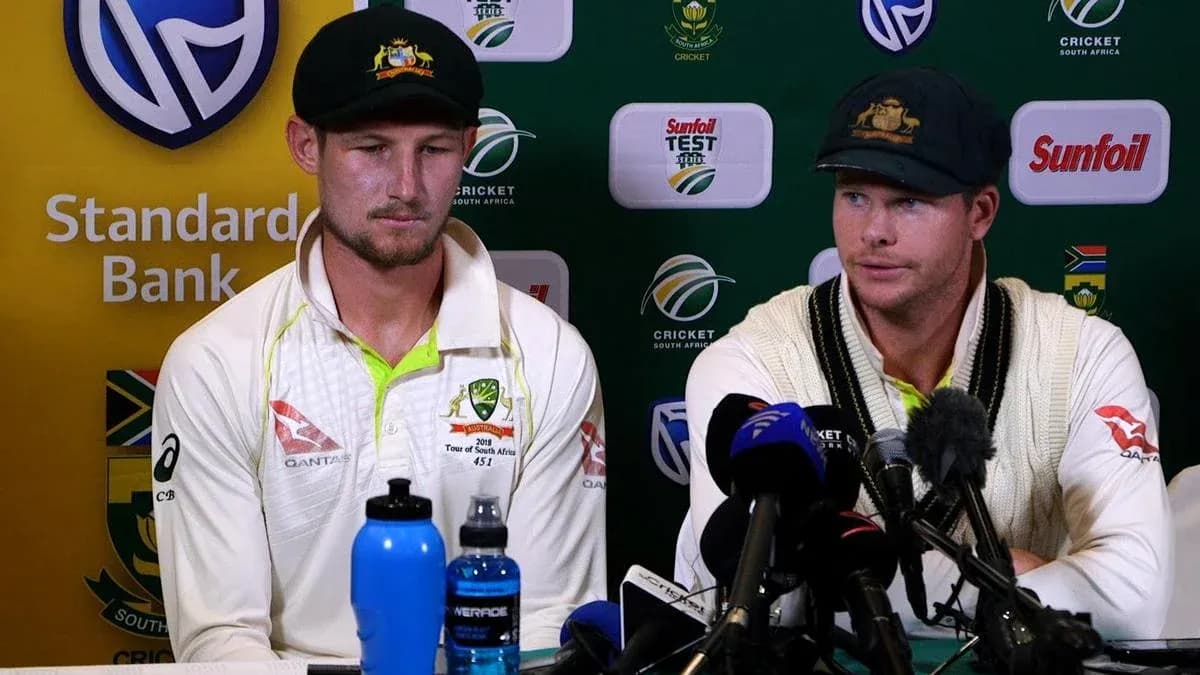
Steve Smith returns to South Africa this week carrying two things: a bat, and a burden he insists has “traumatised” him. The setting is familiar – another Test tour, another chance to reshape a legacy – but the scars date back to 2018 and the series that gave cricket one of its ugliest shorthand labels: sandpapergate.
Back then, Smith was captain, the standard-bearer of a ruthless Australian side. He was also central to a plot so brazen it barely seemed real: using sandpaper to tamper with the ball. It was a grubby act, a clear breach of the laws, and a direct assault on a game that prides itself on something loftier than the rulebook – that hazy, much-invoked “spirit of cricket”.
Smith’s deputy, David Warner, went down with him. Both were banned. Cameron Bancroft, the junior player told to do the dirty work, became the face of the scandal, fumbling with a piece of sandpaper on the big screen as the world watched.
The years since have produced a curious narrative split.
When Smith walked back out in Test whites after his ban, it was at Edgbaston in the cauldron of an Ashes summer. The boos were relentless, the hostility unbroken. He answered with 144 in the first innings and 142 in the second, batting as if encased in steel. He finished that series with 774 runs, a staggering tally built amid a soundtrack of derision. It felt like a story of grit and defiance, of a modern great refusing to be reduced to a single shameful act.
Was that the beginning of redemption? Or the point at which the story became too much about his suffering and not enough about the game he damaged?
Warner’s path was rougher. In that same Ashes series, he scraped together just 95 runs in 10 innings, dismissed seven times by Stuart Broad, who seemed to own him. Warner looked exposed, diminished, a senior player stripped of aura. Then came an unbeaten 335 against Pakistan, the highest score by an Australian in that fixture, a reminder of the force that still lurked in his game.
The public, though, sorted the villains and victims quickly. As Geoff Lemon, who wrote a book on the scandal, observed, opinion “firmly settled on Warner being the criminal and Smith the innocent bystander.” One became the schemer-in-chief, the other the tragic genius who lost his way.
The numbers help Smith’s case. Among players with more than 10,000 Test runs, no one averages more. For a long stretch he sat above 60, second only to Don Bradman in the sport’s most sacred metric. On the field, he is a modern great by any standard.
Yet the current focus on what the episode did to Smith – the trauma, the tears, the lost years – rather than what his decision did to his team and to the game itself, exposes a gap. It is the space between self-obsession and self-awareness.
Cricket writer Gideon Haigh captured that dissonance when he reflected on the original scandal. “What is extraordinary,” he said on television, “is how it was done and how easily it was agreed to by the team and how, not unapologetic, but sort of oblivious to the consequences Smith and Cameron Bancroft seemed to be at the press conference.”
That press conference was chilling in its own way. Not just for the admission of cheating, but for the casualness of it, the sense that this was simply the next step in a culture that had long worshipped a single idol: winning.
The mindset that produced sandpapergate did not appear overnight. It was of a piece with the entitlement and win-at-all-costs philosophy that had been cultivated and rewarded. The board pushed for victories, victories drove public interest, public interest drew sponsorships. The equation was simple and profitable. Almost everything was forgiven, right up until the moment something arrived that could not be.
Smith would later say, “I was thrown to the wolves,” a line delivered at a press conference where he sought understanding for the personal trauma he had endured. It was a revealing choice of words from a man who had instructed a younger teammate to take the risk and the heat on his behalf. The wolves, in that moment, were not the media or the public. They were the consequences he had tried to outsource.
There is another layer here, one that complicates easy judgment. A cricketer as consumed by batting and winning as Smith can be reshaped by suffering. Pain can humanise. A ban can feel like exile. And in sport, as in life, there is power in the idea of a second chance once a debt has been paid.
This writer admits to once calling for a life ban. It felt appropriate for an act that cut so deep into the game’s fabric. Then came a realisation: cricket is only a game. A serious game, a beautiful game, but an artificial construct all the same, no matter what virtues we project onto it. Its arenas are not courts of law. Its heroes are not saints.
Because it is artificial, we can load it with ideals the real world struggles to uphold. We can write codes of behaviour into it that are aspirational, sometimes impossibly so. We can demand a higher standard, then recoil when that standard is shattered.
Sport itself is morally neutral. A bat, a ball, a strip of turf – none of it carries virtue or vice. The acts of athletes do. Cricket’s need to bolt on a “spirit of cricket” preamble to its laws was a warning sign. The unwritten rules that once defined the game’s pride were being gamed, bent and twisted by players and teams who had learned to live in the grey areas.
That erosion says more about the players and the age they inhabit than about the sport itself.
Many international cricketers looked at the bans for Smith, Warner and Bancroft and thought them harsh. Some argued that the so-called “Australian way” – the chest-beating, the aggression, the line-pushing – had to bear its share of responsibility.
Trevor Chappell knows what it is to be a lightning rod for national shame. He was vilified for bowling under-arm to a New Zealand batter to prevent a last-ball six. Decades later, the stigma still clings. “(Smith and the others) will struggle for the rest of their lives,” he said. “I haven’t been able to shake off what happened to me in 37 years. I come up on Google as the man who took the lead role in Australian cricket’s darkest day. It’s a relief I can finally drop that title.”
He then posed the unspoken question: who takes it from him? Who carries the tag of Australian cricket’s darkest day now? Smith and Warner, by most accounts, are the current holders.
When Smith returned to South Africa for a white-ball tour, the reception was surprisingly muted. There were jeers, but not the fury many expected. Perhaps time had dulled the outrage. Perhaps the spectacle had moved on.
He will know, though, that wherever he plays, a section of the crowd will always have a song, a taunt, a single word that can drag him back to Cape Town and that piece of sandpaper. That is the punishment that never expires.
Runs can heal reputations. They cannot erase memory.