Sonal Dinusha: A Rising Star of Sri Lankan Cricket
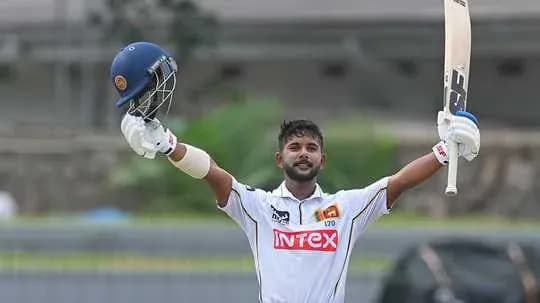
Sonal Dinusha had run out of room.
Darwin, July 2025. Sri Lanka A against Australia A. Three tall quicks – Mitchell Perry, Liam Scott, Henry Thornton – hammering the ball in short, again and again. The kind of barrage that makes a diminutive left-hander feel every inch of the height difference.
He was struggling. Everyone could see it.
"They were bowling bouncers, he was kind of struggling," recalls Avishka Gunawardene, then Sri Lanka A coach. So coach and player slipped away, threw a few balls, talked through the problem, stripped it down to tactics. What are you going to do? Where are your scoring options? How do you ride this?
And then he went back out.
The response was pure Dinusha. A 145-ball 105 in the first unofficial Test, his first hundred on Australian soil. A 191-ball 88 in the second game. Same attack, same short stuff, completely different outcome.
Identify the problem. Find the answer. Move on. That has been his way.
Built in the schoolyards
Dinusha is not an accident of talent. He is a product of Sri Lanka’s deepest cricketing vein: the schools.
He started at De La Salle College in Colombo, just another keen 12-year-old with a bat too big for his shoulders. There he met a coach who would shadow almost every step of his rise – Sonal Dulshan Elwalage, an SLC Level 2 coach barely eight years older, a cricketer whose own playing career had been cut short by family hardship.
"Dinusha began playing cricket there at the age of 12, and I worked with him from that time onwards. I was drawn to the enthusiasm he showed at such a young age," Dulshan says. Coaching became his way of staying in the game. Helping Dinusha climb became a mission.
From De La Salle, the boy moved across Colombo to Mahanama College, a more prestigious cricketing address and the alma mater of his current Test captain, Dhananjaya de Silva. The competition grew sharper, the expectations heavier. Dulshan stayed in his corner.
He saw plenty of big scores. One still glows in his memory.
Under-19 Division 1, February 2020, against Richmond College, Galle. Two-day cricket, the format that reveals who can really bat time. Mahanama 20 for 3 in the eighth over when Dinusha walks in. He doesn’t walk out again until the game is done.
An unbeaten 159 off 227 balls. Fifteen fours, four sixes. First-innings win secured in the 82nd over.
He had to manage the chase, nurse the tail, and he did it with a cold clarity. With No.11 Nisal Akash at the other end, Dinusha kept the strike, shielded his partner, and still found the boundary when needed. Akash faced just 11 balls in an undefeated last-wicket stand that stretched 7.3 overs.
The long vigil, the control of tempo, the calm with the tail – all of it looks very familiar now.
Learning on the job
By 2018, while still at Mahanama, Dinusha had already stepped into first-class cricket with Colombo Cricket Club. The jump barely rattled him.
Ashan Priyanjan, former Sri Lanka international and long-time CCC man, remembers the first impression vividly.
"I still remember he batted out of position at No.3. He's a No.6 batter but for the team's balance he batted at No.3 and got a half-century against a good bowling attack," Priyanjan says.
That willingness to adjust, to do the job the team needs rather than the one the player prefers, has trailed him ever since. So has the verdict from those who worked closest with him: this is not a career built only on talent.
Kalum Gangodawila, Felix Dias, Alan Rodrigo, Tharanga Dhamika – the list of mentors is long. The assessment is almost identical.
Gunawardene puts it plainly. "The main thing that I saw in him was he was a very organised cricketer. He was very methodical. He works hard, he knows exactly what he wants. He knows what areas he needs to work on. If there's any doubt, then he'd come and ask me. But if not, he knows exactly what he needs to do in training. He's a very smart cricketer."
That intelligence bleeds into the way he constructs innings, the way he drills specific skills. Nothing illustrates that better than the shot that has suddenly become his calling card.
The sweep that won a series
Across two Tests against India, Dinusha has scored 173 runs from one stroke alone: the sweep. Conventional, slog, fine – every variation, every angle.
Asked about it after Day 4, he shrugged off the fuss. "I am good at sweep shot, so I play it. That's all."
Of course, it isn’t all. It never is.
At CCC, Priyanjan watched the obsession up close. "He loved playing the sweep shot. He'd train separately in the nets for it. He would finish batting and then take throwdowns just to play the sweep shot."
Repetition, then refinement. Ball after ball, groove after groove, until what looks like instinct is actually hard coding. So when India’s spinners attacked his pads and stumps, he didn’t improvise. He executed.
The numbers in this India series are eye-catching enough – three centuries in four innings, including a monumental 133 off 264 balls that Gary Kirsten believes "would go down in Sri Lankan Test cricket history as one of the great saves."
But the manner of it is what has turned heads in the dressing room.
Earning trust at the highest level
Kirsten’s first proper look at Dinusha came in the West Indies. The situation was bleak: Sri Lanka 110 for 5, the game tilting away. Dinusha walked in at No.7 and stitched a stand of 99 with his captain.
"The first time I really watched him bat properly was in the first innings in the West Indies. He came in at seven and we were 110 for five. And he put on a hundred (99) with the captain. And I thought, ‘jeez, this guy can play.’ And then in the second match he got 92," Kirsten recalls.
The South African saw more than runs. He saw a mind at work.
"I love the way he plays Test cricket. He thinks about it. He plays to his strengths. And he is a smart cricketer. So he understands what the bowlers are trying to do to him. And then he uses his skillsets to communicate that."
That 133 against India, stretched over 264 balls, felt like the culmination of all those years of method and grind. It was not just a score; it was resistance, calculation, and nerve, wrapped in one innings.
No time for laurels
You might expect a young batter, fresh from a series like that, to linger on the numbers, to replay the applause in his head. Dinusha doesn’t seem wired that way.
Even before he completed that third hundred in four knocks, his mind had already drifted ahead – to the next tournament, the next training block, the next small improvement.
The pattern holds. From the bouncer storm in Darwin to the pressure cooker of Test cricket, the response has been the same: confront the flaw, drill the fix, move forward.
Sri Lanka Cricket now finds itself holding something rare: a precocious talent with an old-fashioned appetite for hard work, sharpened by one of the most robust school structures in the game.
The system has done its part, from De La Salle’s dusty nets to Mahanama’s pressure-laden inter-school clashes, from CCC’s first-class grind to A-team tours in hostile conditions.
The question now sits squarely with SLC.
They have a gem who has shown he will do the grunt work in the shadows. Will they give him the space, the continuity, and the backing to see just how high he can climb?