Sonal Dinusha's Remarkable Series Against India
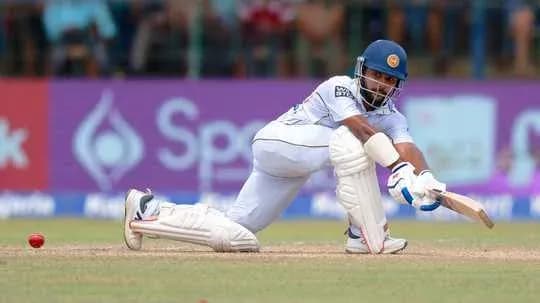
Sonal Dinusha walked into this series against India with just three Tests behind him and a string of thankless entry points ahead. Four innings, four pressure cookers. No soft landings, no gentle introductions. Just India’s spinners, on Sri Lankan pitches, with the game already leaning the wrong way.
He came out of it with 420 runs, three centuries, and something far more valuable than a series win: proof that he belongs in the toughest rooms Test cricket has to offer.
Owning the toughest length
On these surfaces, spinners live in that 3-5m good-length band. It’s where they ask the hardest questions. Most Sri Lankan batters found out quickly that they didn’t have many answers.
Dinusha did.
He scored 182 runs off good-length balls from spin, averaging 91 at a strike rate of 58.89. The series baseline? An average of 26.42 and a strike rate of 45.36. No one from either side scored more runs off that length. Only Niroshan Dickwella, in a much smaller sample, went quicker.
To frame it another way: Player of the Series Devdutt Padikkal averaged 69.50 and struck at 49.82 overall. Dinusha’s numbers against good-length spin alone sat comfortably above that.
The difference lay in where he chose to meet the ball.
Stepping out of the danger zone
Dinusha’s average interception point against good-length spin was 2.64m from the stumps, the farthest of any batter in the series. Padikkal, who liked to hang back, sat at 2.02m. That gap tells a story.
Only 43.4% of good-length balls to Dinusha were met in the so-called danger zone – the 1.5m to 3.5m corridor between pitching and interception. Among Sri Lankans, no one did better. Across both teams, only Padikkal, Rishabh Pant and Ravindra Jadeja kept themselves out of that zone more often.
He wasn’t surviving. He was dictating.
Among batters who faced at least ten overs of spin, Dinusha had the second-highest proportion of balls played off the front foot: 73.6%. Only India captain Shubman Gill went higher at 77.3%.
Gill, though, is tall and rangy, built to reach out and smother spin. Dinusha, listed at just five foot six, had to find another way. He did it with his feet and his sweep.
Feet, hands, and a relentless sweep
Dinusha came down the track to 12% of the balls he faced, second only to Pant’s 13.3%. That alone would mark him out as proactive. Then came the sweep.
His sweep percentage was 21.6%, the highest in the series. The scale of it was staggering: 120 sweeps attempted – including reverse and slog-sweeps – for 173 runs. Both numbers are the highest ever recorded in a series of any length, eclipsing Joe Root’s famed sweep-heavy masterclass in Sri Lanka in 2021.
He scored at better than a run a ball with the sweep against all four of India’s frontline spinners. This wasn’t a release shot. It was a primary scoring option and a tactical weapon rolled into one.
The most dangerous band for batters in the series was that 4-5m range, which produced 27 wickets at 21.14. Dinusha faced 212 balls there, scored 125 runs, and fell just once. Against the length that undid everyone else, he stayed ahead.
He mixed methods constantly. To balls in that 4-5m band, he swept 53 times for 87 runs and advanced down the pitch to 32 deliveries. Bowlers could not lock into a plan. Every time they thought they’d pinned him, he changed the question.
Taking on Jadeja
Doing all of this against Ravindra Jadeja, with his pace through the air and unforgiving trajectory, was perhaps the most impressive element.
Dinusha attempted 34 sweeps against Jadeja – the most by any batter against him in a series in the subcontinent. He also came down the track to Jadeja 36 times, just two fewer than Michael Clarke managed across five innings in that bruising four-Test tour of India in 2013.
This was not a young player cowed by reputation. He forced Jadeja to think, to adjust, to chase a length that no longer felt safe.
Not just about boundaries
For all the audacity of the sweeps and the charge down the pitch, Dinusha’s game was not built on constant big shots.
Eighteen of his 30 boundaries against spin came via sweeps or their variants, mostly in front of square on the leg side. He layered in paddle sweeps and reverse sweeps, and on four occasions he opened a fresh session with a slog sweep to the mid-wicket boundary. Those strokes did more than decorate the scorecard. They punched holes in fields and rattled bowling plans.
Once he had dragged the bowlers away from their preferred length, he went to work in quieter ways. He nudged, pushed, swept and worked the ball around for singles and twos, turning pressure spells into attritional ones for the fielding side. The scoreboard moved, even when the boundary count didn’t.
Only 4.98% of the balls he faced went to the rope, the second-lowest boundary rate among specialist batters who faced a significant volume in the series, ahead of only Jadeja. For a man who swept more than anyone has ever swept in a series, that is a revealing contrast.
It points to a method rooted not in highlight reels but in control.
The shot he refused to play
Perhaps the most telling detail is what Dinusha chose to leave out. Across pace and spin, across four innings and 420 runs, he did not hit a single boundary through the front-of-square off side.
The risky drive stayed in the locker.
In a series where India’s spinners exposed technical gaps and mental frailties all around him, a 23-year-old, three-Test batter walked in under pressure and built his game around clarity: move forward, sweep hard, stay out of the danger zone, and strip away the ego shot.
Sri Lanka did not win. But they may have found a batter built for the long, hard days that define Test cricket’s future.