Percy Fender’s 35-Minute Hundred: The Unbroken Record
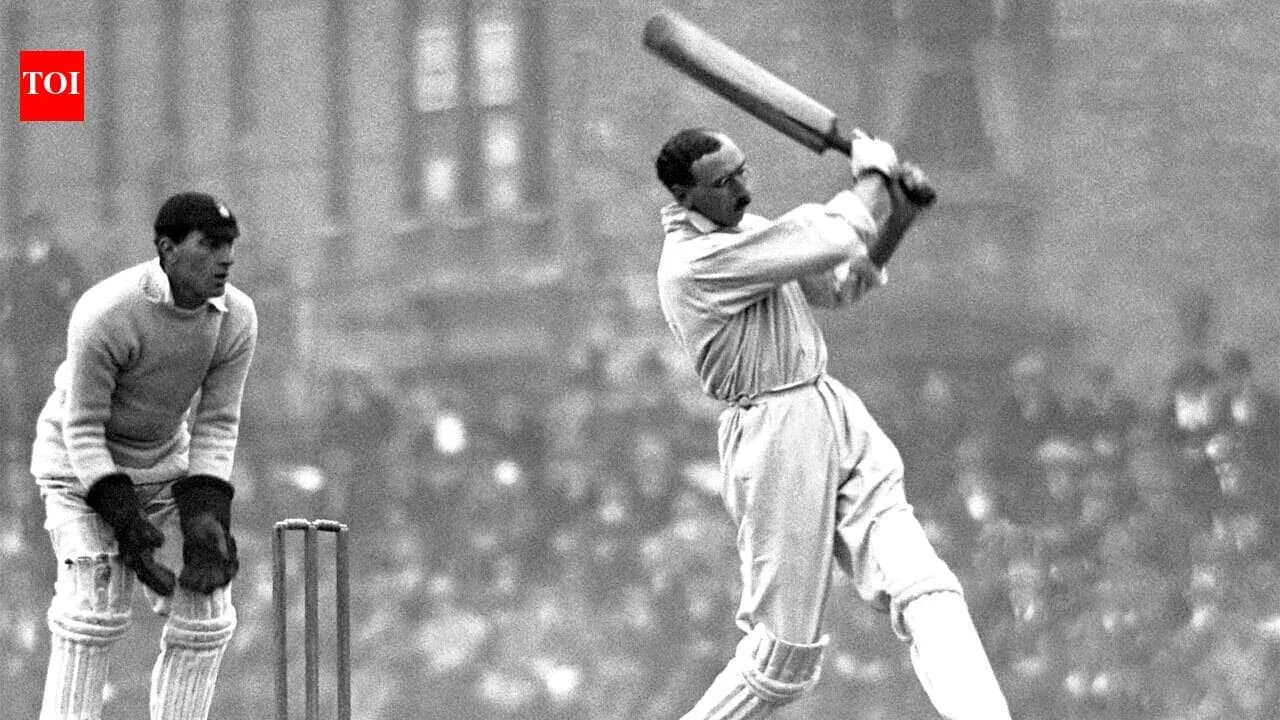
On an August afternoon in 1920, Percy Fender walked out at Northampton as a capable all-rounder and walked back as a permanent fixture in cricket’s record books.
A hundred in 35 minutes. More than a century on, nobody has beaten it in what the game recognises as a fair fight.
A County Game Turns Into Legend
Four days after his 28th birthday, Fender took guard for Surrey in what, on paper, was just another County Championship fixture against Northamptonshire. The match had begun in fairly orthodox fashion. Northamptonshire posted 306 in their first innings, built around a polished 128 from Fanny Walden. Fender had already played his part with the ball, taking three wickets to keep Surrey in touch.
Surrey’s reply stuttered. Andy Sandham’s 92 anchored the innings, but when he fell, the scoreboard read 160 for four and the visitors were wobbling. The contest looked balanced, maybe even tilting towards Northamptonshire.
Then Andy Ducat and Alan Peach ripped up the script.
The pair counter-attacked, adding 288 in just 135 minutes. Ducat, elegant and relentless, surged to 149 before finally departing. His dismissal brought Fender to the crease. The platform was set. What followed was anything but routine.
Nineteen Minutes to Fifty, Thirty-Five to History
Fender did not bother with a sighter. From almost the moment he arrived, he went after Northamptonshire’s bowlers with a ferocity that would not look out of place in a modern T20.
- Booming drives down the ground.
- Fierce cuts square of the wicket.
- Pulls and slashes that carved up the field.
He raced to fifty in just 19 minutes. Northamptonshire had no answer, no way to slow the tempo or disrupt his rhythm. The bowling was not contrived, the field not scattered in surrender. This was a genuine assault in a proper first-class contest.
Gilbert Jessop’s name hovered over proceedings. Since 1897, Jessop had held the record for the fastest first-class hundred by time, his 40-minute blitz for Gloucestershire against Yorkshire at Harrogate regarded as the benchmark for controlled mayhem.
Fender went past him by five minutes.
He reached three figures in 35 minutes, rewriting the record books in real time.
Boundaries, Bedlam and a Declaration
The milestone did not change him. Fender kept swinging.
He finished unbeaten on 113 in just 42 minutes at the crease. The raw numbers still jolt the eye: 16 fours, five sixes, 94 of his 113 runs in boundaries. More than 83 per cent of his score came from fours and sixes. The strike-rate might be modern, but the bat, the pads, the pitches and the mindset belonged to another era entirely.
At the other end, Peach compiled a monumental 203 not out. When he reached his double-century, Surrey declared. The sixth-wicket stand between Peach and Fender had rattled up 171 runs in only 42 minutes, turning the match into a blur of leather and noise.
By today’s standards, with T20 and The Hundred normalising rapid scoring, those figures still feel outrageous. Yet Fender’s achievement is not logged by balls faced. It is measured by the clock: the elapsed time from the moment he took guard to the moment he reached his hundred. That old-fashioned metric is the heart of the record.
And that distinction matters.
When Records Don’t Quite Ring True
For 63 years, Fender’s 35-minute hundred stood alone. Then, in 1983, Steve O’Shaughnessy of Lancashire appeared to join him.
O’Shaughnessy hammered a century in 35 minutes against Leicestershire. On the surface, it looked like history had been matched. But the story behind it tells you why statisticians and historians treat it very differently.
The match had been ravaged by bad weather. Time was running out. Both sides needed to manufacture a result, or at least manufacture some entertainment. After Leicestershire declared, O’Shaughnessy and Graeme Fowler walked out to face an “attack” that included David Gower and James Whitaker turning their arms over.
What followed veered into farce. Gower and Whitaker served up full tosses and long hops, the sort of offerings that would embarrass a net bowler. A short boundary made the exercise even more brutal. Fowler thrashed 100 with 10 sixes. O’Shaughnessy also romped to three figures, his century timed at 35 minutes.
The scoreboard loved it. The record books did not.
This was cricket played under manufactured conditions, with the bowling deliberately friendly and the field set up to encourage boundaries. The runs counted for the match. The “record” did not carry the same weight as Fender’s authentic onslaught.
The Centuries That Came Even Faster – But Don’t Count
O’Shaughnessy is not alone in this grey area. Glen Chapple smashed a century in 21 minutes for Lancashire against Glamorgan in 1993. Mark Pettini did it in 24 minutes for Essex against Leicestershire in 2006. Michael Goodwin and Tom Moody also produced hundreds in 25 and 26 minutes respectively.
On paper, all of them outstrip Fender. In reality, they belong to a different category.
These were the days when three-day County Championship matches often needed a jolt. Captains, boxed in by rain or slow over-rates, had to create time for a result. The solution was sometimes crude but effective: part-time bowlers, gentle offerings, fields pushed back, declarations pre-agreed. The game sped up, the crowd was entertained, and the contest lurched back to life.
The innings were real. The runs stand. Yet as records, they are widely seen as staged, shaped by contrivance rather than contest. That is why statisticians draw a line. Fender’s 35-minute hundred sits on one side of it. The manufactured mayhem lives on the other.
What ‘Fastest’ Really Means
There is another twist. “Fastest century” can mean very different things depending on how you measure it.
If the yardstick is balls faced, Percy Fender steps aside. In first-class cricket, that honour belongs to David Hookes, who blasted 102 from just 34 balls for South Australia against Victoria in 1982. In Test cricket, Brendon McCullum holds the crown, his 54-ball hundred against Australia in Christchurch in 2016 redefining what a farewell innings can look like.
Those feats belong to the modern language of strike-rates and ball-by-ball data. They are spectacular in their own right.
But by elapsed time at the crease, under genuine first-class conditions, Fender still stands alone.
More than 100 years after he tore into Northamptonshire’s attack, nobody has produced a legitimate first-class century faster than his 35 minutes. Faster-looking hundreds have appeared in the scorebooks, some wildly so, yet the context strips them of their claim to the throne.
And so the game keeps returning to that day in 1920, to a Surrey all-rounder who turned a county match into a sprint against the clock. In an era obsessed with speed and spectacle, the question lingers: who, if anyone, will ever chase down Percy Fender’s 35 minutes without cutting any corners?