Pakistan's Struggles Continue in Third Test Against England
The skies over Edgbaston were heavy enough. Inside Pakistan’s dressing room, the mood was darker still.
By lunch on the opening day of the third Test, a series that was supposed to be jolted back to life by a wave of Pakistan Cricket Board changes looked all but beyond saving. The shock therapy has not worked. Not even close. Pakistan slumped to 100-7 in just 23 overs, their innings disintegrating in the kind of slow-motion collapse that leaves a scar.
Downcast barely covers it.
These were changes sold as a defibrillator for a listing side. New faces, new direction, a late bid to salvage pride. Yet from the moment Joe Root won the toss under autumnal Birmingham skies and handed the ball to his seamers, Pakistan looked like a team waiting for something bad to happen rather than trying to prevent it.
Former captain Ramiz Raja did not sugar-coat what he saw.
Pakistan’s “technique and mindset” were “pretty ordinary”, he said on Test Match Special, cutting to the heart of the problem. “There’s mental fatigue and turmoil in the dugout, I can understand that. But from an individual point of view, I think Pakistan have been waiting for the ball to come and damage them completely. They have not been proactive at all. They have to have a plan. This is a flat pitch, it’s not a demon-like pitch, like the third day at Lord’s.”
That last point stung. Because he was right.
England ruthless, Pakistan rattled
England did their part with ruthless efficiency. The four-man seam attack, led by the tall, nagging presence of Ollie Robinson and backed by the hostility of Josh Tongue, settled quickly into a relentless groove. They found just enough movement, exploited just enough indecision.
CricViz numbers showed this surface had a bounce inconsistency rating of 5.7 – more capricious than recent Edgbaston Tests in 2025 (2.6 vs India), 2024 (3.2 vs West Indies) and 2023 (3.3 vs Australia). Tricky, yes. Treacherous, no.
Pakistan made it look like a minefield.
By the time the Thwaite Memorial scoreboard showed 48, the top five were gone. All of them. All out in single figures. It was an unwanted slice of history: only the 12th time in Test cricket a team’s top five have all been dismissed for single figures, and the first time it has ever happened in a first innings.
Former England captain Michael Vaughan watched the carnage and saw a side hollowed out by the events of the past week. “I feel for Pakistan because this is embarrassing with everything they’ve had to cope with in the last week,” he said. They were, he added, “clearly shot for confidence” after such a disastrous morning.
The numbers back him up and then some.
A record chase no team wants
Across this series in England, Pakistan’s early-order returns have lurched from bad to worse. Their second wicket has fallen with the score on 6 and 13 at Leeds, 16 and 7 at Lord’s, and now 14 at Edgbaston. That’s 56 runs in total for the first two wickets across five innings.
An average opening partnership of 5.6. An average of 11.2 when the second wicket falls.
They are closing in on an unwanted record that has stood since 1888. No touring side has ever started innings this poorly in England. Australia’s top order from that Victorian era series averaged 16 for the fall of the second wicket. Pakistan are on course to go beneath even that low watermark.
It is hard not to feel some sympathy, because context matters.
Take Saim Ayub. The left-handed opener, parachuted in for this Test, is playing first-class cricket for the first time since October 2025. His reward? Robinson, with a new ball, in heavy conditions, on a surface misbehaving just enough to mess with a batter’s mind. From the moment Ayub marked his guard, his dismissal felt inevitable, a fait accompli written into the morning’s script.
But not every mistake can be pinned on rust or bad luck.
Senior men, soft shots
As wickets tumbled, the mood in the middle drifted towards something close to end-of-term cricket. The discipline required to dig in and drag a session into the grind never quite arrived. Pakistan’s batters flirted, flashed and nicked their way to trouble.
Four down, with the innings already teetering, Saud Shakeel and Babar Azam should have been the ballast. Instead, both swung hard outside off stump, hunting boundaries when the game demanded survival. Two players in their thirties, with experience and pedigree, played as if it were a T20 powerplay rather than a Test match rescue job.
The numbers were damning. Pakistan’s false-shot percentage in the morning session hit 40% – the second highest in the opening session of a Test since 2006. That is not just pressure. That is poor judgement.
Saud somehow survived until lunch. Babar did not.
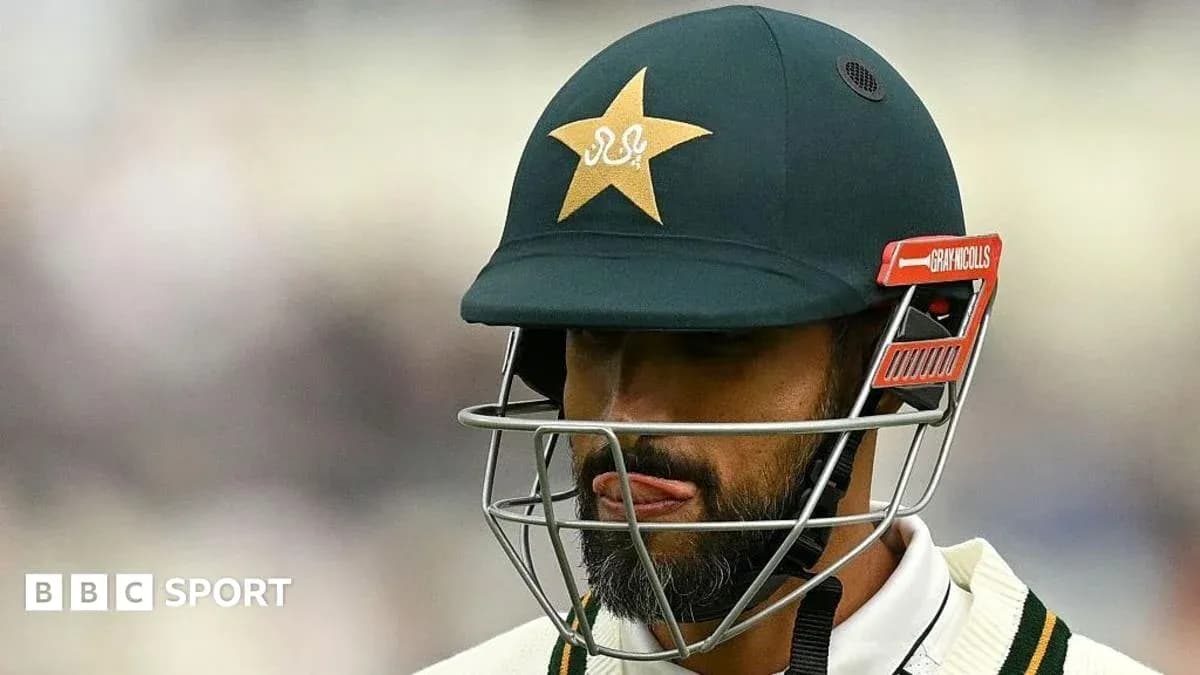
Forty minutes before the interval, Tongue went full and straight, and Pakistan’s captain lost his off stump. Babar gestured at the pitch as he walked off, frustration pouring out in a single movement. Ramiz Raja watched a player he knows well and saw something deeper than a technical flaw.
“He [Babar] disintegrated. It’s tough for him,” Ramiz said. “He’s got to explain all this mayhem and then he has to look after himself and then he’s got to work with the lot that are more T20 in nature than Test cricket. This innings is in serious turmoil.”
Turmoil felt like the right word. On the field. Off it. In the body language of a captain caught between defending his players and demanding more from them.
By lunch, the scoreboard read 100-7 and the stands at Edgbaston buzzed with a different kind of conversation. With only 23 overs bowled, Pakistan’s cause already looked forlorn. Those holding tickets for day three might quietly be thinking about other plans.
England, buoyant and clinical, will sense a swift kill. Pakistan, battered and brittle, must somehow find a way to bat time and restore credibility. Because if this is what the “new” era looks like, what comes next?