Pakistan Faces Historic Collapse Against England at Edgbaston
This was the kind of passage of play that scars a touring side.
Under low, heavy skies at Edgbaston, Pakistan’s top order walked out to what looked a fair, honest Test pitch. Within an hour, they had written their way into an unwanted corner of the record books.
Their top five were all dismissed for single figures – the first time in history that has happened to any side in the first innings of a Test in England. It has occurred 11 times before, always in second innings collapses. This was new territory, and not the kind any batter wants to explore.
From the moment England’s seamers took the new ball, Pakistan looked trapped in a loop they have never quite escaped all series. The second wicket has been a revolving door: it has fallen at 6 and 13 at Leeds, 16 and 7 at Lord’s, and now 14 here. Across the series, the first two wickets have yielded just 56 runs in total – an average of 5.6 for the first partnership and 11.2 by the time the second wicket falls. They are on course to undercut a record that has stood since 1888, when Australia averaged 16 for the fall of their second wicket in England.
Here, the slide felt even more brutal.
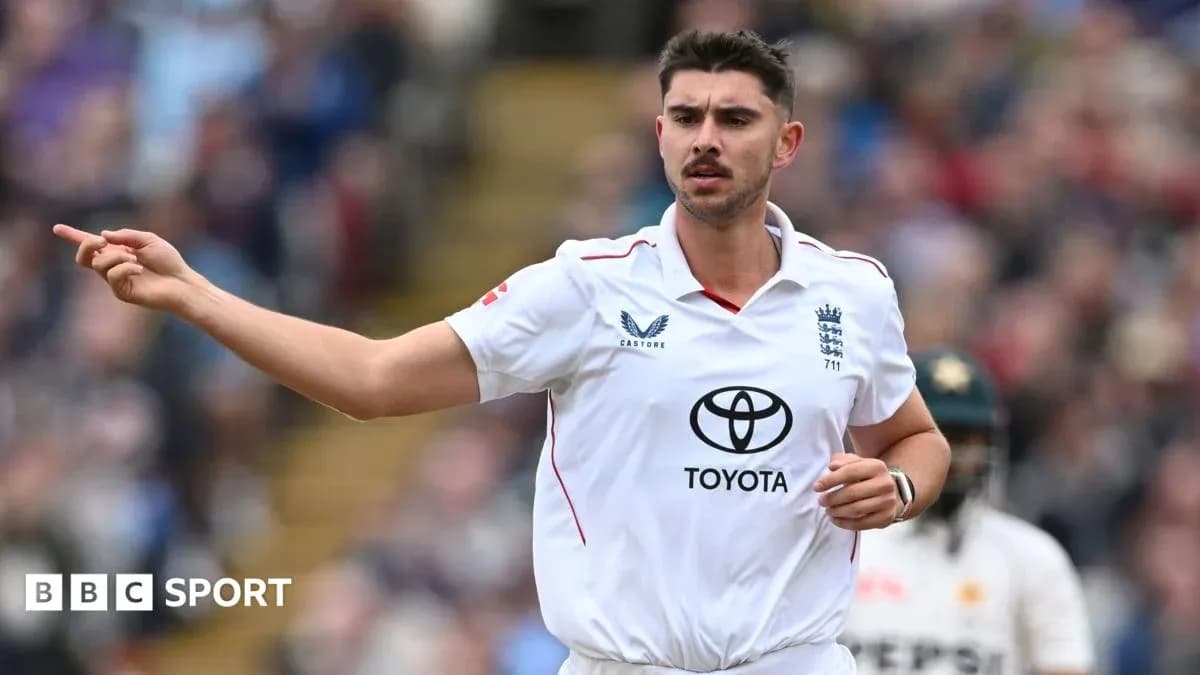
Josh Tongue, fast and bristling with intent, set the tone. His first over ended with the prize wicket of Babar Azam, beaten for pace, his off stump flattened by a full ball that angled in and cannoned into the top of off. It was a classic dismissal, the kind that lives long in a debutant’s memory and in a captain’s nightmares. Babar, on 7, seemed caught in two minds, playing back to a ball that demanded a decisive stride forward. He got nowhere near it. Pakistan slipped to 48-5, and the scoreline looked every bit as frail as it sounded.
By then, the damage at the top had already been done. England’s seamers hunted in a tight, disciplined pack. Ollie Robinson probed with his familiar relentlessness, hitting that awkward length and drawing edges and tentative prods. Jofra Archer’s spell gave way to Gus Atkinson, who has bowled better this series than his solitary, expensive wicket suggests. His figures have not matched his rhythm, but the pressure he built only deepened Pakistan’s anxiety.
Even the rare release felt tainted.
Saud Shakeel, Pakistan’s one note of resistance, played strokes that belonged to a very different scorecard. He drove through the covers with a timing and ease that mocked the chaos around him. One glorious cover drive skimmed through extra cover; another, more expansive attempt, flew off the inside edge and whistled past leg stump for four. A third boundary in the over, middled again through the covers, underlined the quality of his touch and the absurdity of the situation. This was not a minefield. This was a decent pitch exposing a fragile batting unit.
Saud rode his luck as well. On 7, he flashed hard at a hint of width from Atkinson and got a healthy edge. The ball flew high and fast to first slip, where Ben Duckett, already guilty of one drop in the morning, could only get a hand to it. A tougher chance than his earlier miss, but another life for Pakistan’s left-hander and another rueful glance at the scoreboard: 43-4. At 37-4, Saud had calmly pulled a rare short ball from Robinson through square leg, only for sharp work in the deep to deny him a boundary. Robinson, stung, went straight back to his fuller, away-swinging line that has served him so well.
Even the weather seemed unsure whether to intervene or simply watch.
Rain arrived during the drinks break, the covers trundled on, then stopped halfway as the shower eased almost as quickly as it had begun. The umpires waved the groundstaff away. Play would continue. Pakistan might have wished it hadn’t.
At 35-4, a wayward Robinson delivery down the leg side brushed Jamie Smith’s gloves and raced away for four byes, nudging Pakistan slightly further from the ignominy of their lowest ever Test total. A thick edge from Saud added a couple more as the drizzle returned, light but persistent, over Edgbaston.
Yet the scoreboard kept telling the same story. Pakistan 60-5. A top order dismantled. A side flirting with historic lows on a surface that, by any fair measure, has offered them a chance.
The numbers will be poured over in the days to come – that miserable average for the fall of the second wicket, the first-innings record of top-order failure, the looming comparison with Australia’s struggles in 1888. But the more pressing question hangs over this dressing room: how many more times can a team start this badly before something finally breaks?