Pakistan Cricket's Structural Failure: A Deep Dive
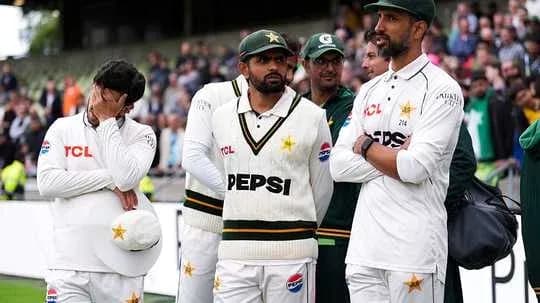
Pakistan cricket is used to turbulence. This is different. This is structural failure, laid bare in a brutal English summer.
Three Tests, three heavy defeats. An innings and 103 runs. Then 194 runs. Then eight wickets. A 3-0 sweep in England in 2026, just as in 2022-23. Another whitewash, another post-mortem. It was Pakistan’s 11th series loss by a 0-3 margin, their sixth whitewash in 12 multi-Test series over the last four years, and their ninth 0-3 defeat in a three-Test series this century – more than any other team.
The response from the Pakistan Cricket Board was swift, dramatic and entirely familiar. Head coach Sarfaraz Ahmed sacked. Bowling coach Umar Gul gone. Seven players sent home. Mike Hesson, already in charge of the white-ball side, handed the Test reins as well. The cycle repeated: crisis, clear-out, fresh start – until the next collapse.
Behind the headlines, the numbers tell a harsher story. This is not a bad month. This is erosion.
A revolving door XI
Since August 2021, the start of the second World Test Championship cycle, Pakistan have picked an unchanged XI just three times in 37 Tests. Three. Those rare occasions – Dhaka in 2021, Colombo in 2023, Rawalpindi in 2024 – all ended in victory and sealed series wins. Continuity worked. It was promptly abandoned.
Across those 37 Tests, Pakistan have used 43 players. After the first 11, they cycled through 32 more across the next 36 matches – an average of 0.89 new players per Test. Among WTC teams, only South Africa have churned more, and their numbers are distorted by a second-string tour to New Zealand during the SA20.
No specialist bowler has appeared in more than 18 of those 37 Tests. Noman Ali, a left-arm spinner, sits on top of that list. Among the quicks, Shaheen Afridi has played just 17. No batter has featured in every Test; Babar Azam has 33, Mohammad Rizwan 32, Salman Agha 28. Since the start of the second WTC, Pakistan have handed out 23 Test caps. Only South Africa (26) and England (24) have given more. Thirteen of Pakistan’s debutants have been specialist bowlers.
The message to players is unmistakable: one bad series and you are expendable. The team has been built not on a core, but on constant auditions.
Chaos in the backroom
The instability is not confined to the dressing room. It runs through the coaching staff and captaincy.
Since Misbah-ul-Haq and Waqar Younis resigned in September 2021, Pakistan have rattled through Saqlain Mushtaq, Grant Bradburn, Mickey Arthur and Mohammad Hafeez. In 2024, the PCB tried a split model: Jason Gillespie for Tests, Gary Kirsten for white-ball cricket. Both were gone within months.
Aqib Javed stepped in as interim before Hesson arrived as permanent white-ball coach in May 2025. Sarfaraz Ahmed, the former captain, took over as red-ball head coach ahead of the 2026 Bangladesh series. His tenure lasted only a few months and ended after defeats at Leeds and Lord’s. Then came the axe, the reshuffle, the promotion of Hesson across formats.
In five years, Pakistan have made 11 coaching changes across formats, including seven different Test coaches since May 2023. Shan Masood’s 3-12 record as captain gave way to Babar Azam’s reinstatement. Every poor series has triggered another round of appointments and sackings.
Test cricket, by nature, rewards systems built over time. Pakistan have chosen the opposite: short-term fixes and public resets, each one eroding trust a little more.
Slipping down the WTC ladder
The World Test Championship table is an unflinching judge. Pakistan finished seventh in the 2021-23 cycle with a points percentage of 38.1% (four wins in 14 Tests). They dropped to ninth in 2023-25 with 27.98% (five wins in 14). In the current cycle, they are bottom: two wins in nine Tests and a points percentage of 14.81%.
Across this period, their overall Test win-loss ratio since the start of the second WTC cycle stands at 0.5, the second-worst among WTC teams. Only West Indies (0.4) have done worse. The broader historical picture is no kinder. Pakistan’s all-time Test win-loss ratio has slipped below 1.0 for the first time since 1987. They now sit on 153 wins and 155 defeats from 474 matches.
For a nation that once measured itself against the very best, that is a line in the sand.
Fortress no more
Home used to be Pakistan’s insurance policy. Not anymore.
Since the start of the 2021-23 cycle, South Africa’s home win-loss ratio is 5.5, Australia’s 5.0, England’s 2.2. India, the benchmark in Asian conditions, sit at 2.0 with 14 wins and seven losses. New Zealand and Sri Lanka both stand at 1.43, each with 10 wins.
Pakistan? Four wins and nine defeats in 17 home Tests. A win-loss ratio of 0.444 – the worst among WTC nations and only better than Zimbabwe’s 0.285. Bangladesh (0.727) and West Indies (0.875) both outstrip them on their own turf.
The away numbers offer little escape. Since August 2021, Pakistan have won seven and lost 13 of 20 Tests on the road – the third-most defeats among WTC teams, behind England (17) and West Indies (15). Their away win-loss ratio of 0.538 ranks fifth, well behind Australia (2.4), South Africa (1.25), New Zealand (1.125) and India (1.1).
Outside Asia, the record is stark. Since the start of the second WTC, Pakistan have not won a Test in SENA countries (South Africa, England, New Zealand, Australia). They are winless in their last 19 Tests in those nations since 2018, losing 17 and drawing two. Their last such victory came at Lord’s in May 2018. Every other Asian side has managed at least one SENA win since 2019. Pakistan stand alone.
Batting in freefall
The most visible symptom of the decline has been the batting. Since the start of the 2021-23 WTC cycle, Pakistan have been dismissed for under 250 in 32 innings out of 37 Tests. Eighteen of those totals have been below 200.
The nadir came on the recent England tour. Pakistan were bowled out for under 200 in five consecutive innings – 171, 135, 110, 194 and 133 – before finally crossing 400 in the third innings at Edgbaston. Those five sub-200 scores, lasting an average of just 41.3 overs each, marked the first such sequence in their Test history.
Their combined batting average in this period is 28.46, sixth among the nine WTC teams. Only South Africa, Bangladesh and West Indies have fared worse. Pakistan’s batters have produced the fourth-fewest centuries among WTC sides in the same span.
Even Babar Azam, the standard-bearer of this generation, is stuck in a long drought. He has gone 40 consecutive Test innings without a century. His last hundred came against New Zealand in Karachi in December 2022.
Seven Pakistan batters have passed 1,000 Test runs since the start of the second WTC cycle. None average above 45. Babar leads the pack with 2,602 runs at 43.4. Rizwan has 1,862 at 35.8 and only two centuries – the fewest among those seven. Shan Masood’s 1,548 runs come at 32.25, placing him sixth among the group, just ahead of Imam-ul-Haq’s 1,380 at 39.42.
Across the rest of the WTC, 51 batters have topped 1,000 runs in this period. Eleven of them average more than 45. The gap in quality and consistency is no longer marginal; it is structural.
Pace identity, spin reality
For decades, Pakistan’s Test identity was built around fast bowling. Imran Khan, Wasim Akram, Waqar Younis, Mohammad Asif – the names are stitched into the fabric of the format. Pace hunted, spin supported.
The modern numbers tell a different story. At home, Pakistan’s success has leaned heavily on spin. Noman Ali, Sajid Khan and Abrar Ahmed have thrived, helped by spin-friendly pitches, attacking fields and long spells.
The shift was glaring in the 2024 home series against England. Across the final two Tests, Noman and Sajid took 39 of England’s 40 wickets – the highest tally by a bowling pair in a two-Test stretch. They claimed all 20 wickets in Multan and all 20 in Rawalpindi, where Pakistan’s specialist pacers did not bowl a single delivery. Spin accounted for 73 wickets in the series, 43 of them by Pakistan’s spinners.
The pattern extended beyond England. Pakistan’s spinners took all 20 wickets in a win over West Indies in Multan and 16 in a victory against South Africa in Lahore. They had also claimed 13 wickets in a series win in Bangladesh in 2021. Since then, Pakistan have lost two Test series to Bangladesh – one at home in 2024 and one away in 2026.
Noman even etched his name into history with Pakistan’s first Test hat-trick by a spinner against West Indies. Their last away Test series win, in Sri Lanka in July 2023, was again built on spin.
Across 37 Tests since the start of the second WTC, Pakistan have won 11. Nine of those victories came when their spinners took 11 or more wickets in a match, including a 14-wicket haul in the West Indies earlier this year. That remains their only win in their last 12 away Tests.
Pace problems, laid bare
While spin has propped up results, pace has drifted from its traditional heights. Since the start of the 2021-23 cycle, Pakistan’s fast bowlers have taken 305 wickets at an average of 32.7 and a strike rate of 55.7. Both figures are the second-worst among the nine WTC teams, ahead of only Bangladesh. In the same period, opposition pacers against Pakistan average 27.4 with a strike rate of 48.7.
Shaheen Afridi is still the spearhead, with 68 wickets in 17 Tests at 26.89. Mohammad Abbas, recalled last November, has been a rare bright spot: 45-plus wickets in 10 Tests, four five-wicket hauls, and 31 wickets at 21.06 in 2026 – second only to Josh Tongue’s 33 at 25.67 this year. Among Pakistan bowlers, only Noman Ali (85 wickets in 18 matches), Sajid Khan (75 in 14) and Shaheen have more wickets than Abbas in this period, and all three have played more Tests.
Yet these individual efforts sit inside a broader decline. The attack that once frightened top orders around the world now too often mirrors the batting: flashes of quality, no sustained bite.
Pakistan’s crisis is not a mystery. The data is unforgiving, the trends long established: unstable selection, revolving-door coaching, a hollowed-out Test record at home and away, a batting unit short on big scores, and a pace attack living on memories while spin carries the load.
The question is no longer what has gone wrong. It is whether Pakistan are willing to do something they have resisted for years: stop reacting to every defeat, and finally build a Test team with the patience the format demands.