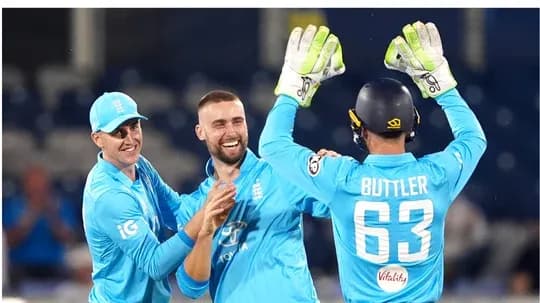
Ollie Robinson: The Seam Bowler Redefining England's Attack

Ollie Robinson has always made bowling look like breathing.
Five years on from his England debut, after the drops, recalls and another drop, that first impression still holds. Strip away the noise, the fitness rows, the selection debates, and what remains is a seam bowler whose action looks as if it has been drawn with a ruler.
Call him robotic and it sounds cold. In Robinson’s case, it is the highest praise. Glenn McGrath owned that word. Metronomic, unflustered, utterly repeatable. Robinson lives in that same neighbourhood.
Watch him from side-on and the elegance is striking. The run-up flows, the gather is simple, the wrist position immaculate. Every ball seems to leave his fingers with purpose. This summer, in conditions he would happily pack into his kitbag and take everywhere, that purity has translated into ruthless numbers: 23 wickets in three matches, crowned by England’s victory in the second Test at Lord’s.
The ball has done anything he has asked of it. Late swing in, late swing away, that teasing wobble off the seam that keeps batsmen guessing even after they have picked the line. Crucially, he has not chased wickets. He has let the pitch, the ball and his method do the heavy lifting.
Right now, Robinson must feel he could run in blindfolded and still find an edge. Bowlers live for that sense of inevitability.
What lifts him beyond a pretty action is his brain. Robinson reads a game quickly. He picks up a batsman’s trigger movement, where the bat comes down from, how late the hands are. Then he turns that information into a plan in a matter of deliveries.
Those who worked with him early in his England days talked about a bowler who would stand up in team meetings and explain how to dismiss particular batsmen. Not just his own plans, but ideas for the entire attack. That tactical sharpness is now married to the confidence of a man in form, and it shows.
All of which throws a harsh light back on last winter.
Plenty will look at this summer and argue that Ben Stokes, Brendon McCullum and managing director Rob Key misread Robinson when they left him out of the Ashes squad. In an environment where trust was said to have frayed and where pace was prioritised, he found himself on the outside again.
His fitness has not always helped him. Bowling coach Jon Lewis publicly challenged him on it in 2022, a moment that jarred with some observers who felt Robinson was not handled with enough care at times. The omission last winter, though, may have been the jolt he needed. The message landed. The response is playing out now, with Joe Root the captain benefitting.
There is another twist to this resurgence, and it comes from Australia of all places.
Alex Carey’s work standing up to the stumps to the seamers during the Ashes reignited an old craft. England have taken that cue with Robinson, and it is transforming the geometry of his spells. With Jamie Smith up to the stumps, modern batsmen lose one of their key counter-punches: they cannot march down the pitch at him without flirting with a stumping.
That single adjustment lets Robinson shift his length a yard fuller. The ball spends longer in the air, has more time to swing, and suddenly more deliveries are threatening the stumps instead of sailing safely over from a back-of-a-length approach.
It only functions if the wicketkeeper is good enough. Smith deserves his share of the credit. After a difficult Ashes behind the stumps, he has clearly sharpened his craft. Under the eye of wicketkeeping coach Sarah Taylor, he has been put through unforgiving pre-play drills: tennis balls hammered at him with a racket, the ball skidding, a batsman in front edging, missing, glancing. Smith must stay low, stay soft, stay sharp.
The work is visible now in real time. Clean takes. Confident movement. The partnership between bowler and keeper looks tight.
The question hanging over Robinson is no longer whether he can run through a side at Lord’s in helpful air. It is whether he can carry this method, and his body, through harder miles: flatter, hotter pitches, long days when the ball refuses to talk. South Africa this winter will provide exactly that kind of examination.
England have often looked at those batter-friendly surfaces and left Robinson out. That logic feels outdated. He has earned the right to be tested in those conditions, not shielded from them.
Behind the scenes, the work is specific. England want him to sit at around 82mph and stay there, rather than starting at that pace and sliding down to 77–78mph as the day drags on. Hold the speed, and the extra bounce he can generate should compensate for any loss of extravagant movement. For a bowler with his control, that trade-off could be decisive.
Before all that, though, comes Edgbaston and the third Test. This is where England must resist their worst instincts.
Robinson, Jofra Archer, Gus Atkinson and Josh Tongue have shown the shape of a new-look attack with genuine teeth. They lack a frontline spinner, but Robinson’s economy at Lord’s – conceding just 1.29 runs per over – proved he can do the holding job when required, locking up an end the way a slow bowler might.
Break that up now and the momentum goes with it.
England have lurched through too many stop-start cycles. Right now they need continuity, not rotation for its own sake. They need wins, yes, but they also need this quartet to learn each other’s rhythms, to understand who thrives with which ball, from which end, in which spell. Root, still learning the nuances of captaincy in this new phase, must discover how best to deploy each of them.
At the heart of it all stands Robinson, the most natural bowler in the country, leading an attack that finally looks like it belongs together.
England have searched for that combination for years. They may just have found it.