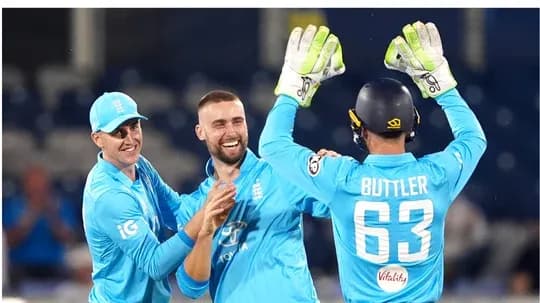
Ollie Robinson: England's Natural Bowling Talent

Five years on from his England debut, Ollie Robinson has been dropped, recalled, dropped again and dragged through just about every public inquest a modern cricketer can face. One thing, though, has refused to budge: he still looks the most natural bowler in the country.
Not natural in the loose, romantic sense. Natural in the Glenn McGrath sense. Robotic, almost – but in the way a metronome is robotic. Same gather, same wrist position, same seam, ball after ball after ball. A repeatable action carved into muscle memory.
Watch him now and the rhythm is unmistakable. He glides in, side-on, wrist perfectly upright, seam bolt straight. At Lord’s, on a surface made for him, he looked as if he could close his eyes and still hit the top of off. Often.
Yes, the conditions have been a gift. This English summer has been made of heavy skies and willing pitches, and Robinson has gorged on them: 23 wickets in three Tests, capped by England’s victory over Pakistan at Lord’s. If he could fold these conditions into his kitbag and take them everywhere, he would. But plenty of bowlers have been handed friendly Dukes balls and green-tinged strips and done nothing with them. Robinson has been ruthless.
Whatever he has asked the ball to do, it has obeyed. Swing in, swing away, wobble off the seam – he has simply put it on a length and let physics and skill do the rest. No hunting for miracle balls, no desperate changes of plan. Just a relentless, nagging interrogation of technique.
There is a particular high for a seam bowler when the game feels that simple. When every time you let go, you expect something to happen. Robinson is living in that space right now.
A bowler who thinks like a captain
The physical gifts are obvious. What elevates him is the brain behind them.
Those inside the dressing room talk about a bowler who reads the game almost as quickly as the captain. He spots a trigger movement, a closed face, a bat coming down a fraction late, and instantly translates that into a plan. A little fuller. A touch straighter. Tempt with width, then spear one back in.
Coaches say that even early in his England career he was the one standing up in team meetings, outlining how to get specific batters out. That tactical sharpness now sits on top of a method that is completely grooved. It is a dangerous combination.
Which is why so many will look at this summer and point an accusing finger at last winter. Ben Stokes, Brendon McCullum and Rob Key left Robinson out of the Ashes squad, turning instead towards bowlers with more pace. The decision, and talk of trust issues between Robinson and the regime, has hovered over his comeback like a cloud.
His fitness has not always helped him. Jon Lewis, then bowling coach, publicly challenged his conditioning in 2022, and there have been days when his speed has dribbled away from the low 80s to the high 70s, taking his threat with it. At times, he has not been handled gently. At others, he has not helped himself.
Maybe that Ashes snub, though, was the jolt he needed. The result is what England are seeing now – and what Joe Root, back as captain, is happily cashing in.
Standing up, cramping space
Australia, unintentionally, have also done him a favour.
During the Ashes, Alex Carey dragged an old trick back into the modern game by standing up to the stumps to the seamers. It cramped batters, stopped them using their feet, forced them to play from the crease. England watched. And learned.
Now Jamie Smith is doing the same for Robinson. It sounds like a small tweak. It isn’t.
With the keeper back, today’s batters would happily walk down the pitch to a bowler operating in the low 80s, smothering movement and knocking him off his length. With Smith up, that option almost disappears. The risk of being stumped is too great.
Robinson can respond by pitching the ball a yard fuller, giving it more time to swing and dragging the stumps properly into play. Instead of hitting a back-of-a-length and watching the ball pass harmlessly over the top, he’s threatening pads and timber. It is old-fashioned, intelligent seam bowling, sharpened by a simple change in field craft.
None of this works without a keeper who can actually do the job. Smith deserves credit. After a bruising Ashes with the gloves, he has tightened his work under the guidance of Sarah Taylor, who has been drilling him with skidding tennis balls before play, forcing him to stay low and sharp as edges flash past a standing batter. The improvement is obvious. The partnership with Robinson already looks like a weapon.
The next examination
The question now is not whether Robinson can bowl like this in England. He has answered that. The question is whether he can do it when the grass is sparse, the sun is high and the pitch refuses to help.
South Africa this winter will provide that examination. Harder, flatter surfaces, long days in the field, heat that exposes every weakness in a fast bowler’s preparation. In the past, England have often looked at such conditions and quietly left Robinson out, fearing his pace would sag and his impact would fade.
That time has gone. He has earned the right to be thrown into those Tests, not protected from them.
Behind the scenes, England are working to keep his speed at a steady 82mph through a spell, rather than starting there and sliding down to 77 or 78mph. If he can hold that level, his natural bounce – he is a tall man with a high release – should compensate when the ball stops nipping and swinging. Less lateral movement, more awkward lift.
At Lord’s, he showed he can also control an innings like a spinner. He went at just 1.29 runs an over across the Test, strangling Pakistan’s scoring and allowing the quicker men around him to attack. In an attack without a frontline slow bowler, that control becomes priceless.
Don’t touch the attack
Edgbaston looms, and with it the familiar modern urge to “manage workloads”. On paper, it would be easy for England to rest one or more of Robinson, Jofra Archer, Gus Atkinson or Josh Tongue. Protect bodies, share minutes, keep everyone fresh.
It would also be a mistake.
This new quartet has the feel of an attack that could define an era if it is allowed to grow together. Different angles, different speeds, different methods – but a shared edge. They need overs in each other’s company. They need to learn when one can attack because another is tying an end down, when to switch ends, when to unleash a short-ball burst and when to go back to the top of off.
Root, returning to the captaincy, needs time in the middle with them too. He must learn their spells, their moods, their preferred fields. That understanding does not arrive in a net session or on a laptop. It comes in the grind of a live Test match.
Robinson sits at the heart of that. He is the bowler Root can throw the ball to when the game needs slowing, when a partnership is swelling, when a plan needs thinking through. He is also, right now, the man most likely to find a way through on a surface offering even a hint of assistance.
So leave it alone. No tinkering for the sake of it. No needless experiments.
England have stumbled through a poor run and finally landed on an attack that looks balanced, threatening and smart. With Robinson leading it, they have something that resembles a blueprint.
The real story now is whether they trust it – and him – enough to carry it into the hardest places in the world.