Middlesex vs Lancashire: A Day of Seam Bowling Mastery
At a sunlit Merchant Taylors’ School, the past and future of English seam bowling shared the same strip – and both left deep marks on a day when wickets fell in clumps and control changed hands by the hour.
By the close, Middlesex had turned a precarious morning into a position of real authority. They lead Lancashire by 212 runs, 116-2 in their second innings after dismissing the visitors for 151, with Max Holden’s blazing, late-evening 50* setting the tone for what could yet become a decisive advantage.
Anderson’s old magic, Middlesex’s early stumble
For more than an hour, all eyes were on James Anderson. Calf grumbling, body battle-worn, but wrist still pure. Bowling down the hill from the Benham End, he produced a spell that could have been lifted from almost any summer of the last two decades.
The ball seemed attached to an invisible thread. Middlesex batters groped, played and missed, and occasionally just froze as deliveries hissed past the edge. It was classic Anderson: tight lines, late movement, relentless questions.
Ironically, his one tangible reward came not from artistry, but from mischief. A ball scuttled low, stayed down, and slipped under Luke Hollman’s bat to bowl him for his overnight 54. Not the prettiest wicket he has ever taken, but perhaps the most fitting on a morning when he deserved far more than figures of 3-40.
The pressure he created at one end cracked the innings at the other. Ben Balderson struck with the first ball of his spell, trapping Ben Geddes lbw after the Middlesex batter had hinted at something substantial. Ben Walkden then ripped out the middle stumps of Harry Duke and Zafar Gohar in the space of three balls, a brutal intervention that left the hosts reeling.
Ryan Higgins, dropped on six at slip, dug in and then counter-punched. He drove fluently and even ramped Walkden audaciously over the head of keeper Matty Hurst. Toby Roland-Jones joined in, muscling three boundaries straight back over the bowler’s head, while Tom Helm launched the only six of the innings to add some late muscle.
It was spirited, but not quite enough. Middlesex were bowled out for 247 on the stroke of lunch, still short of a batting point and very much aware that Anderson and company had left their mark.
Helm, Higgins and Sharma flip the script
If the morning had belonged to Lancashire’s attack, the afternoon was seized by Middlesex’s. Helm, Higgins and Naavya Sharma combined to rip through a Lancashire line-up that never looked settled on a surface offering just enough to bowlers who hit the right areas.
Helm struck early, pinning Keaton Jennings lbw for one. He then produced a brute to remove Harry Singh, a ball that climbed nastily from just short of a length and took the edge through to the keeper. Marcus Harris followed as the fifth lbw of the match, underlining how hard it was to escape once bowlers hit that corridor of uncertainty.
At 35-4, the Red Rose were in disarray. Sharma, already an England Lion, then delivered a spell that felt like a quiet audition for a bigger stage. He speared out Rocky Flintoff’s off stump to deepen the crisis and later used lateral movement to undo Walkden, who had played attractively for his 28.
Hurst, pressed into opening duties despite not being a natural at the top of the order, fought hard. He survived an early appeal for a catch behind and took a nasty blow on the grill from a Helm short ball, but refused to flinch. His 46 became the backbone of Lancashire’s resistance, a gritty effort in a sea of uncertainty.
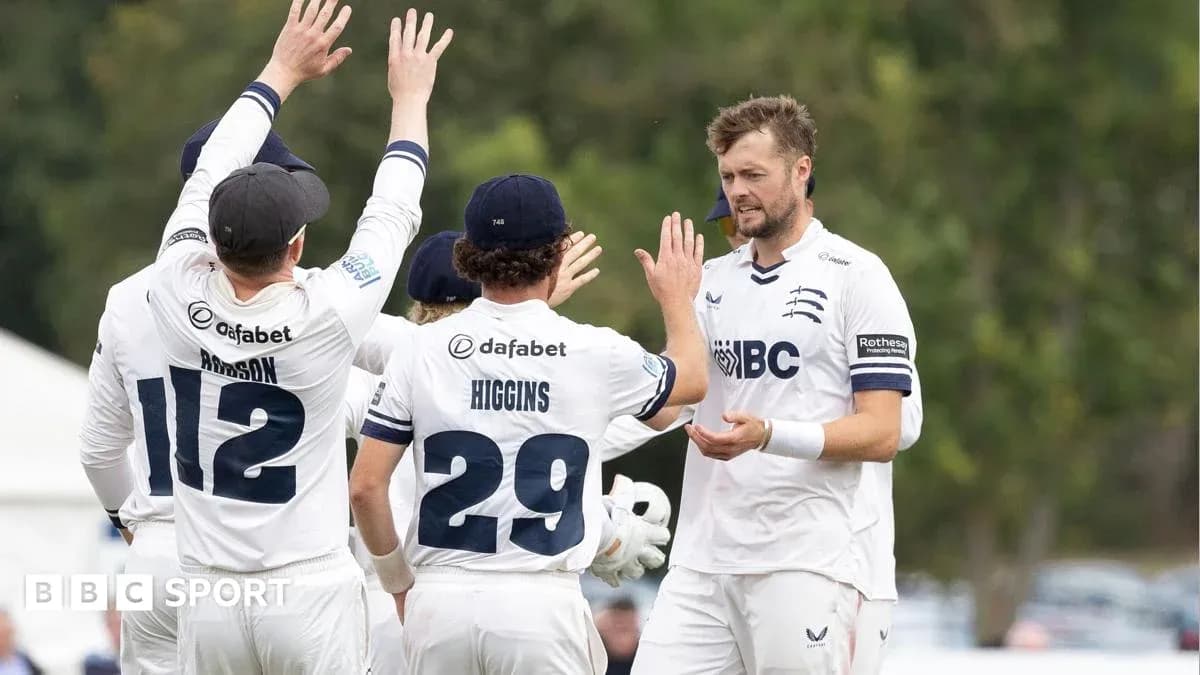
Arav Shetty offered brief support, lofting Helm over long leg and into the beer tent to raise a cheer, only for the bowler to exact revenge and have him caught behind. Balderson tried to marshal the tail, but Helm and Higgins closed in, cleaning up the lower order to secure a 96-run first-innings lead. Higgins finished with 3-39, matching Sharma’s return, while Helm’s 4-40 underlined his role as chief enforcer.
Holden’s late assault tilts the match
Given the fragility on show, Middlesex knew their second innings could define the match. Early signs were nervy. Sam Robson’s lean run continued when Tom Bailey uprooted his off stump, and Hollman, a first-innings half-centurion, saw his stumps spreadeagled by Balderson.
At that point, Lancashire sniffed a way back. Two early wickets, a ball still doing just enough, and the psychological weight of a low-scoring contest hanging over the hosts.
Holden tore that script up.
Having been on a pair, he counter-attacked with intent and clarity, scoring at better than a run a ball. Drives flashed through the covers, anything loose disappeared, and Lancashire’s bowlers suddenly found the initiative ripped from their hands. It was not reckless, just decisive – the kind of innings that can swing not only a day, but a match.
By the time stumps were drawn, Holden had surged to a thrilling 50*, with Middlesex 116-2 and their lead stretched to 212. From the brink of a dogfight, they had carved out breathing space.
And somewhere in that shifting narrative, under the late-afternoon sun, the image lingered: Anderson, still spellbinding with the ball on a string, and Sharma, younger, brisk, and probing, hinting at what might come next for England’s seam-bowling future.
If Middlesex press home this advantage on day three, that passing-of-the-torch feel will only grow louder.