Marco Jansen: From Junior Partner to Leading South Africa's Attack
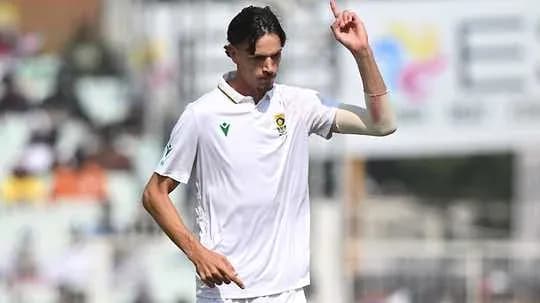
Marco Jansen has spent most of his international life running in with a new ball that belonged, in spirit at least, to someone else. Kagiso Rabada on one end, Lungi Ngidi at the other. Jsen was the tall kid in the middle of the operation, the apprentice in a world-class workshop.
On Thursday at Kingsmead, that changes.
Rabada is out. Ngidi is out. Australia are in town. And the 2.07-metre left-armer is suddenly the man at the front of South Africa’s attack, not the promising understudy lurking just behind the big names.
From junior partner to spearhead
Strip away the hypotheticals about future seasons and left-arm collectives, and one hard reality remains: South Africa’s pace cupboard has taken a beating. Anrich Nortje, Gerald Coetzee and others have had their battles. Now Rabada and Ngidi are missing from this three-match ODI series against Australia. The safety net has gone.
“That leadership role” is how Jansen framed it at his press conference on Monday. No bluster, no bravado, just a quiet acceptance of responsibility.
“Those two not being a part of the squad is a loss,” he said. “They’re world-class bowlers, especially in South Africa. They know how to bowl in these conditions, and they know how to get the most out of the ball on a particular day. It feels like I’m going to have to take that leadership role and lead from the front for the first time.”
Not entirely true, of course. The numbers show he’s been edging towards this for a while.
In Test cricket, Jansen has taken the new ball in four innings, all of them in India last November when Rabada was sidelined with a rib injury. Those are the only times he has delivered the first over of a Test innings, but he has shared the new ball 16 times in the format – every single one of those alongside Rabada.
In ODIs, he has opened the bowling 14 times. Eight of those with Ngidi, three with Rabada. Across 12 ODIs in which he has shared the new ball, Ngidi has gone first seven times, Rabada three.
The pattern holds in T20Is. Jansen has been handed the new ball 18 times. Rabada has followed him with the second over in seven of those games, Ngidi in two, Gerald Coetzee and Aiden Markram in three each. In the 10 T20Is where Jansen has bowled the second over, Ngidi has started six times, Rabada twice.
Add it all up and a clear picture emerges: Jansen has bowled the first or second over of an innings 74 times in international cricket. On 54 of those occasions – almost 73% – the other end has been owned by Rabada or Ngidi.
Now, for the first time in his career, he walks out without either of them anywhere near the team sheet.
Learning from KG and Lungi
The overs they shared won’t be on the field with him. What they taught him will.
“I base what I think leadership looks like on playing with KG and Lungi,” Jansen said. “When things go sideways or it’s tough, especially when we’re in the field, they have a way of calming and slowing things down. That’s what I’ll be trying to do.”
This is where his view of leadership cuts against the stereotype of the fast bowler as a walking solutions manual, barking orders between deliveries.
“Because the last thing you want when you’re struggling in an over or at the death when the ball is flying around is someone just giving solutions and saying do this or do that,” he said. “It’s important to pick up on the moments when a bowler needs time to slow things down and ask simple questions; things like what’s the plan here or how are we going to get this guy off strike.”
The work, he insists, is done before the toss. The plans, the fields, the variations – all that lives on the whiteboard and in the team meetings. Match day is something else entirely.
“We do all the work before the game. We know what plans we want to put into action, what balls we want to bowl, and which fields we want to set. On game day it’s all about how to get the guys in a mental space where they can execute their gameplans. It’s about getting the best out of them.”
So the young man who once looked across to Rabada and Ngidi for cues now has to provide them. The calm voice. The reset button. The sense that the game is still under control even when it plainly isn’t.
A fragile build-up, a fierce response
Given the state of South Africa’s fast-bowling resources, the fact Jansen is fit enough to lead the attack is no small mercy. Even that, he admitted, was touch and go.
His preparation for the Titans’ first-class fixture against the Dolphins in Centurion from September 10 to 12 was shredded by illness.
“My build-up to that game didn’t go as planned,” he said. “I planned to bowl two or three weeks before but then I got sick. I was on antibiotics for a week-and-a-half, two weeks. That cut my preparation short, so I only had three days of prep and felt heavily undercooked going into the match. I also saw two physios as well for small stuff. Coming back from after The Hundred I had to sort out stiffness in the body.”
The scoreboard told a different story.
Nine overs in the Dolphins’ first innings. Figures of 3 for 39. Then 37 off 45 balls with seven fours – a reminder of his growing value down the order. In the second innings he stretched himself properly: 17 overs, 4 for 61, and a role at the heart of an innings-and-60-run win.
Undercooked or not, he hit his straps when it mattered.
A new-look pack behind the new ball
Now the stage shifts to Durban. The ODI series against Australia opens at Kingsmead on Thursday, with Jansen fronting up a pace group that includes Corbin Bosch, Gerald Coetzee, Kwena Maphaka and Duan Jansen, who only last month began his international white-ball career in Namibia.
South Africa’s long season stretches ahead: the three-Test series against Australia starting in Durban on October 9, then Bangladesh at the Wanderers and Centurion in November, and England in Johannesburg, Centurion and Cape Town over the turn of the year.
If the injuries keep biting and the left-armers keep standing, those future line-ups could be stacked with variations of Jansen, Maphaka and others, with Keshav Maharaj’s left-arm spin tying it all together. For now, that’s still the realm of possibility.
What is certain is this: the safety blanket has been ripped away. For the first time in his international career, Marco Jansen walks to the top of his mark as South Africa’s undisputed leader of the attack.
Australia will not wait for him to grow into the role. The question is whether the lessons learned alongside Rabada and Ngidi are enough for him to own it.