Maia Bouchier’s Blazing Hundred Leads England to Record Chase Against Ireland
England did not just hunt down Ireland’s 281 for 5. They dismantled it.
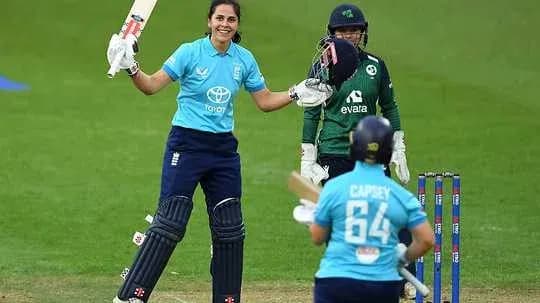
On a sunlit afternoon at Grace Road in Leicester, Maia Bouchier produced the kind of one-day innings that changes how a player is viewed. Opening the chase, she tore into Ireland’s attack for a 95-ball 104, the engine of England’s highest successful ODI run chase, completed with ease in the 39th over.
By the time she walked off, job almost done, the contest had long since tilted beyond recovery for the visitors.
Ireland set a target – and then England reset the bar
Ireland had every right to feel they were in the game at halfway. Their 281 for 5 was built with patience, then finished with a flourish.
After an early setback, Amy Hunter and Gaby Lewis steadied the innings and then pushed it into strong territory. Their second-wicket stand of 136 from 152 balls gave Ireland the platform they craved. Hunter and Lewis both passed fifty, both finished in the 60s, and between them struck 13 fours, threading gaps rather than relying on brute force.
The wobble came right on cue. From the 30th over, three wickets disappeared in 7.1 overs and the innings threatened to sag towards something under 250, the kind of total that rarely intimidates this England side.
Leah Paul and Rebecca Stokell refused to let that happen. They changed the tone of the innings, adding 84 from just 71 balls and dragging the score back into imposing territory. Ireland plundered 77 runs from the final 60 deliveries, the sort of surge that usually shifts shoulders back in the dressing room and gives bowlers something to growl about.
For a short while, 281 looked like a serious question.
Bouchier and England answered it with a shrug.
Bouchier explodes, Dunkley drives, Ireland drown
From the moment Bouchier took guard, there was a hint of intent. It became impossible to miss in the sixth over.
Jane Maguire, 23 and searching for rhythm, ran in again and again. Bouchier met her with four consecutive boundaries, an over that ripped away Ireland’s early discipline and set the tone for the chase. The ball kept racing to the rope, the field kept shifting, and England’s run rate never dropped back into anything resembling caution.
At the other end, Sophia Dunkley matched the tempo. Where Bouchier punched and drove with authority, Dunkley brought her own urgency, feeding the scoreboard and squeezing the life from the chase. After 10 overs, England sat at 72 without loss. Ireland’s 281 already looked smaller.
Dunkley’s fifty came from just 40 balls in the 15th over. Bouchier’s half-century followed in the 17th, off 53 deliveries. They were not just ahead of the rate; they were stretching it, scoring at more than seven an over and turning what should have been a tense pursuit into a training manual on how to dismantle a total.
The partnership reached 143 from 118 balls, a brutal alliance that pushed Ireland’s bowlers into defensive fields and drained the belief from their lines and lengths.
Cara Murray finally broke through in the 20th over, removing Dunkley for a sparkling 73 from 61 balls. It felt important. It had to be. If Ireland were to claw their way back, this had to be the start.
It wasn’t.
Capsey, Kemp and the final surge
Murray struck again almost immediately, dismissing Jodi Grewcock in the next over to leave England two down. For a moment, there was a murmur. Two quick wickets, a big chase, a glimmer of doubt.
Bouchier and Alice Capsey shut that door quickly.
They added 50 with calm assurance, Capsey rotating the strike, Bouchier still finding gaps, still dictating the tempo. In the 31st over, Bouchier reached her hundred from 91 balls, a landmark innings that had turned a potentially tricky chase into a procession.
She fell in the 32nd over, out for 104 with 11 fours, finally giving Ireland a moment of relief. It did nothing to change the direction of travel.
Freya Kemp arrived with license and no intention of hanging around. She went after the bowling with immediate aggression, taking on Louise Little for two boundaries in an over, then tearing into Arlene Kelly with four more fours as England surged past 250 in the 34th.
Murray, Ireland’s standout bowler on a punishing day, claimed Kemp for 36 off just 22 balls to complete a three-wicket haul. By then, the damage was irreversible.
Capsey, unbeaten on 41 from 40 balls, finished the job with a boundary in the following over. No fuss. No late drama. Just a clean, emphatic end to a chase that had been under control almost from the moment it began.
Ireland had batted with heart, finished with a flourish, and put a sizeable total on the board. England responded with something else entirely: authority, aggression, and a statement that on days like this, even 281 is nowhere near enough.