Japan Faces India in Historic Cricket Match
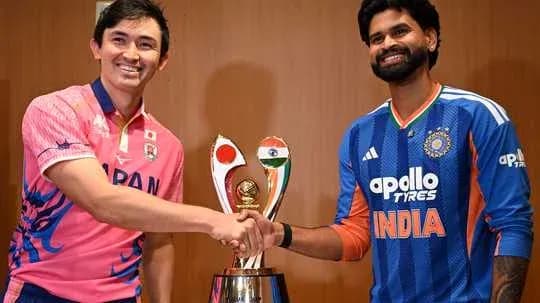
For years, when Naoki Alex Miyaji spoke about bringing India to Japan, it sounded like wishful thinking. The CEO of the Japan Cricket Association was talking about world champions flying to a country ranked 41st in the format, to play at a modest venue in Sano. Ambition, yes. Realistic? Not to many.
Then the Asian Games arrived, and the fantasy found a schedule.
On Tuesday, at Sano International Stadium, Japan will walk out behind Kendel Kadowaki Fleming to face India. Not in a warm-up, not in a promotional hit-and-giggle, but in a full international that carries weight for both a global powerhouse and a determined Associate.
“The CEO has had this dream for a long time,” Japan captain Kendel says. “When news first came up that we were hosting the Asian Games, Naoki had been talking about the concept of having India here for a game. So, for it to turn into reality is extremely special for a lot of people involved, and as a men's team, we can't wait.”
The road to this fixture has been long and, at times, improbable. For Japan, it meant years of quiet work in the background, lobbying, planning, and convincing. For India, it meant saying yes.
Kendel knows exactly how much had to align. “It's taken a massive effort from a lot of people involved to make it happen.” He is quick to point beyond the dressing room door. Credit, he insists, belongs not just to the Board of Control for Cricket in India for accepting the proposal, but also “to our leadership team here at the Japan Cricket Association (JCA), and in particular, the CEO.”
India have never played a bilateral match against an Associate nation. That fact alone makes this contest historic. For Japan’s players, it is far more than a line in a record book. It is a once-in-a-generation chance to test themselves against the very top.
The scale of the opportunity is not lost on Kendel. Playing the reigning world champions is one thing. Doing it at home, in front of the biggest cricket crowd the country has ever seen, is something else entirely.
“It's got the potential to accelerate the growth of cricket across the country,” he says. “There's going to be more people here than ever before for a cricket match. And clearly the best quality players that we've ever had here as well.”
Those players are not faceless names on a team sheet. They are Jasprit Bumrah, Abhishek Sharma, Shreyas Iyer – headline acts in the modern game, now set to share a field with a team that has spent years playing in obscurity.
“It still does sound quite surreal to be hearing about them playing here in Japan,” Kendel admits.
Surreal, yes. Intimidating, no.
Japan know where they stand in the global order, but they refuse to treat this as a sightseeing tour. “I can't guarantee any outcome,” Kendel says, “but what I can guarantee is that we will try our best. We'll compete and hopefully we'll give it our best shot.”
He will lead from the front. At 30, Kendel is a left-handed batter and right-arm off-spinner, the kind of dual-role cricketer Associate teams often rely on. Around him, Japan have assembled a balanced group, a blend of hardened campaigners and emerging talent shaped by the country’s pathway system.
One of those emerging names is Charlie Hara-Hinze, a 17-year-old all-rounder who bowls left-arm spin. Players like him are the real barometer of what this fixture might mean: teenagers who suddenly find themselves bowling to India’s stars, with the cameras on and the stakes raised.
Japan’s cricket identity has long been built around spin. Conditions at home and in the Associate circuit — in places like PNG, Thailand and Oman — have nudged them in that direction. Surfaces are often slow, rewards come to those who can tweak the ball and out-think batters rather than blast them out.
Within that niche, they have learned to punch above their weight. At the ICC Men’s T20 World Cup Qualifier 2026, Japan produced a landmark win, beating Kuwait by five wickets. It was more than just a result; it was a statement that they could stand up to higher-ranked opposition and not simply make up the numbers.
Now comes a far bigger examination.
The significance of this game is not lost on the International Cricket Council either. William Glenwright, ICC Head of Global Development, calls the match “enormous” and ties it directly to one of the governing body’s key ambitions.
More than 1,000 bilateral games were played last year, and over 860 have already been staged this year. Yet this one, between a full member and an Associate, carries a different kind of weight.
“Having a full member and the world champions playing any associate member is hugely important to us from a cricket perspective,” Glenwright says. The implications stretch beyond one afternoon in Sano. “What does it mean for the country of Japan and cricket's significance in Japan? And that's the ripple effect of a fixture like this. Because it reflects a growing confidence in the game and in the full members' belief in the abilities of our associate members to host full members in major international cricket.”
That “ripple effect” is what Japan are banking on. This is not just about a result; it is about visibility in a sports market dominated by other games.
In Japan, cricketers do not walk through airports trailed by cameras. They do not front national advertising campaigns or command prime-time television slots. The country’s biggest sporting icon is Shohei Ohtani, the two-way superstar who has redefined what is possible in baseball.
“He’s the Virat Kohli of baseball,” Kendel says. In Japan, baseball is the sport that fills stadiums and dominates conversation. “It’s definitely a sport that many of the supporters get behind in Japan.”
Cricket, for now, is a niche, a curiosity played in pockets and followed by a small but committed community. Yet Kendel refuses to accept that it must always stay that way.
“There's no reason why we can't aspire to become like that in cricket someday,” he says. The gap to the full members is obvious, and he does not pretend otherwise. “We've got a long road ahead if we can try to replicate the full-member countries for sure.”
On Tuesday, that road briefly intersects with the very summit of the sport. For Japan, this is not the end of a journey. It is a starting point, under bright lights, against the best in the world, with a nation watching to see what cricket might become.