Japan's Emerging Role in International Cricket
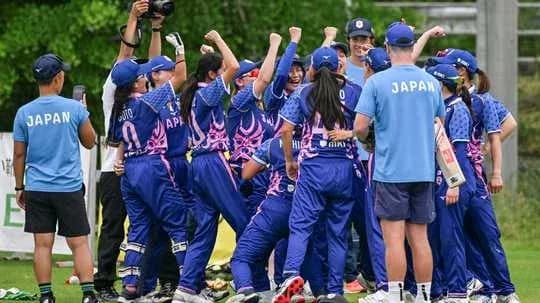
Japan is not yet a cricket nation in the way India or England instinctively are. But it is becoming something just as valuable to the sport’s rulers: a strategic frontier.
This is a country that has already proved it can stage the world’s biggest shows. The Olympics. The World Aquatics Championships. The World Athletics Championships. Next up, the Asian Games. The International Cricket Council can read a calendar as well as anyone. It wants cricket to be ready when Japan’s stadium lights swing its way.
ICC’s long game with Japan
Inside ICC headquarters, Japan is no longer treated as a curiosity on the periphery. It sits on the development map as a potential host, not just a participant.
“So part of our longer-term strategic planning with Japan is how do we work with them to build up their capabilities to host larger ICC events, and potentially one day… there might be an opportunity to host or co-host a Youth World Cup or something as part of a bigger plan,” says William Glenwright, ICC GM – Development.
That “bigger plan” has taken a tangible step this week. India, the world champions and the most powerful team in the sport, have agreed to play a T20I against Japan, ranked 41st. On paper, it is a mismatch. Politically and structurally, it is gold.
“India's tour of Japan is so important,” Glenwright explains, “because not only does it build, obviously, the capability of the cricket team, but it builds the broader capabilities of the organisation around meeting the demands that come with hosting world champions.”
This is not just about a one-off game. It is a live drill for the Japan Cricket Association. Ticketing. Security. Broadcast. Logistics. The kind of detail that decides whether a nation can step up from regional events to ICC tournaments.
“And it's important that the administrators of Japan Cricket Association be exposed to that, because if we aspire to bring major ICC events to Japan, then they need to have that capability,” Glenwright says.
When a full member and the reigning world champions visit an associate, the ICC pays attention. So do governments and sponsors.
“Having a full member and the world champions playing any associate member is hugely important to us from a cricket perspective,” Glenwright adds. “And then there's the other element of that, which is – what does it mean for the country of Japan and cricket's significance in Japan? And that's the ripple effect of a fixture like this.”
The symbolism is clear: full members trust that associates like Japan can host them. That confidence can move budgets, unlock grants and nudge broadcasters to look east.
Results that demand a second look
The numbers suggest Japan’s rise is not just a boardroom project. It is happening out in the middle.
The men’s national side has quietly pieced together an increasingly serious schedule. Seven games in 2022 (five wins, two defeats). Eight in 2023 (four wins, four losses). A busy 2024 with 25 matches (18 wins, six defeats, one abandoned). Eleven more in 2025 (six wins, five losses). And already 10 in 2026, with eight victories and only two defeats.
Within those figures sit landmark results. Wins over Kuwait (ranked 23rd), Bahrain (27th) and Papua New Guinea (22nd) show Japan are no longer just making up numbers. They are competing with mid-tier associates and beating them.
The women’s curve is even steeper. Four games in 2022, all lost. Then the turn. Sixteen matches in 2023 brought four wins. In 2024, they won 10 of 14. In 2025, seven wins from 11. In 2026 so far, three wins in five.
Those are not powerhouse records yet. They are the records of a team that has moved from survival to relevance in a short span.
The ICC has noticed. And so have fans.
A digital audience wakes up
For the first time, the ICC live-streamed select matches into key emerging markets on YouTube and Facebook. Japan responded.
Across platforms in Japan, the streams drew more than 1.1 million views. On YouTube, non-English language feeds across Japan and Indonesia combined for 201,000 views. Japan alone delivered 118,000 of those – 58 percent – with the rest split between Hindi and Urdu.
On Facebook, the pattern was even clearer. Non-English feeds from the two territories attracted 252,000 views. Japanese-language coverage accounted for 70 percent.
These are not blockbuster global numbers, but they matter where it counts. They show that when cricket is made accessible in Japanese, people watch. For a sport trying to crack a new market, that is the first sign of life.
“Facing India is just unreal”
On the ground, the shift is felt most keenly by players like Mai Yanagida, captain of Japan’s women’s team. Her side opens its Asian Games campaign against India on Friday morning (IST), a fixture that would have sounded fanciful not so long ago.
“Yeah, Japan is not a cricket nation like India,” Yanagida says, “but I think over the last few years, or 10 years, I think the awareness of cricketers and the popularity of cricketers has increased. So hopefully there'll be a lot of crowd and people will watch us play. And hopefully, yeah, we'll compete with one of the top nations.”
Her squad has done its homework. They followed India’s women through the recent Asia Cup and watched the WPL closely, studying players they will now share a field with.
“Facing India is just unreal. And it's very exciting,” she says. “Of course, we've never played against them before. They are one of the top nations. We were watching the Asia Cup, we were following them. They just won the tournament. I know that all the players are top-class players. It can be intimidating. But it's more like an excitement to watch them and see them play and share the field with them.”
For Japan, this is not just a test of skill. It is a chance to measure their progress against the best, to see how far the gap has closed – and how far remains.
Asian Games: gateway to something bigger
Behind the emotion of that fixture sits a colder calculation from the ICC. The Asian Games are a development tool.
“For a number of reasons,” Glenwright says. “Firstly, because the Olympic Games is limited in size, as it is for all sports, the Asian Games or the regional games allow more of our members to participate in a multi-sport event. And secondly, that unlocks all sorts of funding from governments, from Olympic committees and from sponsors, in addition to the increased competitive opportunities that it provides.”
The impact is already visible on Japan’s infrastructure map. Cricket now has two international-standard grounds in the country. Sano was the first. Nagoya is the new one, built in part because of the Asian Games.
“On account of the Asian Games, we now have, or Japan Cricket now has, a second international cricket ground available to them,” Glenwright says. “So there's one in Sano, and there's now one in Nagoya. So that means we have two international-standard facilities in Japan, which means all of a sudden, the capability and potential for Japan to host major ICC events, where by and large you need at least two international facilities, changes now, and it brings Japan into the equation.”
That phrase – “into the equation” – is key. Two grounds transform Japan from an interesting idea into a realistic host candidate for age-group World Cups or qualifying tournaments.
Pitch, not perception
There have been murmurs about the Asian Games venue. The event falls under the Asian Cricket Council’s remit, and concerns surfaced around the wider athlete facilities: changing rooms, media areas, general enclosures.
On the cricket itself, Glenwright is firm.
“The ground itself, we have no concerns with. We held a World Cup qualifier there earlier this year. The reports are that the pitch and the outfield are excellent. We wouldn't have held a World Cup qualifier there if we weren't confident in it,” he says.
“I know there have been some concerns expressed by the Asian Cricket Council, who manage the Asian Games, around athletes’ enclosures, like the changing rooms, the media areas, and the like.
“I believe they are being addressed. And the last update that we had is that they were being addressed. But in terms of the pitch itself and the outfield, the cricket facility, we're very confident that it's going to be a great facility that reflects the importance of this event and the members participating in it.”
So the stage is set: a solid surface, a rising host, and the world champions in town.
Japan is still learning the rhythms of a sport that has shaped other nations for more than a century. But with packed schedules, growing digital audiences, two international grounds and the ICC openly talking about future World Cups, the question is no longer whether cricket belongs in Japan.
It is how quickly Japan can make itself impossible to ignore.