India's Spinners Dominate Pakistan in Historic T20I
DUBAI: A landmark day for Pakistan cricket turned brutal in a hurry.
On the occasion of their 200th Women’s T20I, Pakistan walked out in Dubai with a chance to make a statement against their fiercest rivals. They walked back 18.1 overs later with their lowest total in the format, skittled for just 55, and with India’s bowlers having ripped through them with ruthless precision.
What began as a platform turned into a freefall.
Bright start, brutal collapse
Opting to bat first, Pakistan did the early running. Muneeba Ali and Shawaal Zulfiqar moved them to 27 without loss, nudging, driving, and, for a brief spell, quietening an Indian attack that had bullied Thailand and Hong Kong earlier in the tournament.
Muneeba, living dangerously, survived a couple of early alarms. The ball beat the edge, hands went to heads, but the scoreboard ticked on. Shawaal matched her, 14 off 14, and for six overs Pakistan looked settled.
Then Shafali Verma shattered the illusion.
She finally snuck one through Muneeba, and the mood shifted instantly. The dismissal cracked open the innings; India’s spinners did the rest.
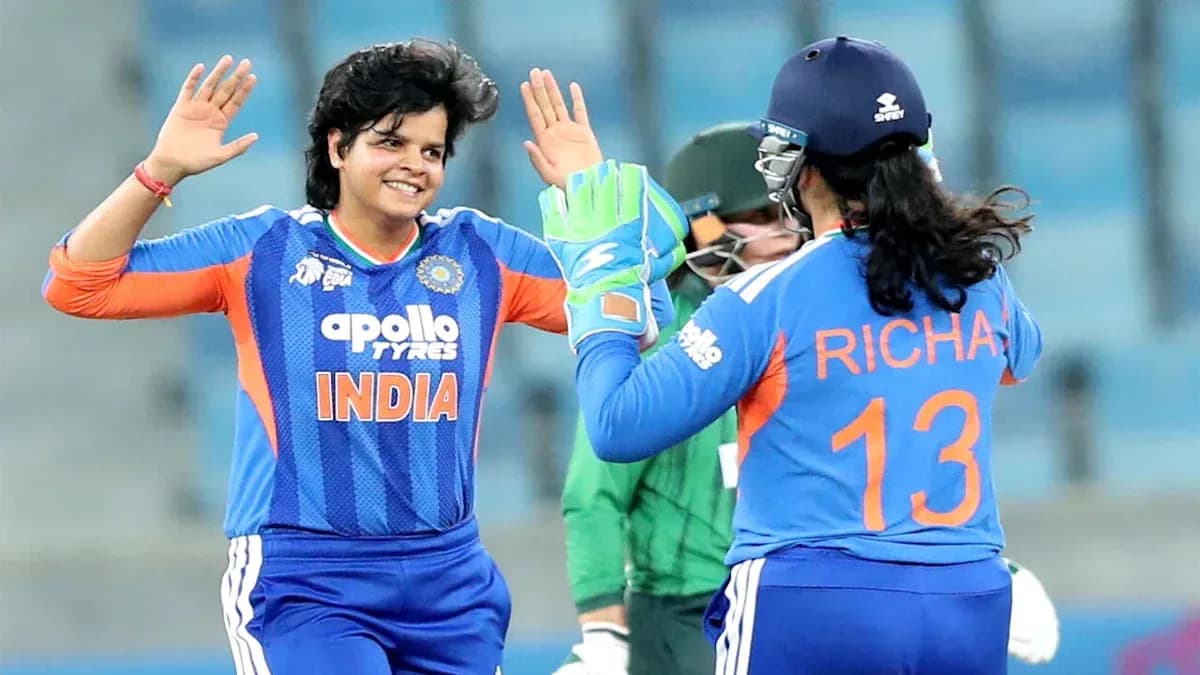
Sree Charani stepped in and tore the game away in a single over. Bowling the last of the powerplay, she struck twice, and Pakistan’s solid 27/0 suddenly looked fragile at 27/3. From there, it was a procession.
The numbers are stark: 27/0 to 35/6. Six wickets for eight runs. A batting card in ruins.
Charani and Rawat choke the life out of Pakistan
India sensed panic and tightened the noose. Line, length, and relentlessness.
Charani was the standout. She finished with a stunning 3/7, barely giving Pakistan room to breathe, let alone score. She hit the pitch hard, gave the ball sharp revs, and kept dragging the batters forward into indecision.
At the break, she kept the explanation simple: bowl to her strengths, trust the coaching message to the spinners, and keep working on the arm ball and yorker accuracy. On the field, it looked anything but simple for Pakistan’s batters.
From the other end, Prema Rawat mirrored that control. Her 3/9 underlined the depth in India’s spin resources, as she picked off the middle and lower order with cold efficiency. Deepti Sharma chipped in with 2/5, while Shafali’s early strike had already opened the door.
No partnership grew. No counter-attack came. Singles dried up, boundaries vanished, and Pakistan’s innings disintegrated into a series of desperate pokes and misjudged strokes.
By the time the last wicket fell with the score on 55, India had exposed every crack. Pakistan had lasted fewer than 19 overs and never once looked like posting a total that could stretch a side already assured of a semi-final place.
An unwanted record on a milestone day
The number will sting: 55 all out.
It undercuts Pakistan’s previous lowest all-out total in Women’s T20Is, 56 against New Zealand on the same Dubai turf in 2024. It now sits alongside some of their bleakest batting days: 60 against England in Taunton in 2009, 63 against India in Guangzhou in 2012, 65 against West Indies in St Andrew’s in 2011.
To register that on the day of their 200th T20I adds another layer of frustration. This was supposed to be a celebration of longevity in the format. Instead, it became a harsh reminder of the gap they still need to bridge against the elite.
India, meanwhile, added another entry to a growing list of dominant displays against their neighbours. They had already won nine of the previous ten T20I meetings between the sides, the only blemish in that run coming at the 2022 Asia Cup. This performance simply extended the pattern.
For the bowlers, it was also a statistical feather: 55 now ranks as the fifth-lowest total India have ever conceded in Women’s T20Is.
Harmanpreet’s landmark, India’s statement
Amid the chaos of Pakistan’s collapse, another milestone quietly took its place in the record books. Harmanpreet Kaur, leading India once again, became the first cricketer – male or female – to captain in 150 T20Is.
It is a staggering number in a format defined by churn and change. On a day that demanded authority, her attack delivered exactly that.
India had already booked their semi-final spot before a ball was bowled, but there was no sense of easing off. The way Charani, Rawat, Deepti and Shafali hunted in a pack, the way they squeezed the run-rate and forced error after error, sent a message that will echo beyond this group stage.
Pakistan will have to absorb this blow quickly and find answers. India, with their bowlers humming and their captain rewriting records, look like a side intent on turning dominance into silverware.