India Claims Under-19 Asia Cup in Dramatic Finale Against Pakistan
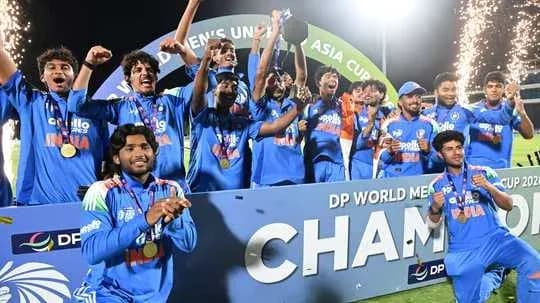
India snatched the Under-19 Asia Cup in the most dramatic fashion imaginable, dragging a lost cause back from the brink and ripping it out of Pakistan’s hands with the very last ball in Al Amerat.
Needing 338, they were nine down, 29 runs short, and almost out of time. Pakistan had one hand on the trophy. India’s dressing room had gone quiet. Then a final-wicket stand refused to read the script, and Mohit Ulva carved his name into age-group folklore with a boundary when three were needed off the final ball.
The ball flew, the rope disappeared, and so did any semblance of restraint. The entire Indian squad burst onto the field, a blue wave engulfing Ulva as Pakistan’s players sank into the outfield, stunned.
A chase in slow motion, then fast forward
India did not begin like a side chasing 338. The openers took their time, wary rather than reckless. Aaryavir Sehwag, who would later be named Player of the Tournament, was the one to break free first. He unfurled the full range – drives on the rise, fierce cuts, confident pulls – and rolled to his fourth fifty-plus score of the competition.
He looked set to turn it into something bigger. He didn’t. Pakistan dragged him back, found the breakthrough, and with it a way to keep nudging India off balance.
Lakshaya Raichandani played the anchor, but the clock kept ticking. His half-century came off 72 balls, steady but increasingly heavy in the context of a mounting required rate. India needed a gear change; Pakistan kept finding ways to stop it.
The game seemed to drift. Then it snapped back to life.
Anvay Dravid and Raichandani suddenly broke loose. Boundaries began to pepper the scorecard as the pair finally punched back, threading gaps and forcing Pakistan’s bowlers into their first real spell of discomfort. For a brief spell, India’s chase looked orderly again, almost comfortable.
Then came the gut punch.
Both set batters fell off successive deliveries. Two wickets, two balls, and with them went India’s apparent control. The chase, already steep, now looked close to impossible.
Chauhan’s counterattack and a final twist
Out walked Manal Chauhan, and with him came the kind of intent the situation demanded. He didn’t tiptoe into the contest; he tore into it. Chauhan counterattacked, threading the field and clearing it when needed, refusing to let the game meander to a tame conclusion.
Partners kept disappearing at the other end. He kept swinging. Each boundary dragged the equation back into the realms of the improbable rather than the impossible.
Then came the partnership that changed everything.
Chauhan and Ulva came together with India still in deep trouble but not yet buried. They chose violence at the death. Boundaries started to come in clusters, not singles. Pakistan, who had looked so assured, suddenly felt the game slipping through their fingers.
When the ninth wicket fell in the 48th over, Pakistan still fancied themselves. They should have. India were still behind the game, and the pressure of a final has a way of freezing young hands.
Ulva had other ideas.
He launched the penultimate over with a four and a six, ripping the equation down and flipping the tension onto the fielding side. Every hit now carried weight; every misfield drew gasps. By the time the final over began, India needed eight off six. The match had become a nerve test.
Ahmed Hussain ran in for Pakistan, tasked with dragging his side over the line. He almost did. He squeezed the chase, dragged it to the very last delivery, refusing to give Ulva an easy release shot.
Three needed. One ball. Fielders spread, hearts racing.
Ulva swung, connected, and sent the ball screaming to the boundary. Game over. Title won. A final decided on the final ball.
Pakistan’s platform, and the collapse that came back to haunt them
All of this drama sat on top of a first-innings story that had seemed, for most of the afternoon, like a coronation for Pakistan.
Usman Khan once again anchored their innings with a composed, well-constructed century. He played the role every coach dreams of in a final: calm early, assertive late, always in control. Around him, the fireworks crackled.
Abdul Qadir lit up the middle overs with a blistering 80 off just 54 balls, clearing the ropes eight times. He didn’t just score; he intimidated, forcing India’s bowlers off their lengths and pushing the total towards something monstrous. Every time the ball sailed over the boundary, Pakistan’s dugout grew louder, more animated, sensing a total that could crush a chase before it began.
When Qadir fell, skipper Farhan Yousuf took over. He added a brisk half-century of his own, keeping the tempo high and the pressure constant. At 299 for 3 after 44 overs, Pakistan were cruising, perfectly placed to blast their way beyond 350 and out of sight.
Then the innings buckled.
Over the final six overs, Pakistan’s momentum vanished. Wickets began to tumble, intent turned into indecision, and the scoreboard slowed. From that dominant platform, they scraped together only 38 more runs and lost six wickets in the process.
What had looked like a statement total turned into something else: challenging, yes, but not untouchable.
In the end, that collapse mattered. Those missing 20 or 25 runs hovered over the chase like a ghost. When Ulva’s final stroke pierced the field and crashed into the rope, the cost of those last-overs jitters became brutally clear.
India’s youngsters walked away with the trophy. Pakistan walked away knowing they had it in their hands – twice – and let it slip.