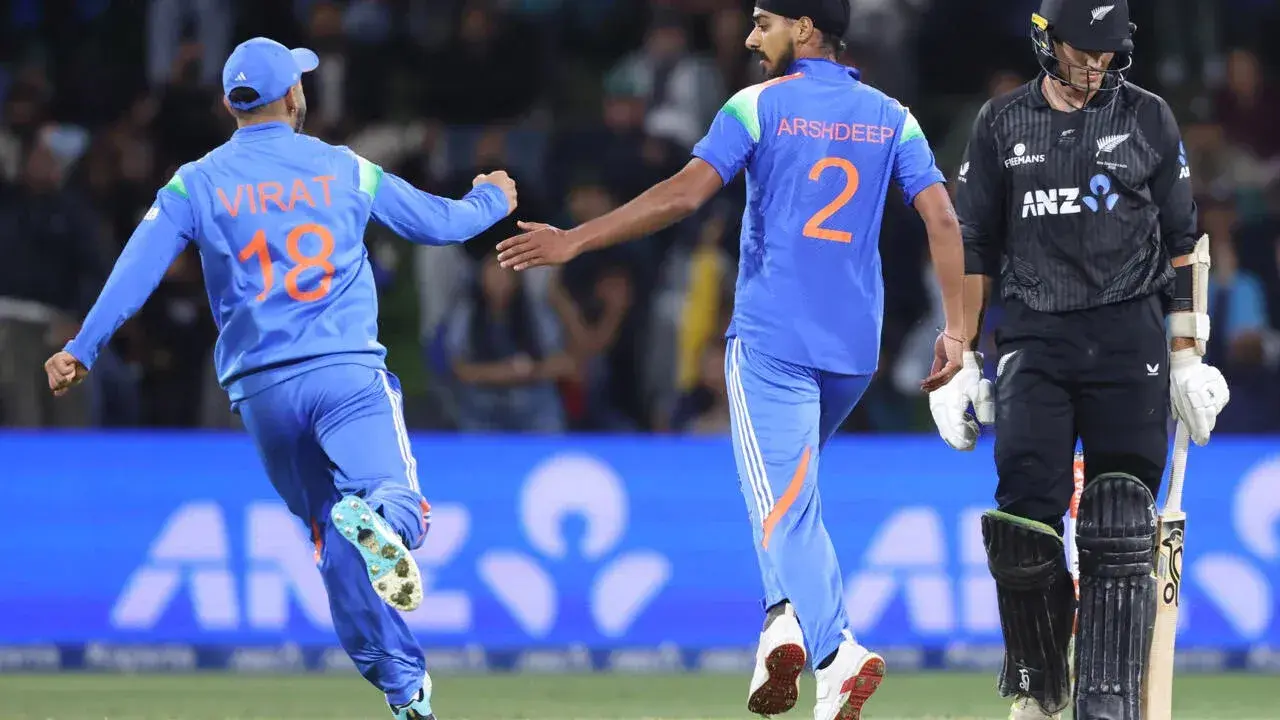
India's Batting Collapse in Mount Maunganui Decider

The script promised a thriller. A series on the line, a sun-splashed Bay Oval, and – quite possibly – a last look at Rohit Sharma and Virat Kohli in New Zealand.
Instead, India’s top order blinked, New Zealand’s seamers and spinners pounced, and the visitors lurched from one mini-collapse to the next in a muddled innings that never truly settled.
Fisher floors the big guns early
The tone was set almost immediately. Jacob Duffy’s first over jagged past Rohit’s outside edge, the India captain surviving the first ball of the innings by a whisker before lifting a controlled four over cover. It looked like the kind of nervous start that might quickly smooth out.
Ruturaj Gaikwad tried to inject that calm. Two boundaries off Ben Sears’ replacement Will O’Rourke’s new-ball partner Ben Fisher – one a thick edge through the vacant slips, the other clipped neatly through mid-wicket – pushed India to 21 without loss after four overs. A fluent start, if not entirely convincing.
Then came the crack.
On 23/0, Fisher dragged his length back just enough and took the pace off. Rohit, on 7, flicked loosely and picked out Dean Foxcroft at mid-wicket. A soft end for the captain, who closed a grim tour with just 30 runs in four innings, two of them ducks.
Kohli walked out to the familiar New Zealand murmur – respect laced with the memory of old scars. He had opened this series with a commanding 74 in Auckland, but the runs had dried up since.
They didn’t return here.
Fisher went short and wide, tempting the big drive. Kohli threw everything at it. The top edge flew high, Tim Seifert sprinted, leapt to his right and held on. Kohli gone for 5 off 7. India 33/2, and Bay Oval suddenly felt a lot bigger.
For a pair who have defined India’s white-ball batting for over a decade, this was no farewell lap of honour. If this does prove to be their final outing in New Zealand, it will not be remembered fondly: Rohit’s 30 runs across the series, Kohli’s 74 in Auckland followed by just 12 more in the next three innings, including a duck.
Gaikwad wastes his opening, middle order wobbles
With Shubman Gill missing the last two games, this tour was a chance for Gaikwad to make a case as India’s back-up ODI opener. Instead, he left that door half open at best.
Having looked the most assured batter early on, he became the third wicket to fall. Jacob Duffy went fuller, the ball nipped back, and Gaikwad’s attempted drive produced only a thick inside edge. Seifert did the rest. Gaikwad departed with India 37/3 in nine overs, another opportunity missed after managing just 23 runs across two innings in New Zealand.
Shreyas Iyer and Axar Patel were left to pick through the wreckage. It was scratchy, it was nervous, and it was exactly what India needed.
New Zealand, though, refused to let them breathe.
Duffy drew a loose drive from Iyer, only for Finn Allen to spill the edge at third slip. On the next ball, Axar survived a run-out scare. India crawled to 47/3 after 11 overs, living dangerously and surviving on New Zealand’s generosity.
The pitch offered just enough – holding occasionally, spitting with extra bounce when the ball was dug in. It demanded patience. It demanded discipline. Axar and Iyer began to find some.
They stitched together a 34-run stand off 35 balls, nudging India to 68/3 by the 14th over. Both had been dropped, both were still there, and for the first time, New Zealand’s grip loosened slightly.
Then, the lights quite literally went out.
Power cut, then more damage
Axar ended the 14th over with a crisp four off Kristian Clarke, then launched Blair Tickner for six. Just as India seemed to be clawing back control, a power cut at Bay Oval knocked out the main broadcast feed. When pictures returned, the view came from a spare camera at deep cover – a reminder that even the technology was scrambling to keep up.
On the field, New Zealand were far more composed.
Tickner went short at Iyer. The right-hander, on 22 off 26, mistimed the pull and picked out mid-on. Another partnership broken just when it threatened to matter.
Ishan Kishan, having survived a close shave when Tickner’s short ball brushed his thigh pad rather than his bat, tried to settle in. He answered that scare with a boundary in the same over, dragging India to 97/4 after 21, but the innings still felt one wicket away from collapse.
Axar, though, stood firm.
He brought up India’s hundred with a crunching four through cover off Tickner, then followed it with a punchy back-foot shot wide of backward point for another boundary. At 107/4 in 22 overs, he had faced more balls than anyone in blue, playing the anchor in an innings short on stability.
Axar falls short, Santner takes charge
Just when Axar seemed set for a landmark, the surface held one back. On 46, he went for the lofted stroke over mid-wicket. The ball stuck, the shot lost its timing, and he could only pick out the fielder. Michael Bracewell, probing away, had his man.
Axar stood there for a moment, staring down at the pitch in disbelief. No fifty, no platform. India 121/5 after 25 overs, and the tail beginning to stir uncomfortably.
Naman Dhir tried to change the mood. Fresh at the crease, he punched Santner for a boundary after the drinks break, finding a rhythm that drew praise from the commentary box. Ravi Shastri called him a “find” for India on this tour – a player with the tools to become a mainstay in the format, and handy with the ball as well.
For a brief spell, Dhir and Ishan hinted at a rebuild. India edged to 138/5 in 29 overs, the approach cautious but necessary. Ishan moved into the 20s, Dhir looked increasingly assured, and New Zealand’s fielders sharpened their angles, sensing that one mistake could open the door to the lower order.
The mistake came from India. The door was kicked down by Mitchell Santner.
The left-arm spinner slowed it up dramatically to Dhir, tossing a fuller ball wide enough to tempt the big shot. Dhir went for the big clearance over deep cover, only to find the fielder on the rope. He walked back for 22, another partnership snapped just as it began to matter.
At 160/6 in 33.2 overs, the pattern was painfully familiar: just when India stitched something together, New Zealand found a way to cut it apart.
Collapse at the death
Santner, captaining with icy control, wasn’t done.
Auqib Nabi, searching for a way to push India towards a competitive total, lasted only nine balls. Santner drew him into a simple chip to Finn Allen at cover. Out for 5, India 166/7, New Zealand’s bowlers now all over the innings.
The pressure finally told again in the same over.
Santner produced a double-wicket maiden, removing debutant Yash Thakur for a duck with the last ball. From the other end, Ishan could only watch as wickets fell in clusters, his own innings trapped in a shrinking circle of options.
India slumped to 166/8 after 36 overs, the series decider tilting heavily towards the hosts before they had even picked up a bat.
A series finale with hard questions
On a surface where India had been skittled for 89 only a day earlier in a chase of 334 – Matt Henry ripping through them with a six-for that evoked memories of the 2019 World Cup semifinal – this was supposed to be an answer, a statement that the visitors had learned quickly.
Instead, it raised more questions.
Siraj’s return, backed by debutant Yash Thakur, underlined India’s desire to test their bench strength. Iyer, at the toss, had spoken of Siraj’s hunger to play across formats and his experience in knowing “how to go about things.” But that experience at the bowling crease will now need to bail out a batting unit that never quite trusted itself.
From Rohit and Kohli’s subdued farewell to Gaikwad’s squandered chance, from Axar’s near-miss to Santner’s ruthless spell, this innings told a blunt story: New Zealand seized every opening; India let too many of theirs slip.
The ball is now with India’s bowlers. On a pitch with grip, bounce and just enough mischief, can they drag this contest back from the brink, or will this finale in Mount Maunganui become a full stop on a tour that promised far more than it delivered?