Historic Moment as Vande Mataram Opens India vs Afghanistan T20I
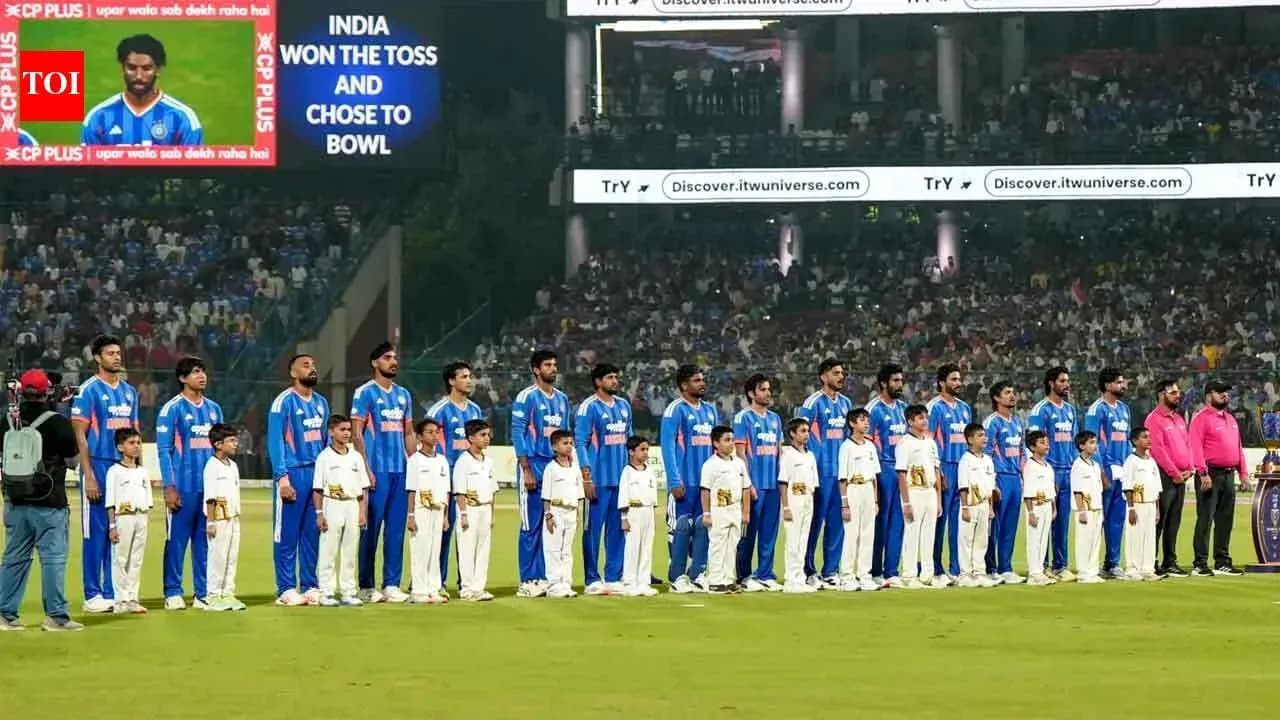
The noise at Arun Jaitley Stadium dipped into an unusual hush before the cricket even began.
Two teams, one series, and a moment never seen before at an international match: Vande Mataram rang out across the ground ahead of India’s opening T20I against Afghanistan in New Delhi on Sunday, followed by the National Anthem.
Not a clip, not a token rendition. The National Song in full, then Jana Gana Mana. A layered, ceremonial prelude to a format built on speed.
A first for international cricket
Players from India and Afghanistan lined up on the outfield as the familiar strains of Vande Mataram began. This was the first time the National Song had been sung before an international cricket fixture.
The move followed a Ministry of Home Affairs notification earlier this year that set out protocols for singing Vande Mataram at official functions. The directive, dated January 28, specified that all six stanzas should be sung, a rendition lasting around 3 minutes and 10 seconds.
The ministry also detailed occasions where Vande Mataram must be sung along with the National Anthem. Sporting events did not feature on that list. Yet here, in the heart of the capital, the two were paired on a cricket field, echoing a landmark moment from August 15, 2026, when both were sung in full for the first time after Prime Minister Narendra Modi’s Independence Day address.
On Sunday, that symbolism moved from the Red Fort to a packed stadium, just minutes before the first ball of a T20I.
India bowl first, Bumrah returns
Once the ceremony ended, the evening snapped back into the familiar rhythms of modern cricket. The toss went India’s way, and Shreyas Iyer did not hesitate.
“We are going to bowl first,” he said, pointing straight to Delhi’s reputation. The surface at Arun Jaitley Stadium has long encouraged captains to chase, and Iyer leaned into that history. “Whenever you come to Delhi, you know what the pitch has got to offer; it usually is a bowl-first wicket. We had a lot of positives in Zimbabwe; we will try and continue on that. We know Bumrah is a match-winner.”
The headline from the team sheet was as big as the anthem moment. Jasprit Bumrah walked back into India’s T20I XI for the first time since IPL 2026, a major boost for a side in transition in the shortest format. His presence instantly stiffened India’s attack, the familiar run-up and whiplash action returning to international duty under the floodlights.
Selection calls and notable absentees
The flip side of Bumrah’s inclusion was a reshaped XI. Vaibhav Sooryavanshi, who had impressed in the Zimbabwe T20I series, missed out despite his recent form. Sanju Samson came in, taking the gloves and a spot in the middle order.
Iyer confirmed at the toss that Vaibhav and Washington Sundar were among those to sit this one out. “Vaibhav is not playing, Washington is not playing, and two more,” he said, underlining the churn and competition within the squad as India test their depth.
There was another quirk: on paper, India were the away side. Afghanistan, designated as the official home team for the series, hosted in name while the matches unfolded in Delhi. A neutral venue in geography, but not in atmosphere.
XIs on the board, eyes on the contest
By the time the captains walked off, the stage was clear.
India lined up with: Sanju Samson (w), Abhishek Sharma, Ishan Kishan, Shreyas Iyer (c), Tilak Varma, Nitish Kumar Reddy, Shivam Dube, Axar Patel, Arshdeep Singh, Jasprit Bumrah, Varun Chakaravarthy.
Afghanistan named: Ibrahim Zadran (c), Rahmanullah Gurbaz (w), Sediqullah Atal, Darwish Rasooli, Azmatullah Omarzai, Gulbadin Naib, Mohammad Nabi, Rashid Khan, Mujeeb Ur Rahman, Noor Ahmad, Fazalhaq Farooqi.
A historic prelude, a high-stakes return for India’s premier fast bowler, and an Afghanistan side bristling with spin and all-rounders. The songs had set the tone; the cricket now had to match the occasion.