England’s bowlers dominate Pakistan at Lord’s
By the time the light finally seeped away over Lord’s, England’s seamers had done almost everything but win the series there and then.
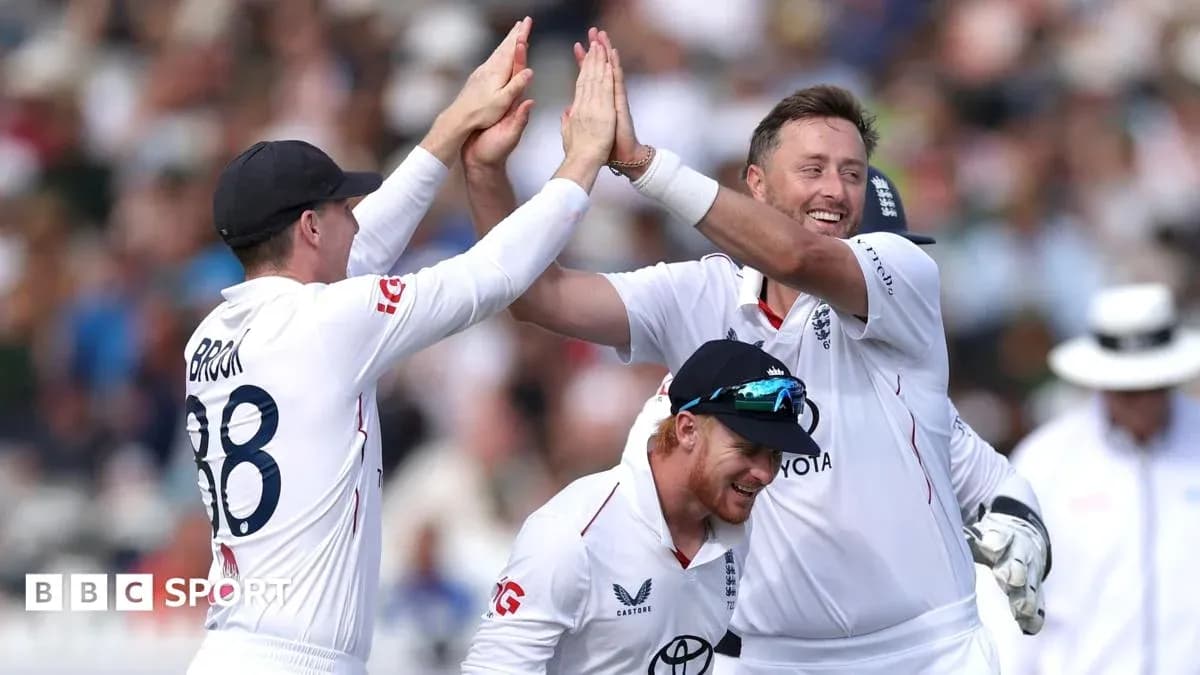
On a day that began with tailenders swinging and ended with Pakistan clinging on, Ollie Robinson and Jofra Archer led a ruthless pace display that left England 261 runs ahead and almost out of sight in this second Rothesay Test.
Pakistan, already without the injured Imam-ul-Haq, were bundled out for 110. Only Azan Awais, with a gritty 46, offered any resistance. The next highest contributor was extras. That told its own story.
Robinson and Archer choke the life out of Pakistan
The tone was set the moment England’s attack took hold of the ball. Archer thundered in at the Pavilion End, Robinson probed from the Nursery, and Pakistan’s innings never really drew breath.
Archer’s first spell was classic Lord’s theatre. The speed gun flicked up to 95mph, his average sat at 90.7mph, and Awais repeatedly groped at thin air. For five overs, it felt like every ball might take a wicket. Somehow, only Shan Masood departed, undone by that hostile pace.
At the other end, Robinson was the ice to Archer’s fire. Barely touching 80mph, wicketkeeper Jamie Smith standing up to the stumps, he dismantled batters with nagging precision and lavish movement. Every ball asked a question. Most got the wrong answer.
Pakistan never escaped. Saud Shakeel and Muhammad Rizwan fell to lbw decisions that owed as much to smart reviewing as to skilful bowling. A short ball finally accounted for Awais, who had fought as well as anyone could in the circumstances. Those strikes pushed Robinson’s tally for the summer to 19 wickets in three matches at an absurd average of 8.84.
Archer came back to cash in on the pressure he had created earlier, bowling Ali Usman and Muhammad Abbas to close the innings. His record at Lord’s now looks like a different bowler to the one elsewhere: a bowling average of 17 here, more than 30 everywhere else.
Behind the headline pair, Josh Tongue and Gus Atkinson were hardly passengers. Tongue’s fuller length again made him a constant threat; he now strikes once every 13.3 balls in this series. Atkinson’s figures remain miserly rather than spectacular – just one wicket in three innings – but he was inches from more, denied when Awais successfully reviewed a caught-behind decision just as rain drove the players from the field.
When they returned, Pakistan walked into a storm.
Tailenders turn the tide
The damage had actually started much earlier, with bat rather than ball.
England resumed on 248-9 and squeezed every last drop from their first innings. Atkinson and Tongue, the numbers ten and eleven, dragged the total to 290 with a 10th-wicket stand worth 47, 42 of those runs coming in the morning. Those were not decorative runs. They shifted the mood.
On a surface that had offered plenty to the bowlers on day one, that extra lower-order resistance suddenly looked priceless once England’s seamers went to work. Conditions eased slightly, but there was still enough in the pitch for anyone willing to hit a nagging length. England’s quartet did it relentlessly.
Pakistan’s frailty only sharpened the sense of control. In three innings on this tour, they have yet to pass 171 or survive 50 overs. Imam’s calf injury did them no favours, but the pattern is unmistakable: this batting line-up is not living with England’s pace battery.
Top-order wobble, Gay hangs in
If there was a moment when Pakistan might have clawed back a sliver of hope, it came at the start of England’s second innings.
Defending a 180-run deficit, Khurram Shahzad struck twice inside 19 balls. Ben Duckett flung his hands at a loose drive and picked out mid-off. Jordan Cox, fresh from two half-centuries in the series and one of the stories of England’s new-look top order, was trapped on the crease and pinned lbw.
From 13-2, the atmosphere quietened. Not panic – the cushion was still large – but a reminder that this match was not yet a formality.
Emilio Gay and Joe Root steadied things with a stand of 47. Gay, a left-hander under scrutiny with Jacob Bethell due back from a knee injury and the top order increasingly crowded, chose patience. He left well, picked off anything too wide, and nudged his way into the 20s.
Root looked set. Then the familiar problem returned.
Root’s lbw problem refuses to go away
When Mohammad Ali nipped one back into Root’s pads, the England captain instantly reviewed. It felt more in hope than expectation.
Out. Again.
This was the ninth time in seven Tests that Root has been dismissed lbw by a seamer. In his previous 39 matches, it had happened only three times. Whether the keeper is up to the stumps or back, the mode of dismissal is becoming a pattern he cannot ignore.
The very next ball almost brought a carbon copy. Harry Brook, England’s vice-captain, was rapped on the pad by Ali. This time, a thin inside edge saved him on review. It was a let-off, and a reminder that Pakistan’s seamers still had something to work with.
As the light deteriorated, survival became the priority. Gay edged Abbas short of the cordon, rode out the closing overs and walked off unbeaten on 30. Brook remained with him, England 81-3 and firmly in charge.
Gay now has a chance that could shape his immediate future. With Cox scoring runs and Bethell waiting in the wings, someone will eventually make way. An innings of substance here, under pressure, would make a powerful argument that it should not be him.
Weather, time and a looming series win
The forecast for Saturday is grim, with the prospect of a complete washout. Even that feels like an inconvenience rather than a threat to England’s position.
They already hold a lead that looks beyond this Pakistan batting line-up, and they have two more days beyond the deluge to finish the job. If day one hinted at balance, day two ripped that notion apart.
This pace attack, assembled in the wake of Ben Stokes’ retirement, has come together out of necessity. The opposition has been fragile, so any long-term predictions should be cautious. But across this series, England’s quicks have been relentless, varied and ruthless.
At Lord’s, where Archer roars, Robinson dissembles and Tongue and Atkinson snap at the edges, they now stand one good session away from a series win.
The only real question is not whether Pakistan can resist them, but how long they can hold out.