Dunkley’s Masterclass Powers England to 288 Against Ireland
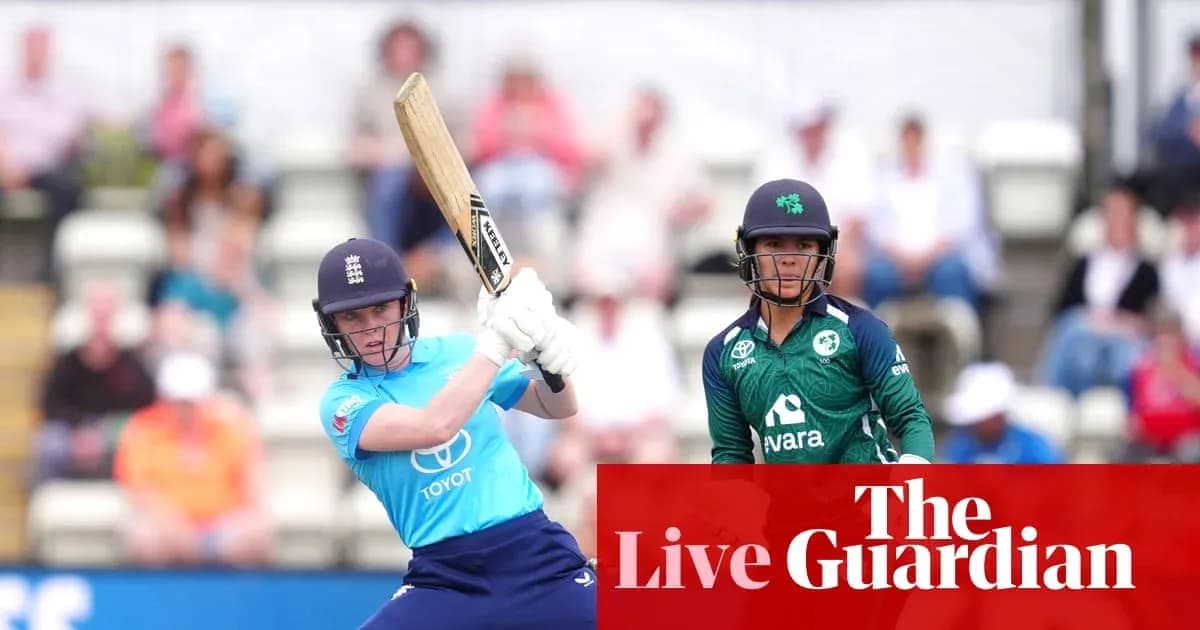
Sophia Dunkley’s commanding century lit up New Road as England’s batters surged, stuttered, then scrambled their way to a hefty total against Ireland in a fluctuating final ten overs that veered from cruise control to mild chaos.
Dunkley’s masterclass
The innings belonged to Dunkley. She started cautiously, then tightened her grip on the game until Ireland could barely shift her. Her hundred arrived in style in the 29th over: a pull for four to move to 99, then a calm single to reach three figures from exactly 100 balls. Helmet off, bat raised, a brief punch of the glove – a second international century, and one carved with authority rather than flash.
By then, England were 173 for 1, Dunkley on 100 and Seren Grewcock on 29, the pair having rebuilt and then accelerated after the early loss of the first wicket. Dunkley’s dominance had been clear for some time. She had already driven Kelly through cover, rocked back to cut for four, and punished anything remotely loose. Her 11th boundary came in the 26th over, a crouched cut that underlined just how securely she controlled the tempo.
Ireland’s bowlers searched for answers. Cara Murray tried the short ball; Arlene Kelly mixed in slower deliveries; Georgina Dempsey’s replacement, Rachel McBride, probed away. Dunkley simply kept moving through the gears. Into the 90s she went with a slower ball from Kelly dispatched over long-on, then a clipped stroke leg side off another poor delivery. England were 167 for 1 in the 28th over and sailing.
Grewcock settles, Capsey’s cruel exit
At the other end, Grewcock took longer to find her range. She nudged, prodded and waited 26 balls for her first boundary, but when it came in the 24th over it was worth the delay: a classical on-drive, straight and true. She followed it with a less textbook back-foot swipe past cover, giving Dunkley yet another four and England even more momentum.
By the 30th over, Grewcock had grown into her role. A checked drive for four, the bat held in a lingering pose, took her to 34. She looked increasingly assured, only to fall in tame fashion: shuffling into position and chipping a return catch back to Murray, who stooped to take it by her ankles. Grewcock departed for 35 with England 183 for 2.
Alice Capsey arrived as wicketkeeper and appeared in no hurry. Singles with Dunkley pushed England to 189 for 2 and then 197 for 2, the pair content to milk the field. Then came the moment of rotten luck. Dunkley drilled McCartney straight back; the bowler, in big sunglasses and a long ponytail, thrust out a hand. The slightest touch deflected the ball onto the stumps at the non-striker’s end. Capsey, having just nudged a single to bring up England’s 200, was stranded out of her ground and run out for 10. A stinker of a dismissal, and a gift for Ireland just as the partnership threatened to harden.
Dunkley falls, Kemp and Gibson take the reins
If that run-out rocked England, Dunkley did her best to steady them. She kept sweeping and reversing, picking up threes and fours, and moved serenely to 115. Yet her attempt to finally clear the rope for six ended her stay. On 119, she launched McBride towards deep midwicket, only to pick out Orla Prendergast, Ireland’s tallest fielder, balanced expertly on the rope. A beautiful strike, but straight to the one player who could both reach and hold it. England were 214 for 4, and Ireland at last had the prize wicket.
The responsibility shifted to Freya Kemp and Maia Gibson. Kemp announced herself with a majestic cut in the 35th over, helped by a slip on the boundary that turned a firm stroke into four. She then stood tall and whipped Little through the covers, another clean boundary that underlined her intent. By the 39th over she had 17, driving through extra cover and forcing a diving Gaby Lewis into a desperate, unsuccessful stop.
Gibson, meanwhile, took a little time to settle. A cross-batted four over backward point in the 40th over – helped by another fumble in the field – finally got her going. Ireland’s ground work continued to let them down; mishandles at backward point and in the ring repeatedly turned ones into twos and pressure into release. With ten overs left, England were 242 for 4 and eyeing something imposing.
Late surge, late wobble
The charge began properly in the 41st and 42nd overs. Kemp chanced her arm against mid-off and should have been gone, only for the throw to miss. She survived, pinched singles, and then watched Gibson unleash the shot of the day: a brutal club over long-off off McCartney, the first six of the innings, struck like a caveman on a day trip. England moved to 256 for 4, the platform fully built.
Kemp then exploded. Facing Murray, she strode down and launched the ball high into the Worcestershire sky. For a moment it looked destined for the stands; instead it dropped on the very thread of the rope, where Lewis, backpedalling and stretching full length, pulled off a superb catch. Kemp’s 23 from 21 balls had been brisk and bold, but it ended just as she threatened to rip the game away. England slipped to 260 for 5.
The same over turned into a double blow. Charlie Dean greeted Murray with a shanked full toss for four, only to nick a more flighted delivery soon after, Hunter taking a neat catch behind the stumps. From 260 for 4, England were suddenly 264 for 6, Ireland’s spinners dragging them back into the contest.
McCartney tightened things further with a tidy 44th over to close out her spell – 1 for 53 from ten overs, a solid return on a day when batters dominated. Boundaries dried up. England, who had once looked set for a late-innings avalanche, now had to scrap.
Villiers tried to shift the mood but misread Murray. Early in the 45th over she almost lost her off stump with an over-ambitious reverse sweep. Three balls later she danced down and lofted a gentle offering straight to deep midwicket. Lewis made no mistake. Villiers was gone for 3, England 270 for 7 and very much faltering.
Gibson refused to go quietly. She cut McBride for four in the 46th over, nudged singles, and then produced a deft ramp at the end of the 47th, gliding the ball for another boundary with real style. Her composure under pressure kept England ticking.
At the other end, Ryana MacDonald-Gay lived more dangerously. She slog-swept her second ball just out of Lewis’s reach, then later heaved to long-on and picked out Murray, gifting Kelly a wicket in her farewell appearance. MacDonald-Gay’s 7 came and went in a blur. England, once cruising, had slipped to 288 for 8.
A total with teeth
By the close of the 47th over, Gibson had moved to 41, busy and inventive, the anchor of England’s closing effort. The outfield, freshened by overnight rain and tinged with extra green, had played true. The crowd at New Road, swelling as the innings unfolded, had seen a little of everything: a dominant century, a freak run-out, a clutch of sharp catches on the rope and a late-order wobble that gave Ireland something to cling to.
England’s final total carried both weight and warning. Ireland had dragged them back from what once looked like an unreachable score. Now the question hung over New Road: could their batters match Dunkley’s authority, or would England’s bowlers turn that 288 for 8 into a statement of superiority?