Chadd Sayers Reveals Everyone Knew About Sandpapergate
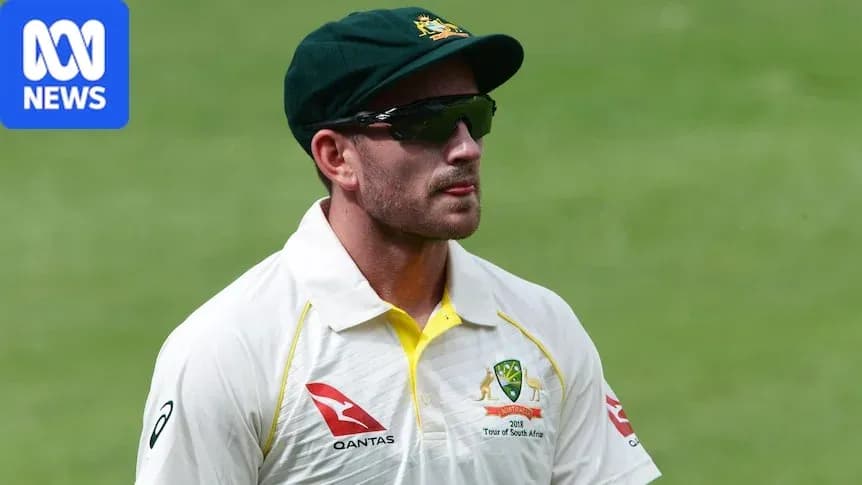
Chadd Sayers lifts lid on Sandpapergate: “Everyone knew what was going on”
Australian cricket’s deepest scar has been reopened, and this time it is a quiet swing bowler from Adelaide turning the knife.
Chadd Sayers, the seamer who played his only Test in the immediate aftermath of Sandpapergate on the 2018 tour of South Africa, has declared he is “comfortable” saying the entire team knew about the ball-tampering plan.
Speaking on SEN ahead of Australia’s second ODI against England in Adelaide, Sayers left little room for ambiguity.
“I’m comfortable saying where I’m sitting now that everyone knew what was going on [in South Africa in 2018],” he said.
“It [sandpaper] was used in two Test matches and there were discussions in change rooms … I’m not taking sides; it’s just my recollection of what took place.”
With that, the battle lines in Australian cricket’s civil war hardened again.
Khawaja’s memoir lights the fuse
The controversy has flared again because of Usman Khawaja’s memoir, Sabr, which drags the Cape Town Test back under the spotlight and insists ball-tampering was “commonplace” and a shared responsibility.
Khawaja writes that he knew sandpaper was being used on the ball and even told Cameron Bancroft to be careful. He also argues the entire team needed to own the behaviour, not just the three men formally punished.
The book has split opinion in the dressing room and beyond. It has also split former teammates.
David Warner, banned along with then-captain Steve Smith and Bancroft after the infamous footage of Bancroft working on the ball with sandpaper, has publicly backed Khawaja’s version of events.
Warner called Khawaja’s account “100 per cent accurate”, a powerful endorsement from the player who carried much of the blame.
But where Warner and Khawaja have aligned, Pat Cummins has taken a very different path.
Cummins pushes back: “Complete and utter nonsense”
Cummins, now Test captain and a member of that 2018 side, fronted a 70‑minute press conference on Friday and again denied any knowledge of sandpaper being used.
“When he says ‘we all knew’, if by that he means we knew sandpaper was going out on the field, he’s 100 per cent wrong,” Cummins said.
“I’ve said that consistently for the last eight years; I did not know that was happening.”
The fast bowler went further, accusing Khawaja of crossing a line.
“But I think Usman actually says things that are far more serious than that. He says that I and others were architects of a scheme to ball tamper with sandpaper; that’s complete and utter nonsense.”
Cummins also expressed shock at Khawaja’s admission that he warned Bancroft to be careful.
“I was genuinely shocked this week when I found out Usman admitted that he told Cam [Bancroft] to be careful when using sandpaper. That’s not the Usman that I know. It’s not the Usman that has been part of the team that’s helped rebuild the Australian cricket culture over the last eight years, and the Usman that would have stopped that from happening there and then.”
His frustration was personal as much as professional.
“Usman’s a friend, but friends aren’t casual with each other’s lives and reputations. In his book Ussie’s been casual with my [life] and the lives of many others, and I think Australian cricket. I support his right to tell a story, 100 per cent. I’m really glad he feels like he can, but we have to be accountable for the things that we say and do.”
The bowlers from that Cape Town Test — Cummins, Josh Hazlewood, Mitchell Starc and Nathan Lyon — have always denied knowing sandpaper was being used. Sayers’ comments cut directly across that long‑held line.
He also revealed there was a lengthy meeting in the immediate aftermath of the scandal, lasting between 60 and 90 minutes, once the team had been caught.
If the official narrative was once neat, it no longer is.
Warner turns his guns on Cricket Australia
Away from the microphones and memoirs, Warner has taken his fight to social media, accusing Cricket Australia of running a “shoddy” investigation in 2018 and hinting at a potential cover‑up.
On Saturday, he claimed he believed the bowlers were not interviewed by CA during the original probe.
“As far as I am aware, CA did not interview Josh Hazlewood, Mitchell Starc or Nathan Lyon in their 2018 investigation,” he wrote on Instagram.
“If that’s correct then how can CA push the idea that the bowlers didn’t know?
“It looks like they had decided who they wanted to blame from the very beginning … ran a shoddy investigation to serve the purpose and now they want to maintain the false narrative that the bowlers had no idea.
“That stinks of a cover-up.”
Multiple outlets, including ABC Sport, have reported that the bowlers were in fact interviewed by CA. Warner, though, doubled down on Sunday, saying the key point was that he was never told that at the time.
“Just to clarify ‘As far as I am aware’ was the POINT,” he posted.
“I was never told the bowlers had been interviewed or provided statements.
“That information would’ve been pretty useful when I was forced to make decisions back in 2018.
“Why weren’t we given all the evidence by CA?”
A wound that refuses to heal
Six years on from Cape Town, the basic facts remain the same: Bancroft was caught on camera using sandpaper on the ball; an investigation found he, Smith and vice-captain Warner responsible; the trio were suspended; the rest of the side denied involvement.
What has changed is the chorus around that core.
Khawaja now says ball-tampering was routine and the responsibility collective. Warner says Khawaja is right and Cricket Australia got it wrong. Cummins says both of them have gone too far. Sayers says everyone knew.
The reputations at stake are not just those of individuals but of a generation of Australian players, and of a governing body that insists it dealt with the crisis properly.
The ball from Cape Town has long since gone out of shape. The story around it clearly has not.