Bangladesh's Quest for Asia Cup Glory: Belief Against India
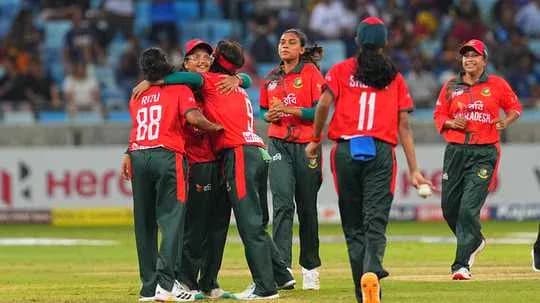
On the eve of a seismic Asia Cup semi-final in Dubai, Bangladesh are refusing to tiptoe around the obvious. To lift this trophy, they know the road runs straight through India.
Sharmin Akhter Supta is not interested in polite disclaimers.
“If we don't even believe that we can beat India, then we shouldn't even dream of becoming Asia Cup champions,” the batter told Cricbuzz ahead of Thursday’s clash at Dubai International Stadium. “I firmly believe that to win the Asia Cup, you inevitably have to face India at some stage, whether in the semifinal or the final. You must have that self-belief.”
Bangladesh reached the last four by squeezing past UAE, a 34-run win that was more grind than glamour. They were held to 103 for 7 on a slow surface, rescued only by a stubborn 42-run stand between Sharmin and Nahida Akter. It was enough, but only just.
That narrow escape has sharpened minds rather than dulled ambition.
Memories of 2018 – and a Giant to Topple Again
For this group, India are not just the superpower across the border. They are the benchmark, the obstacle, and in 2018, the stepping stone to glory.
Bangladesh’s greatest moment in women’s cricket came in that Asia Cup in Malaysia, where they beat India in the group stage and then stunned them again in the final to claim the title. Sharmin reaches for that memory now, not as nostalgia, but as proof.
“Even back in the 2018 Asia Cup when we became champions, we had to beat India in the group stage, and then we defeated them again in the final to claim the trophy,” she said. “As I mentioned earlier, back in 2018, we beat India twice on our way to becoming champions. India is undeniably a big name, but if you can beat them, the path to the Asia Cup becomes much clearer.”
The numbers since then tell a harsher story. From that final to now, the sides have met 13 times in T20Is. India have won 12 of those. Bangladesh have managed just one victory.
Still, Sharmin refuses to treat that record as destiny.
“The same principle applies to us now: nothing is impossible,” she insisted. “Yes, they are a formidable team whose primary strength lies in their batting, whereas our primary strength is our bowling. If we can back up our bowling with an improved batting performance and play well on that particular day, I genuinely believe we can beat India.”
Bowling as the Blade, Batting as the Question
Bangladesh’s blueprint is clear. The bowlers carry the edge; the batters must provide just enough steel.
Against UAE, that balance was fragile. Sharmin top-scored with 38 off 31 balls, striking three fours, while Nahida’s unbeaten 16 off 26 balls helped drag the total past three figures. On a sluggish pitch, it felt like a rescue act rather than a platform.
Nahida knows they cannot afford a repeat against India.
“Alhamdulillah that we were able to win yesterday's match (against UAE), even though it was a low-scoring one. Still, I’d say we won because of our strength, our bowling strength,” she told Cricbuzz. She pointed straight at the surface as a complicating factor. “Given the behavior of the pitch, or the kind of wicket we've been playing on here, I feel it’s a bit of a slow-track wicket. On a pitch like that, I reckon 120–130 runs is a perfect total. That said, we were probably 10–15 runs short.”
She did not leave the batters out of the conversation.
“Having said that, I know our batters are capable of much more. We have that belief in them, and we always hold that faith. InshaAllah, our batters will make a strong comeback.”
The message is blunt: the bowlers have done their job; the batters must now match that standard if India are to be rattled.
Blocking Out the Badge, Trusting the Day
India’s aura in Asian women’s cricket is real. Sharmin feels it, but she chooses to weaponise it.
“When playing against India, there’s naturally a strong positive vibe among everyone to perform well, as India is a big name in Asian cricket. I feel that this positive energy motivates the entire squad. If we perform well, there’s no doubt we’ll create a strong chance of winning,” she said.
For her personally, the preparation is almost stubbornly simple. No over-analysis. No shadow-boxing against reputations.
“As for how I prepare myself, when I step onto the field, I don't overthink who the bowler is or how big the opposition is, focusing on that beforehand doesn't help,” she explained. “We never truly know what will happen on the field. On any given day, even the best bowler can have an off day, and an unexpected bowler can deliver an outstanding spell. That specific day is what really matters, how well your plans are designed and how effectively you execute them. I hope we stay focused on going in with a strong plan and executing it well.”
The semi-final, she insists, levels more than it divides.
“In a knockout game, you have to treat whichever opponent you face as a tough team. The main focus right now is to go out there and enjoy the game. You have to play with enjoyment, aim to minimize mistakes on that given day, and play strictly to win. At the end of the day, in a semifinal, how big a team is doesn't really matter all that much.”
A Plan for India, and a Test of Nerves
Inside the Bangladesh camp, the approach for India is already mapped out. Nahida did not dress it up.
“Since we have a match against India tomorrow, we definitely have a team plan in place. We will try to bowl according to that plan. That said, India is a big team - as we all know - and everyone is well aware of their batting strength.”
The roles are defined. India’s batters will come hard. Bangladesh’s bowlers will try to drag them into a scrap on a slow Dubai surface. Somewhere in between, the batters in green must find enough runs to make their bowling “strength” count.
For a side that once toppled India twice in one tournament, the question now is not whether they remember how. It is whether they can summon that same defiance, on one more day, with everything on the line.