Babar Azam Meets King Charles Amidst England Tour Challenges
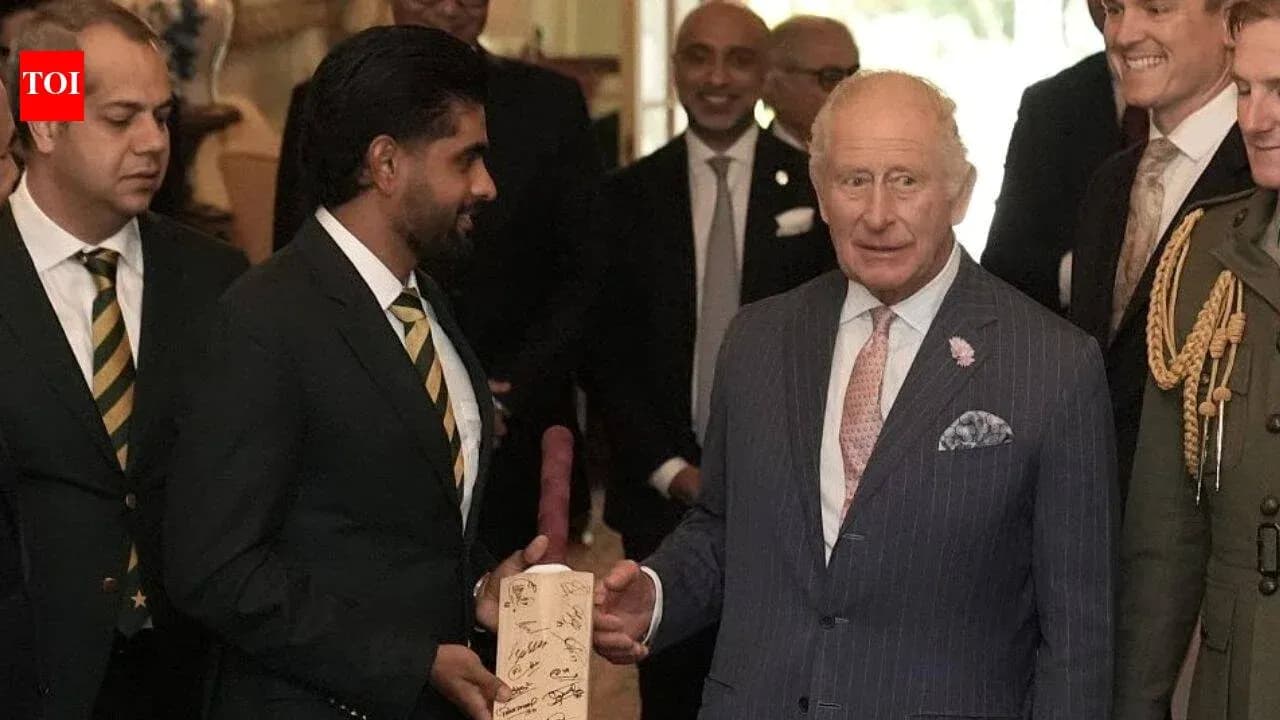
On a grey London afternoon, Pakistan’s embattled Test captain Babar Azam walked into Clarence House carrying a bat rather than a scorecard. At the other end of the room stood King Charles III, smiling as Babar presented him with a cricket bat signed by the entire Pakistan squad.
It was a moment of ceremony and soft power, a reminder of cricket’s shared history between the two countries. It also came in the middle of one of Pakistan’s most chastening tours of England in recent memory.
Royal courtesy, harsh reality
Babar, accompanied by his teammates and Pakistan Cricket Board (PCB) chairman Mohsin Naqvi, visited the royal residence on September 2. The gesture was polished and diplomatic: the captain of Pakistan handing the monarch of the United Kingdom a bat inked with every player’s signature.
Away from the cameras and the royal formality, the numbers from the field tell a far harsher story.
England have already sealed the three-Test series with a 2-0 lead. The margins are brutal. An innings and 103 runs in the first Test. A 194-run defeat in the second. Across four completed innings, Pakistan have not once reached 200. Not once.
For a team that has prided itself on resilience in foreign conditions, this has cut deep.
Turmoil in the touring party
The pressure finally told in the dressing room and the boardroom.
In response to the collapse on the field, the PCB has swung the axe. Seven players have been recalled from outside the original touring party, among them Mohammad Rizwan, Salman Ali Agha and injured opener Imam-ul-Haq. The churn has not stopped with the playing XI.
Head coach Sarfaraz Ahmed and bowling coach Umar Gul have both been removed before the final Test. Their departure underlines the sense of urgency, and perhaps panic, surrounding the campaign.
Into the void step white-ball coach Mike Hesson and bowling coach Ashley Noffke, hastily tasked with steadying a faltering red-ball operation. They will take charge for the third Test at Birmingham, starting September 9, trying to piece together a side that has looked technically short and mentally drained.
Captain under the microscope
At the centre of it all stands Babar.
His return as Test captain, already a talking point before the tour, now sits squarely under scrutiny. A finger injury kept him out of the first Test, and his comeback at Lord’s was supposed to bring authority and calm.
Instead, it only deepened the questions.
He managed scores of 8 and 6 at the Home of Cricket, as Pakistan folded for 110 in the first innings and 194 in pursuit of 389. The Lord’s defeat did not just extend England’s dominance; it stretched Babar’s own lean patch in the longest format.
He has now gone 18 Test innings without a half-century. Since the start of 2023, across nine Tests, his average has dipped below 21. For a batter once bracketed among the modern game’s elite across formats, those numbers are stark.
This is no passing blip anymore. It is a prolonged drought.
A symbolic bat, and a looming Test
So the image of Babar handing a signed bat to King Charles carries a certain irony. A beautifully presented piece of willow from a team that has barely laid a meaningful stroke on England’s bowlers.
Yet the visit also underscores the strange duality of elite sport: diplomatic duties and ceremonial engagements on one side, a crisis of form and identity on the other.
As Pakistan head to Birmingham, the royal pleasantries are over. The third Test offers no trophy, only a sliver of redemption. For Babar and his team, the question is blunt: can they turn a symbolic gesture into a statement on the field, or will this tour be remembered only for a photo at Clarence House and a series of crushing defeats?