Anshuman Hooda: From Engineer to DPL Star
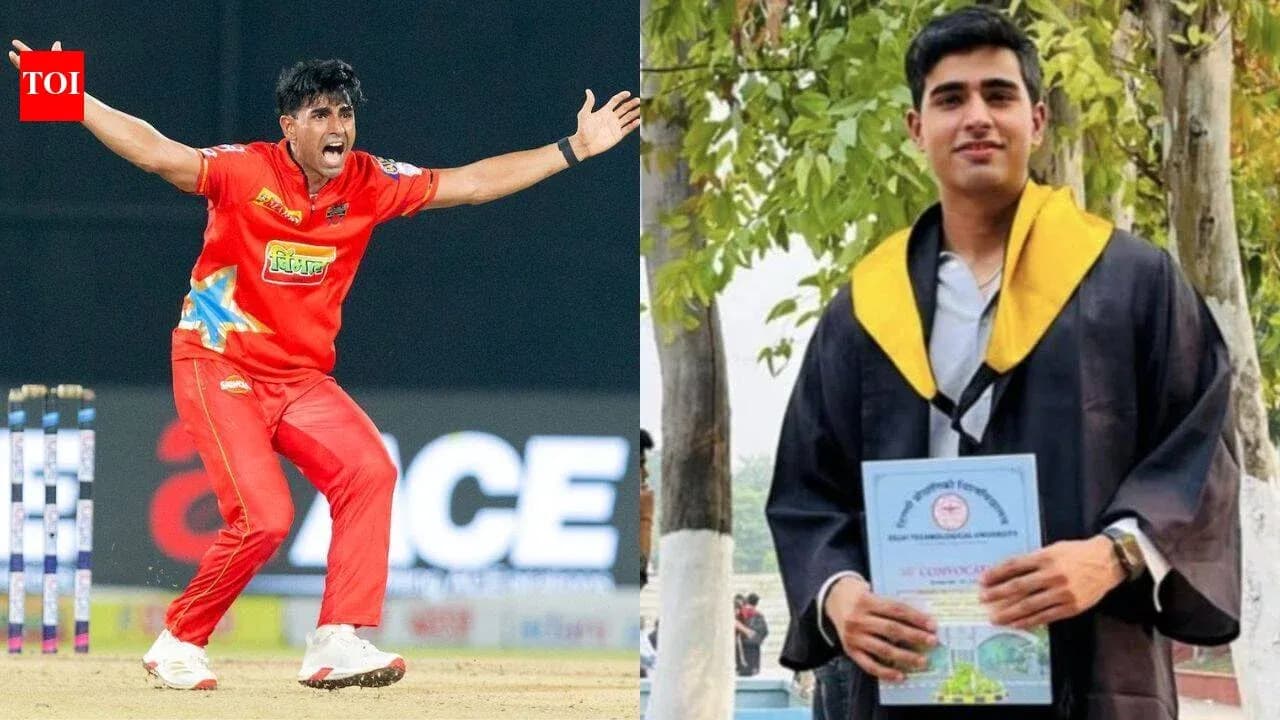
The question makes him laugh. Laptop or cricket ball?
“My cricket ball is my best friend,” says Anshuman Hooda, and the chuckle that follows tells its own story. The 25-year-old sits at the most delicate crossroads of his life, but his answer arrives without a flicker of doubt.
Only a year ago, that certainty did not exist.
From near-quit to Purple Cap
Hooda finished the third edition of the Delhi Premier League as its standout quick, the Purple Cap winner with 22 wickets, the spearhead of South Delhi Superstarz’ title run. He bowled with pace, menace and a growing sense of authority that turned matches and drew eyes from far beyond Delhi’s club circuit.
Yet this surge came from a player who, not long ago, was convinced the game had passed him by.
Two failed attempts at Delhi’s Under-23 trials. No junior cricket on his record. No age-group pedigree, no state caps, no neat ladder to the Ranji Trophy. Just an engineering degree from Delhi Technological University and a corporate offer from EY that promised stability and a clear path.
“I tried for Under-23 for two years, but I couldn’t make it,” he recalls. “I thought it would be very difficult because I hadn’t played any professional cricket or age-group cricket. It would have been very difficult to directly get selected for the Ranji Trophy or first-class cricket.”
The logical conclusion? Close the cricket chapter. Focus on the career that made sense on paper.
His family understood that logic. His elder brother, Vikram, had gone down the conventional route: science, engineering, a job. Their mother, Prem Lata Singh, a primary school teacher with the Municipal Corporation of Delhi, had long wanted the same security for Anshuman.
“Earlier, they used to say that he needed a job. Now that he has one and is doing well, she is happy,” Vikram says.
Happy, and yet, as it turns out, about to watch her younger son take the biggest gamble of his life.
The coach who refused to let go
Just when Hooda decided he would quit, one voice would not let him.
Harish Dagar, who runs the Delhi Cricket Hub academy in Paschim Vihar and also trains youngsters at DTU, had spotted him in 2019. He had seen the raw material before the player himself believed in it. When Hooda graduated in 2023 and prepared to bury himself in a corporate career, Dagar intervened.
“It was in 2023. He had just graduated. He had got the job through campus placement and was ready to move on with his life. I pleaded with him to give it one more year,” Dagar says. “I asked him to come to my academy four days a week for a year, and if nothing would pan out, I would let him pursue his corporate job.”
It was not a technical pitch. It was a challenge to his mindset.
“I worked on his mind 80-85 per cent. I made him mentally strong. I told him never to think that he was tired or burdened. Once I worked on his mindset and the roadmap was clear in front of him, he knew what he had to do.”
Hooda agreed. Four days a week. One more year. One last attempt.
The decision would change everything.
The skater who became a fast bowler
In cricketing terms, 25 is not ancient, but for a fast bowler just breaking through, it counts as late. Hooda’s route to the new ball was anything but conventional.
He did not grow up shadow-bowling in an academy or obsessing over outswing. He grew up on wheels.
As a youngster, he was a national-level roller skater. Cricket was there in the background, largely because of Vikram, but it did not define him. Like many younger siblings, he followed his brother into science and engineering almost by default. When it came to sport, though, his path veered off.
Only in college did cricket truly grab him.
“I just started playing in college, and that’s when I got into leather-ball cricket professionally, playing for the college team and all,” he says. “That’s when I fell in love with bowling fast, getting wickets and the aggression that comes with it. I just loved bowling fast.”
Dagar’s first impression of him was not of a finished product. It was of a frame and a rhythm that could be built upon.
“His body alignment was natural. His strength was natural, and his pace was natural. But he didn't have enough strength in his body initially,” the coach explains. “That's why I told him that if you don't maintain your fitness along with your natural pace, you will face problems.”
Hooda was juggling his studies then. Later, he would juggle a job.
“He was also busy with his job. He couldn't always take proper sessions. He would come at night, then have to go to the gym and take practice sessions. It was very hectic,” Dagar says.
The schedule was brutal. But the coach kept drilling the same message: don’t think of tiredness, think of the roadmap.
When the body learns to bowl fast
Fast bowling is not a gentle pursuit. Hooda knows this as well as anyone.
“Fast bowling is not a very comfortable activity for the body. You accelerate, then your whole body has to absorb the impact before you bowl. It definitely takes a toll on the body,” he says.
The toll arrived in the form of niggles and aches, the kind of pains that tempt late starters to step away before they’ve even arrived. Instead, Hooda doubled down.
“It was just the love for the sport and the love for bowling fast that kept me motivated and helped me come back stronger every time,” he says.
Dagar’s methods moved into more professional territory. Periodisation. Rest windows. Strength blocks. Workload management. Diet. Physiotherapy. Technical tweaks.
The target was clear: not just a bowler who could hit a high number on the speed gun, but a fast bowler who could repeat it, over after over.
Hooda worked on a stock ball he could trust under pressure. He added leg-cutters and off-cutters, variations that could live alongside his pace rather than dilute it. The coach watched his body closely, building him up to withstand the demands of long spells.
Meanwhile, his life outside cricket seemed to be settling into a conventional rhythm.
He graduated from DTU in 2023 with a degree in Production and Industrial Engineering and joined a multinational company through campus placement. The work-from-home setup allowed him to stretch his days: laptop hours, gym hours, net sessions. It was sustainable only because of his discipline and because his coach had mapped every week like a training blueprint.
Still, the question lingered. How long could he keep living two lives?
DPL: The door swings open
The answer began to emerge in the Delhi Premier League.
In 2024, South Delhi handed him a chance. Initially, it was modest: limited overs, few spells, a young quick still earning trust. Then came a burst of bowling that changed how people looked at him.
The following season, he went further. More overs. A five-wicket haul. A rhythm that refused to fade. By the third edition, he was no longer just a promising quick – he was the league’s most prolific wicket-taker, his 22 scalps driving South Delhi Superstarz to the title.
With the wickets came attention. IPL franchises began to take note, looking at him as a potential net bowler and trial option. For a player who had never worn an age-group Delhi cap, this was a dramatic shift.
The moment that truly hit home arrived off the field.
Shikhar Dhawan, owner of the South Delhi side and one of Indian cricket’s most recognisable faces, walked up to him after his performances.
“Shikhar Dhawan himself, the team owner, surprised me. He came and we had a little conversation. He gave me some very good tips and a direction to work towards from here,” Hooda says.
Dhawan later praised him on Instagram. For many young players, a social media nod is a nice bonus. For Hooda, it felt like a stamp of validation from the establishment he had always stood outside.
Chasing speed, guarding accuracy
At his best, Hooda is already clocking around 140 kmph. That number alone can alter a career, especially in a domestic scene always searching for genuine pace.
He wants more.
“Definitely, speed is what I want. If I can, I will definitely look to bowl even faster and build the strength and skills to do that, while making sure there is no compromise on accuracy and line,” he says.
That last line reveals the education of the past few years. Pace attracts selectors. Accuracy keeps a fast bowler in the XI.
His focus now stretches beyond white-ball bursts. He is already thinking in red-ball terms, about four-day and five-day cricket, about the grind that separates quicks who flash briefly from those who endure.
“These are the things we prepare for. Who bowls in a four-day or five-day game and bowls long spells with the same effort? That is what I am preparing for. If I get an opportunity, I will definitely do that.”
The ambition is laid out in a simple, ascending ladder: break into Delhi, then first-class cricket, then the IPL, then India.
“The eventual goal is to play and win matches for the country. That is my ultimate goal,” he says.
Job security vs the leap of faith
Away from the nets, another contest runs quietly in the background.
On one side stands the engineer: DTU graduate, employee at a respected multinational, recently promoted before the DPL season. A steady salary, a clear hierarchy, a predictable future.
On the other side stands the fast bowler: 140 kmph, 22 wickets in a season, praise from Shikhar Dhawan, whispers from IPL scouts, and a career that could soar – or vanish – in a matter of seasons.
“Currently, I have joined back,” he says of his job. “But as I have seen some substantial progress in my cricket in recent months and in this tournament, I might, in the coming times, shift my whole focus to cricket and give it my all.”
That is not a throwaway line. It comes from someone who once decided to walk away from the game entirely. From someone who has seen the inside of both worlds and knows exactly what he would be giving up.
His mother, who once worried mainly about him finding a job, now watches her son stand on the verge of turning his “best friend” – the cricket ball – into his full-time companion. His coach, who fought to keep him in the sport, now prepares him for a level where there will be no more half-measures.
The irony is hard to miss. The engineer who learned to balance competing demands may soon have to abandon balance altogether.
Hooda is clear about one thing.
“I will give it my all. Let’s see what happens ahead.”
The next spell he bowls may not just decide a match. It may decide which life he chooses.