Abhishek's Explosive 82 Runs Leads India to Victory Against Afghanistan
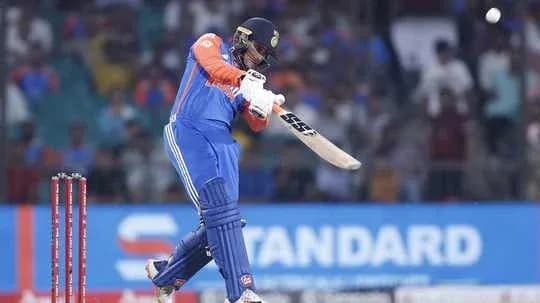
Abhishek walks out of a lean patch the way he knows best – by tearing up a bowling attack so completely that the contest feels like a formality.
India’s chase of 156 against Afghanistan in the T20I series opener was never going to be a mountain, not on a Delhi surface begging to be hit. But Abhishek turned a routine pursuit into a spectacle, a 32-ball demolition that left the visitors’ vaunted attack searching for answers that simply weren’t there.
The first scoring shot set the tone. Fazalhaq Farooqi pitched it up, Abhishek leaned out and lifted him inside-out over cover for six, a stroke that carried authority as much as it carried distance. It looked audacious. It was actually a statement.
Losing his opening partner early in the third over could have been a pause. It became a trigger. Azmatullah Omarzai walked in with the ball and immediately walked into trouble. Abhishek sent him soaring over long-off, then rocked back to drag a short ball through square leg. Two very different shots, one clear message: he was dictating terms.
The real damage, though, came when Farooqi returned. The left-armer’s fifth over vanished for 26. Abhishek strode forward to a slower short ball and muscled it over the on-side for six, then flattened a stroke to the off-side rope. The bowler kept changing pace; the batter kept changing angles. Only one of them looked in control.
Afghanistan’s pace unit had no sting, no surprise. Against a batter reading length this quickly, that’s fatal. By the time Ibrahim Zadran turned to spin, the horse had bolted.
Mohammad Nabi arrived to plug the flow. He left with his figures dented. Abhishek drilled him for back-to-back fours to close the Powerplay at a bruising 82 for 1. India had raced away; Abhishek had 41 off 15, exactly half the total, and he looked nowhere near done. Rashid Khan, Afghanistan’s trump card, got the same treatment first ball – another crisp inside-out boundary over cover, the kind of shot that usually belongs at the back end, not in the sixth over.
Only Noor Ahmad managed to briefly interrupt the carnage. A couple of sharp deliveries drew something you almost never see from Abhishek in this format: a textbook forward defence. A small nod of respect, a reminder that this was calculation, not slogging.
The fifty came quietly, a single tucked off Rashid to the leg side. The gears changed again immediately. Abhishek danced down to whip a six over midwicket, then carved another blow to deep cover to turn Afghanistan’s most experienced T20 bowler into just another name on the hit list. Fifteen off the over, and whatever plans they had for Rashid disintegrated with it.
There was nowhere left to hide. Noor, who had earned that fleeting defensive shot earlier, now joined the queue. A short ball disappeared over deep midwicket. The fuller one that followed sailed even higher, a towering 83-metre strike over deep extra cover that showcased the full arc of his hitting range. It was the kind of over that drains a fielding side of belief.
By the time the dust settled, Abhishek had bulldozed 82 runs with seven sixes and seven fours, and with them a couple of milestones. He became the second-fastest man to 6000 T20 runs and chalked up his 14th fifty in fewer than 25 balls – no one else has more than nine, not even Suryakumar Yadav.
The numbers tell one story. The method tells another.
This wasn’t reckless abandon. It was systematic dismantling. He targeted pace first, then spin, then circled back to anything that missed its mark by a fraction. Against seam, he plundered 28 off nine balls at a strike rate of 311.1. Against a spin attack that usually forms Afghanistan’s backbone, he hammered 54 off 23 at 234.78. Every over had a plan: pick the length early, move the feet decisively, and treat anything remotely loose with disdain.
Context makes the innings loom even larger.
Abhishek walked into this series carrying more questions than runs. His T20 World Cup at home had begun in nightmare fashion – three ducks in three innings – before he steadied himself in the second half of India’s title defence. The recovery, though, hadn’t fully stuck. Across his previous six T20I knocks, he had only two scores in double figures, with 16 his highest. In the ten T20Is of this World Cup cycle before this game, he had scraped together 191 runs.
Those numbers usually invite change, especially in a setup where options are a luxury, not a wish list. Sanju Samson’s experience lurked in the background. Vaibhav Sooryavanshi’s fearlessness added another layer of pressure at the top. Three of India’s most dangerous T20 openers were effectively fighting for two spots.
Yet the management kept the faith. They saw a ceiling others only guessed at. They backed the method, not just the highlights. On this night in Delhi, that faith looked less like a gamble and more like foresight.
From the balcony, Varun Chakaravarthy – who has worn the scars of Abhishek’s hitting in the domestic circuit – could only half-smile and half-winced for Afghanistan’s bowlers. “I have personally bowled against them, I know how hard it is. I feel for their spinners,” he said later, distilling in one line what 32 breathless balls had just proved.
Abhishek didn’t just find form. He reclaimed his identity – the fearless opener who doesn’t wait for the game to come to him, he seizes it and bends it to his tempo. If this is the version India get for the rest of the season, the debate about who opens may not last much longer.