Zverev Wins Second Grand Slam Title at U.S. Open
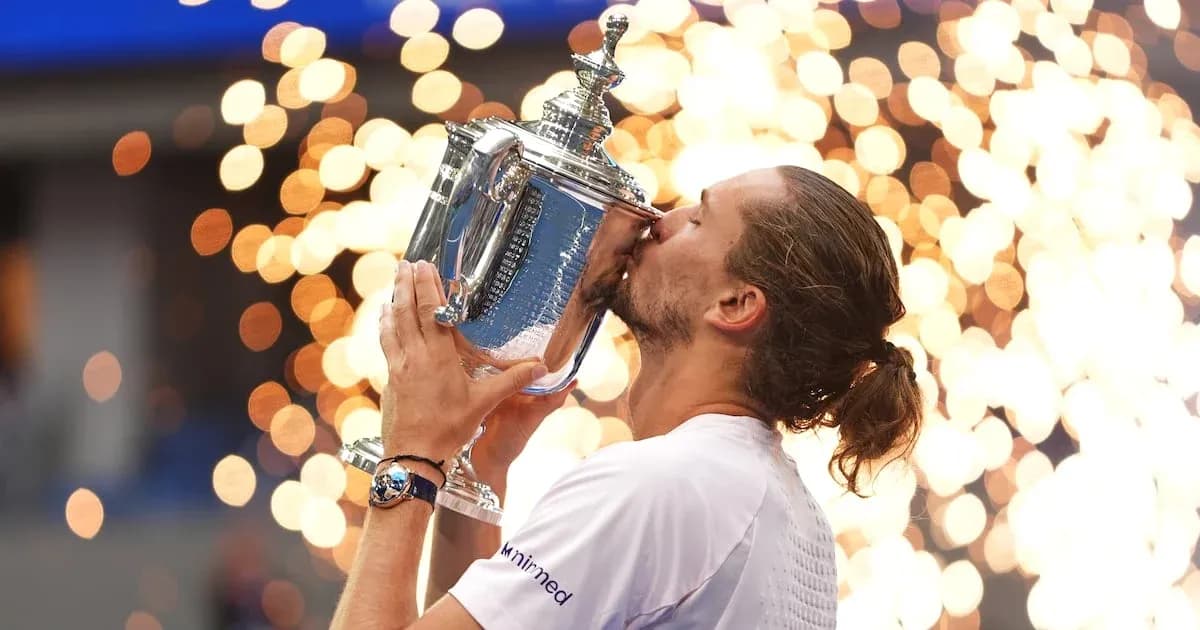
NEW YORK — The wait goes on for American men’s tennis. Alexander Zverev’s moment has finally arrived.
On a hot, heavy Sunday inside Arthur Ashe Stadium, the German walked into the most partisan atmosphere of his career and walked out with his second Grand Slam title, beating Ben Shelton 6-3, 7-6 (2), 5-7, 6-2 in the U.S. Open final.
He quieted a crowd that came to see history. He made some of his own instead.
Zverev closes the circle
For Zverev, this felt less like a breakthrough and more like a circle finally closing.
He lifted his first major trophy just months ago at Roland Garros. Now he has the one that got away. In 2020, on this same court, he led Dominic Thiem by two sets and came within two points of the title before collapsing, becoming the first man since 1949 to lose a U.S. Open final from that position.
Those ghosts were supposed to linger. On Sunday, they were nowhere to be seen.
Seeded No. 1 at a Slam for the first time, elevated to top billing when Jannik Sinner pulled out with a knee injury, Zverev carried the weight of expectation and the hostility of a crowd desperate for a home champion. He met both head on.
His tennis was measured, controlled, occasionally brutal. His resolve, unflinching.
Shelton’s stage, Zverev’s start
If the night began as Ben Shelton’s show, it turned into Zverev’s tutorial on how to handle a first major final.
Shelton’s entrance felt like a prizefight walkout. Fans rose to their feet, roaring as the 23-year-old American strode through the tunnel. The noise swelled, a pent-up, 21-year craving for a men’s champion since Andy Roddick’s 2003 triumph in the same arena.
Then the match began, and the air went out of the building.
Serving first, Shelton opened with two quick points lost. The tension showed in his shoulders, in the rushed motion of his arm. The game ended with a double-fault. One game in, Zverev had the break, and he never let it go.
Shelton’s serve, usually a thunderclap, betrayed him again to close the set — another double-fault, another gift. Zverev, steady and almost clinical, took the opener 6-3 without needing to dazzle. He simply refused to miss.
Silencing a restless stadium
Zverev did something else, too. He turned Ashe into a library.
His serving routine is deliberate, almost maddening. Ten bounces, sometimes twelve, occasionally closer to twenty. No rhythm for the opponent, no easy cue for the crowd. Just long pockets of enforced quiet.
Under tennis etiquette, fans must fall silent as a player prepares to serve and stay that way until the point ends. Zverev’s drawn-out ritual stretched those silences, dulling the crowd’s ability to ride the momentum and roar on their man.
They tried to break through. A few cheered his missed first serves, enough for the chair umpire to intervene. It didn’t rattle him. Zverev had said before the match he relished a hostile crowd. On this evidence, he meant it.
A ruthless tiebreak
The second set became Shelton’s chance to ignite the match. He settled on serve, began to land the heavy blows that had carried him past Carlos Alcaraz in that wild, 3:33 a.m. quarterfinal — the latest finish in U.S. Open history.
But when the set boiled down to a tiebreak, Zverev tightened the screws.
Shelton sent the first return long. Then Zverev threaded a gorgeous passing shot past him. Next came a 16-shot rally, Zverev probing, absorbing, then striking to go up 3-0. The American suddenly looked rushed again, forced to play on the German’s terms.
The serve did the rest. Zverev unloaded a 147 mph bomb, followed by another at 124 mph that Shelton couldn’t touch. Down 5-2, Shelton finally got a return in play, but Zverev won that point as well, then finished the breaker with a 139 mph missile.
Seven points played, seven statements made. Zverev led by two sets and had the match on a leash.
Shelton swings back
Shelton, though, is not built to go quietly.
This has been his tournament of defiance — the man who took out the defending champion, who refused to wilt in the deepest hours of the night against Alcaraz, who carried the hope of becoming the first Black man since Arthur Ashe in 1968 to win the U.S. Open men’s crown.
The third set finally gave the crowd what they came for. Shelton loosened his arm, started to step inside the baseline, started to hit through Zverev’s defenses. The rallies shortened. The forehand began to crack like a whip.
Zverev, so composed for two sets, blinked. Shelton pounced and dragged the match into a fourth with a 7-5 set that felt like a jolt of electricity through the stadium.
For a few minutes, the possibility hung in the air: another five-set epic, another chapter in Zverev’s complicated history with this court.
No repeat of 2020
This time, he slammed that door shut.
The fourth set belonged to Zverev from the first game. He reset, cut out the errors and went back to suffocating Shelton with depth and weight of shot. The American’s level dipped just enough — a few loose forehands, a couple of missed first serves — and Zverev pounced.
The No. 8 seed, who had never beaten Zverev in five previous meetings and had taken only one set off him, could not manufacture one last surge. The physical and emotional toll of the fortnight, the Alcaraz marathon, the burden of history, all seemed to land at once.
Zverev broke, then broke again. The rallies lost their edge. The crowd’s belief thinned with each German hold. At 6-2, it was over, Shelton’s dream delayed, Zverev’s redemption complete.
A new order, an old drought
Shelton leaves New York without the trophy but with something else: confirmation that his ceiling is as high as advertised. At 23, with a huge game and a taste for big stages, he will be back in this position.
Americans will cling to that. They have been waiting since Roddick, watching generation after generation fall short as the drought stretches past two decades.
Zverev, meanwhile, walks into a different conversation now. A French Open champion. A U.S. Open champion. A Wimbledon finalist. The man who once couldn’t close on the biggest stage now owns two of the sport’s four pillars.
He didn’t just outplay Shelton on Sunday. He outlasted his own past.
On a night built for an American coronation, it was the German who stood at the net, arms raised, while the stadium tried to make sense of what comes next.