Alexander Zverev's Grand Slam Win Sparks Time Rule Debate
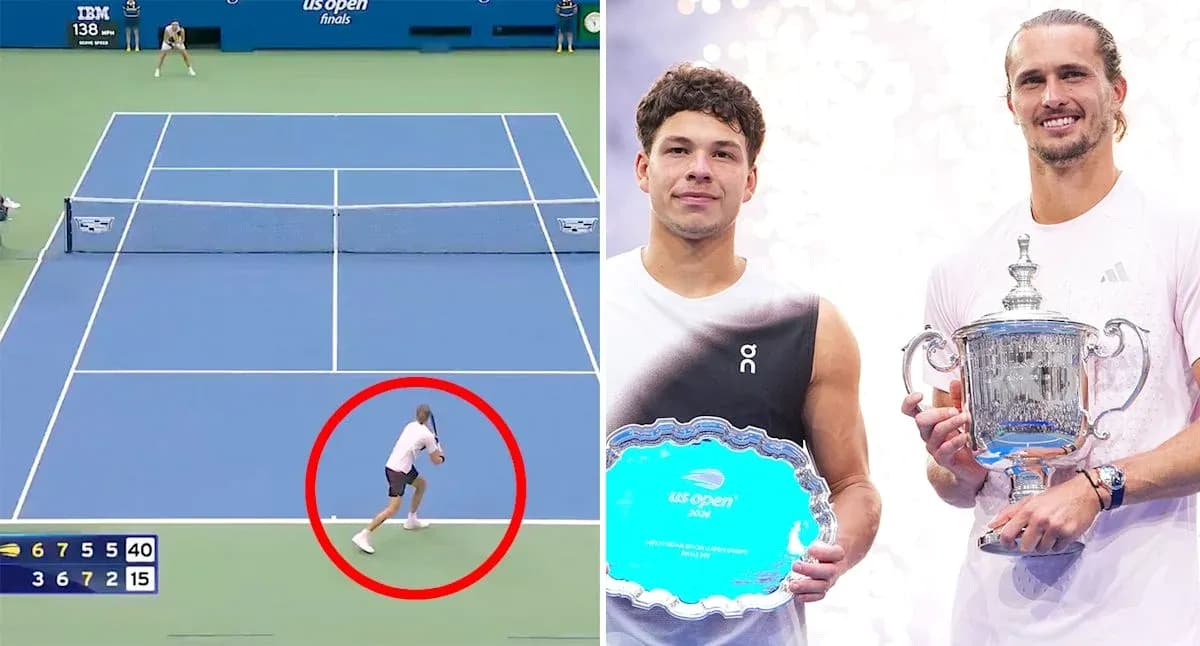
Alexander Zverev walked away with another grand slam trophy. He also walked straight into the centre of a rule-change storm.
The German claimed his second major in succession with a 6-3 7-6 (7-2) 5-7 6-2 win over Ben Shelton in the US Open final, but the tennis itself shared the stage with something far more mundane: time. Specifically, the time he took to serve.
Across the fortnight, Zverev’s ritual became a talking point. In the final, it became a flashpoint. Point after point, he stood on the baseline, bouncing the ball again and again, pushing the service clock to its limit and the crowd’s patience beyond it.
Under current rules, players have 25 seconds from the end of the previous point to start the next. Once the first serve is struck, the clock disappears. On second serves, there is no countdown, only the vague requirement to play “without delay” and the umpire’s judgment.
That loophole is where the frustration lives.
Shelton, who spent four sets watching Zverev stretch that grey area to breaking point, did not hide his feelings afterwards. The American, now a grand slam finalist and a rising voice in the locker room, called directly for a second-serve clock.
“For a first serve you should be able to do whatever you want and use the full 25 seconds every time,” he said in his press conference. Then came the push. “There should be some sort of rule limiting time on second serves. There shouldn't be unlimited time. It's tough to be sitting there for that long for the next action to happen.”
Shelton is not alone. The chorus is growing, and it includes some heavyweight names.
Andy Roddick, speaking on his “Served” podcast, had already laid out the case before the final even began. “The rules should change,” he said. “As long as he's doing it within the 25-second shot clock, yeah, what are you going to say? There needs to be a shot clock for the second serve.
“You cannot bounce the ball 20-something times between first and second serve. And then act shocked when we finish at 3 in the morning. Like, we just can't do it.”
Roddick’s point cut to the heart of the modern game’s time problem. Matches stretch deep into the night, players cling to their routines, and the sport tries to sell itself to a broader, younger audience that does not want to watch a man stare at the court and bounce a ball into oblivion.
The frustration was not confined to podcasts and press rooms. It spilled into the live broadcast of the final.
John McEnroe, on commentary duty for ESPN, locked onto another wrinkle: Zverev repeatedly tossing the ball up, aborting the motion, and starting again as the clock ticked down. McEnroe argued that if the toss goes up with only a couple of seconds left and the serve is abandoned, the player should pay for it.
“This should be over the serve clock. It was at two (seconds left) when he tossed it. Should be a fault,” McEnroe said, cutting through the noise with the bluntness that has defined his second career.
His brother Patrick McEnroe, also on the call, focused on the returner’s plight. When an opponent draws out the pre-serve routine to that extent, the receiver is trapped in a mental and physical limbo.
“As a returner, when a guy's doing this (bouncing the ball so many times) you should be able to step away, just before he serves,” he said. A small adjustment, but one that would at least give the returner some control back.
The umpires, meanwhile, found themselves stuck. Zverev did receive time violations during both the semi-final and the final, yet those came almost exclusively between points, where the 25-second rule is clear. Once the first serve missed, their options narrowed. Without a second-serve clock, “without delay” is a phrase begging for interpretation, and any strict enforcement risks looking arbitrary.
Players feel it too. Karen Khachanov, beaten by Zverev in the semi-finals, admitted the routine grates on his peers.
After their match, the Russian did not sugar-coat it. Zverev’s endless bouncing, he said, “annoys” not only him but others in the locker room. “It takes so much time,” Khachanov said. Yet he also acknowledged the reality: “At the end of the day, if it's within the rules with the time between points, I cannot say anything against that. If he extends the time, then he gets a time violation, so it's as simple as that.”
That is the crux of the debate. Zverev is pushing the limits, but he is largely doing it within a framework that allows – even invites – exploitation. He is not the first to stretch the clock. He will not be the last.
What has changed is the volume of the complaints and the profile of the voices making them. A current star in Shelton. A former US Open champion in Roddick. A Hall of Famer in McEnroe. All pointing at the same gap in the rulebook and asking the same question: how long is too long?
Tennis has modernised parts of its presentation – electronic line-calling, visible serve clocks, on-court coaching in some events – yet the second serve remains oddly unregulated in terms of time. The first-serve clock was meant to speed things up. Instead, it has exposed the blind spot that comes after a fault.
The US Open final showed the best and the worst of that reality. On one side of the net, a relentless Zverev, absorbing pressure and striking when it mattered. On the other, Shelton, trying to ride the emotional wave of his breakthrough run while waiting, and waiting, and waiting to see the next ball.
The sport now has a choice to make. Does it tighten the rules to match the modern rhythm it wants, or does it continue to leave second serves floating in a grey zone that invites controversy every time the stakes rise?