Alexander Zverev: From Next to Now as a Two-Time Grand Slam Champion
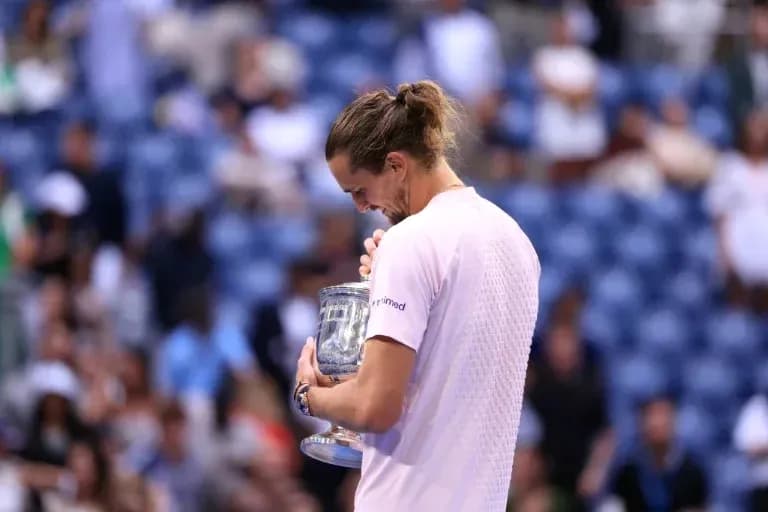
Alexander Zverev stood on Arthur Ashe Stadium on Sunday night not as the nearly man of his generation, but as a two-time Grand Slam champion whose floodgates have finally burst open.
Four months after lifting his first major at Roland Garros, the 29-year-old German claimed the US Open title, beating rising American Ben Shelton to cap a run of three straight Grand Slam finals and close the chapter on more than a decade of frustration, physical pain and off-court turbulence.
For a player long tagged as “next,” this felt emphatically like “now.”
From prodigy to proof
Zverev has lived with the weight of expectation for as long as he has held a racket. Born into a tennis family, with both parents competing at a high level in the former Soviet Union, he grew up with the sport as a second language. The 6-foot-6 right-hander seemed engineered for the modern game: huge serve, heavy groundstrokes, and a court presence that screamed inevitability.
"For me, my family is everything and I owe them a lot for helping me to become the tennis player that I am today," he has said. The line sounds simple, but for Zverev it underpins everything — from the grind of junior circuits to the lonely rehab rooms after surgery.
He idolized Roger Federer, but his own route to the summit has been far rougher around the edges.
Zverev has spent his career managing Type 1 diabetes, an invisible opponent that shadows every training session and match. Then came the very visible one: a gruesome ankle injury at Roland Garros in 2022, when he tore ligaments while trading blows with Rafael Nadal in a brutal semi-final. One moment he was pushing the king of clay to the brink; the next he was being wheeled off court, his season in pieces.
Surgery followed. So did doubts.
Scars from New York and Melbourne
New York has always carried a particular sting for Zverev. His first Grand Slam final came at the 2020 US Open, where he led Dominic Thiem by two sets to love and still lost in five. It was a collapse that branded him, fairly or not, as fragile when it mattered most.
"That was exactly the time when I had real struggles with my serve and my second serve," he later admitted. "I knew that my serve could break down at any moment. That's one difference that I do feel now, luckily for me."
That difference has been everything. The serve that once betrayed him now anchors his game. The player who once looked over his shoulder in big moments now leans into them.
Yet the scars didn’t stop with 2020. After returning from his ankle surgery in January 2023 and rebuilding his ranking, Zverev marched back into the business end of majors. He reached the French Open final in 2024, then finished runner-up at Wimbledon, only to suffer another Grand Slam heartbreak in January 2025, losing in straight sets to Jannik Sinner in the Australian Open final — his third defeat on the last Sunday of a major.
Every time he seemed ready to step through the door, someone slammed it in his face. Sinner and Carlos Alcaraz, the sport’s new twin forces, took control of men’s tennis, stringing together nine consecutive majors between them and pushing Zverev’s quest for a breakthrough further into the shadows.
The question hung over him: was this as far as he could go?
A career in extremes
Zverev’s journey has never been a simple tale of forehands and trophies. The highs have been towering: 20 career titles by mid-2023, a triumphant return in Hamburg after his injury, and the standout achievement before his Grand Slam run — Olympic gold in Tokyo in 2021, where he stunned Novak Djokovic and then swept past Karen Khachanov in the final.
Yet the lows have cut deep, on and off the court.
He has been forced to live and compete under the shadow of domestic violence allegations made by two former partners, Olga Sharypova and Brenda Patea, accusations he has consistently and strenuously denied. An ATP Tour investigation into one of the claims concluded there was insufficient evidence to impose sanctions.
The case involving Patea, the mother of his daughter, resulted in a penalty order and fine from a German court in 2023. Zverev appealed, and the two reached a settlement in June 2024 — just hours before he walked back onto Court Philippe-Chatrier for his French Open semi-final. It was an extraordinary collision of personal turmoil and professional stakes, the kind of off-court storm that would derail many careers.
"In the life of a professional athlete, you will have the highest highs and the lowest lows," Zverev has said. "Getting caught up in the lows is the biggest mistake that you can make. You shouldn't try to evaluate everything when times are tough, you should try to find ways to get better when you're on a high."
Those words read differently now, with two majors in his pocket and a ranking that has surged to world number two.
Belief, finally rewarded
The turning point came in Paris this year, where Zverev finally closed out a major final and lifted the French Open trophy. That win didn’t just end his own drought; it cut through the narrative that Sinner and Alcaraz had locked the door on their peers for good.
Once that barrier fell, his tennis loosened. The Wimbledon final brought another step, even in defeat. The US Open title confirmed it: this is no longer a story about potential, but about delivery.
He has always insisted he never stopped believing.
"I believed in it. I believed that it's possible," he told reporters in New York, before adding with a laugh: "I think not many of you guys did."
The line landed with a mix of relief and defiance. For years, Zverev’s career felt like a promise constantly delayed, a talent forever on the cusp. Now, with two majors in four months and three consecutive Slam finals behind him, the question shifts.
After a decade spent chasing the elite, is Alexander Zverev finally ready to define this era, rather than just survive in it?