Alexander Zverev Advances to Third Straight Grand Slam Final
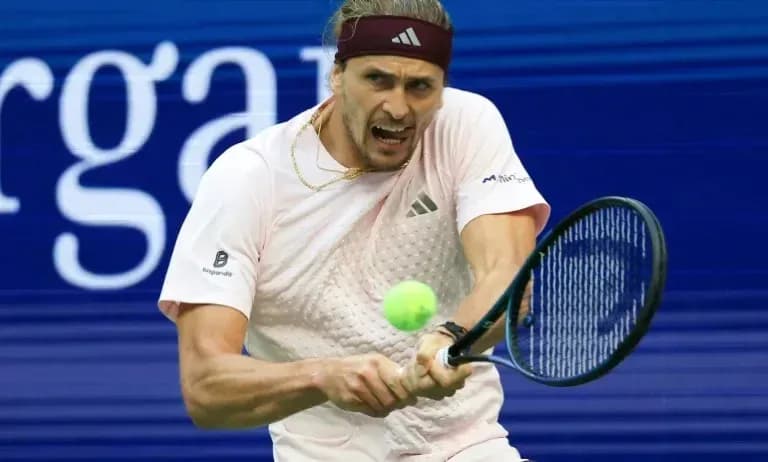
Alexander Zverev walked into Arthur Ashe Stadium on Friday night looking every inch the man who now expects to be here. By the time he walked off, he had booked a third straight Grand Slam final, dismissed Karen Khachanov in straight sets, and underlined that this version of Zverev is built for the long haul at the very top of the sport.
The scoreline – 6-3, 7-6 (9/7), 7-6 (8/6) – looks clean. The match was anything but.
Zverev grinds, then sharpens
The top seed arrived in New York with heavy legs and heavier questions. Nine hours and 26 minutes on court across two laborious five-set wins in the opening rounds had raised the old doubts about his stamina and nerve in the biggest moments.
Since then, he has played like a man insulted by the narrative.
Against Khachanov, he needed two hours and 57 minutes, not to escape, but to control. He absorbed the Russian’s power, managed the scoreboard, and, when the margins shrank to a few points in back-to-back tiebreaks, he was the one who held his nerve.
“Straight-set win, but anything but straightforward in a way,” Zverev admitted. “He played incredibly well, fought incredibly well.”
The assessment was accurate. The edge belonged to Zverev only in the moments that mattered most.
Khachanov swings back
The opening set offered little encouragement for Khachanov. He couldn’t make a dent on Zverev’s serve, couldn’t find any real foothold in the rallies, and slipped behind 6-3 with a sense of inevitability.
Then the match changed.
Early in the second set, Zverev grabbed a quick break and looked ready to pull away. Khachanov refused to follow the script. When he threaded a passing shot past Zverev to open the fourth game, he allowed himself a grin. Three points later, a forehand winner gave him his first break point of the night. Zverev blinked, double-faulting to hand it back.
The Russian, ranked 50 in the world and chasing a place in history as the lowest-ranked Grand Slam finalist since Marcos Baghdatis in 2006, started swinging with freedom. The rallies lengthened. The crowd leaned in. The tension thickened.
They collided in a fierce tiebreak.
Zverev earned two set points. Khachanov erased both, first with a thumping forehand, then with a backhand down the line that ripped through the court. Just when the momentum seemed to tilt towards the underdog, Zverev tightened his game, found his first serve, and edged the breaker 9/7.
That was the pattern of the night: Khachanov threatening to rip the match open, Zverev quietly closing the door.
Knife-edge finish
The third set turned into a stalemate. No breaks. No real chances. Just two big men trading blows, each testing the other’s patience and resolve.
Again, the tiebreak became the crucible.
This time Khachanov surged to a 6-4 lead. Two set points. A lifeline. Maybe more.
He couldn’t take either.
Both slipped away on forehand errors, the kind that linger in the mind long after the handshake. Zverev, sensing the opening, landed his 15th ace to bring up match point, then watched as one final Khachanov forehand sailed long.
“Second and third set I think it’s more than obvious that they could have gone both ways,” Zverev said. “I just played a few points better here and there, and I'm happy with the win.”
That was the story: a semifinal decided in the narrow space between courage and control, where Zverev, once so fragile in these moments, now looks hardened.
A different Zverev, same New York mission
Four years ago, Zverev stood one set from the US Open title, only to see Dominic Thiem drag him into a five-set epic and tear the trophy from his grasp. That scar still lives here.
This time, he returns to the final as a Grand Slam champion, with a French Open title in his pocket and a Wimbledon runner-up finish still fresh. The progression is clear. The belief is louder.
Waiting for him on Sunday will be an American – either Ben Shelton or Frances Tiafoe – and an entire nation’s longing. No American man has lifted a Grand Slam singles trophy since Andy Roddick in 2003. Twenty-three years. An era, not a gap.
Shelton has already lit up this fortnight, toppling defending champion and seven-time major winner Carlos Alcaraz in a wild, five-set quarter-final that finished at 3:34 am, the latest end in US Open history. He is chasing his first major final. So is Tiafoe, a showman with scars of his own and a clear sense of what this moment would mean.
Shelton leads their head-to-head, and their rivalry at Flushing Meadows is already a little thread in the tournament’s recent history: Shelton winning their 2023 quarter-final, Tiafoe flipping the script in the third round a year later.
Zverev knows exactly what he’s walking into on Sunday: the noise, the flags, the storylines.
“Hopefully I can not make the American dream come true on Sunday,” he said, half-smiling, fully serious.
A night with weight beyond tennis
Before the tennis, the stadium paused.
On the 25th anniversary of the September 11 attacks that brought down the twin towers of the World Trade Center, national anthem ceremonies in both the day and night sessions carried a somber, reflective tone. For all the noise that would follow, there was a stillness first, a reminder of the city’s history and the tournament’s place within it.
From that silence, the sport roared back to life.
On Saturday, Elena Rybakina will try to deny Aryna Sabalenka a third straight US Open crown, just days after the Kazakh’s run to the semi-finals ended the Belarusian’s near two-year reign as world number one.
On Sunday, Alexander Zverev will walk into another Grand Slam final, again carrying the weight of his own past and the expectations of a sport that has watched him grow up in front of it.
Across the net, an American will carry a nation’s drought and a generation’s hope.
One of those stories has to break.