Wild Morning for Aussies at Flushing Meadows: Rain and Upsets
For the third straight day, the weather has muscled its way into the story.
Rain again rolled over Flushing Meadows, pushing back the morning schedule by a couple of hours and leaving players, officials and fans in that familiar New York limbo. Showers swept across the grounds, light but persistent, the kind that tease you into thinking play might continue before the radar delivers the bad news.
At first, players were told to stay put. Then, almost mid-thought, came the instruction no one wanted: pack up. The outside courts emptied. Like Melbourne, the two main arenas are covered, so the show goes on under the roofs, but beyond those, the day suddenly looked very long.
Kasatkina blitzed as Badosa storms through opener
The timing of the interruption could not have been more awkward for Daria Kasatkina.
She had finally started to find some rhythm in the second set, only to see momentum sliced apart by the weather. Earlier, she had been swept aside. Quick as a flash, the first set was gone.
Paula Badosa broke to love for 3-1 and never looked back, dictating from the baseline and turning rallies into one-way traffic. On commentary for Nine, Jelena Dokic highlighted exactly what was happening: Badosa came out swinging at the start of points, while Kasatkina needed to “weather the storm” and drag exchanges into longer patterns where her variety could bite.
She never got there. Errors arrived before the rallies could properly develop, and with Badosa striking cleanly, the set vanished in just 23 minutes. Brutal. Clinical. Over in a blink.
Schoolkate serves up a statement win
Elsewhere, an Australian morning that began under grey skies quickly brightened.
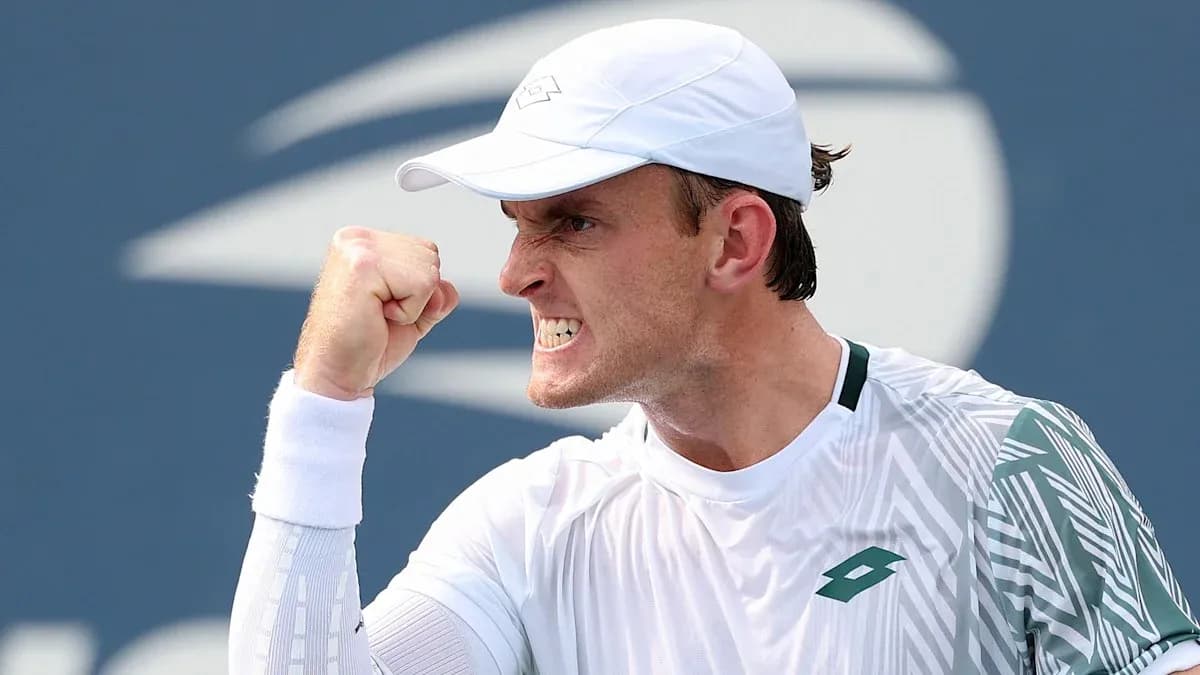
Tristan Schoolkate powered into the second round with a four-set win over American Nishesh Basavareddy, 7-6 (4), 3-6, 6-3, 6-4. It was the serve that carried him. Again and again.
Schoolkate finished with 25 aces and an imposing 82 per cent first-serve percentage, a platform that allowed him to ride out the inevitable swings in baseline exchanges. By the final point, the margins were razor-thin: 121 points won to Basavareddy’s 119. The scoreboard reads solid; the numbers underneath say knife-edge.
For his efforts, Schoolkate also banks a significant payday. The cheque for reaching the second round sits just under $266,000. For a player still carving out his place on tour, that kind of money can change a season.
Sweeny’s strange, emotional passage
If Schoolkate’s path was straightforward, Dane Sweeny’s was anything but.
He advanced when Corentin Moutet retired, moments after Sweeny had surged to a 3-0 lead in the third set. The Frenchman walked to the net, offered his hand, and then buried his face in his towel on the sideline.
The exact cause of the retirement was not immediately clear, though Moutet had heavy strapping on his forearm and looked increasingly uncomfortable. There appeared to be a discussion with the chair umpire, with suggestions he might have requested a physio earlier and been denied, but the details remained murky.
What was clear: this had the makings of a major upset.
Sweeny, ranked outside the top 100, stood across from a player who, as recently as June, sat at No.30 in the world and still sits in the 60s. On paper, Moutet is the superior name. On court, Sweeny refused to read the script.
He took the first two sets 7-6 (4), 6-4, in a match far tighter than the set count suggests. Moutet fired five aces to Sweeny’s one, but his first serve misfired too often, opening the door for the Australian to pounce. Sweeny broke serve four times to Moutet’s three, and the total points told the story of a battle, not a blowout: 92-83 in Sweeny’s favour when the Frenchman stopped.
There was even a moment that summed up Sweeny’s day. Mid-rally in the second set, he slipped, lost his footing, and still had the presence and touch to feather a drop shot winner. The crowd loved it. More importantly, Sweeny believed.
Basavareddy pushes, but Schoolkate stands firm
While Sweeny wrestled with Moutet and the drama around him, Schoolkate’s match against Basavareddy unfolded on a different court but with a similar thread: an Australian holding his nerve at key moments.
At one stage, Schoolkate led 7-6 (4), 3-6, 6-3, with the American snatching the opening game of the fourth set to keep the contest alive. The serve remained Schoolkate’s weapon of choice. He had already launched 18 aces and was landing 83 per cent of his first serves.
Yet even there, the numbers carried a twist. Despite the scoreboard advantage, Schoolkate had actually won fewer total points at that point, 97 to Basavareddy’s 93. The American hung around, pressed where he could, but whenever the pressure peaked, Schoolkate’s delivery bailed him out.
On a day of delays and interruptions, that kind of reliability was gold.
Heartbreak for Kokkinakis
Not every Australian story on the day carried a smile.
Fan favourite Thanasi Kokkinakis withdrew only hours before his scheduled first-round match, another cruel blow in a career littered with them. The 30-year-old has been battling an ankle injury, the latest addition to a long list of physical setbacks.
At the Australian Open earlier this year it was his shoulder that kept him out. This time, it was the ankle that forced him to step aside, scratching him from a much-anticipated clash with rising star Rafael Jodar.
For the tournament, it was a disappointment. For Kokkinakis, it was something harsher: another reminder that his greatest opponent remains his own body.
On a rain-soaked morning in New York, Australia still found reasons to cheer. But as the clouds rolled back over Flushing Meadows, the day felt like a snapshot of the sport itself: opportunity for some, frustration for others, and the sense that, at any moment, everything can turn on a single point, a single step, or a single scan of the radar.