Venus Williams' Late Night Farewell at US Open
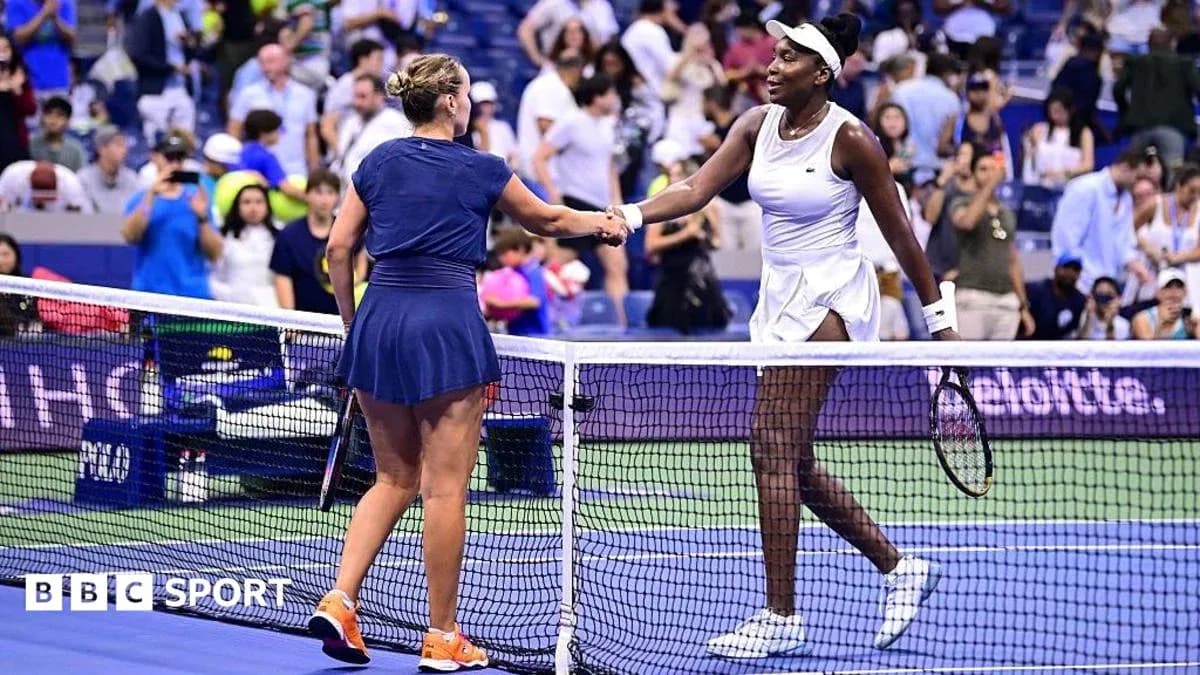
The lights were still blazing on Arthur Ashe Stadium when Venus Williams finally walked out for what had been billed as a primetime farewell. The problem? Primetime had come and gone.
Her first-round match against fellow American Sofia Kenin, originally slated for Sunday night, did not begin until just after midnight on Monday. By the time Kenin closed out a straight-sets win, the clock had slipped past 2am in New York and the vast bowl of Ashe, built for 23,933 people, was dotted with empty seats.
For Williams, 46 years old and on a 15-match losing streak in singles, the occasion was supposed to be about one more big night in front of a home crowd. Instead, it turned into another exhibit in tennis’ most stubborn problem: late-night marathons that suit broadcasters and balance sheets far more than they suit players’ bodies.
“It wasn't ideal,” she said afterwards, adding that the timing “wasn't great” for either player’s conditioning. She is far from alone.
The business of the night session
Three of the four Grand Slams – the Australian Open, Roland Garros and the US Open – are built around split schedules. Day session. Night session. Two products, two ticketed windows, two bites at the commercial cherry.
At the US Open, organisers pick one men’s and one women’s match to start at 7pm on Ashe, long after the daytime programme has begun. The logic is brutally straightforward: the same seat can be sold twice. Once for the day, once for the night. Night tickets are usually pricier. Fans can come after work, and they are promised star names under the lights.
The real engine, though, is television.
ESPN, which holds the domestic rights, agreed in 2024 to pay $2.04bn to show every match at the US Open until 2037 – around $170m a year. Primetime sport allows the network to charge premium rates for advertising slots, and in the US, those lucrative hours run late. Many of the country’s flagship late-night shows do not even start until around 11pm.
A guaranteed evening showpiece, often stretching deep into the night, fits neatly into that model. It also locks the tournament into a delicate trade-off: more money on one side, more strain on players on the other.
Wimbledon stands as the outlier. Play there starts at 11am and stops at 11pm, full stop. If a match is not finished, it resumes the next day. Those rules occasionally frustrate players and fans when a contest is halted on the brink of a conclusion, but everyone knows where they stand. Spectators can rely on public transport. Players can plan recovery and routines. And because the BBC is not dependent on advertising revenue in the same way, the tournament does not face the same commercial pressure to engineer late-night epics.
When the clock takes over
The US Open, by contrast, lives with uncertainty. Tournament director Stacey Allaster said in 2023 that late matches had been “heavily discussed and reviewed” after the 2022 event, but the basic structure stayed intact.
Organisers considered starting the evening session at 6pm instead of 7pm. Allaster said that was “not really a possibility” because it was already hard for New Yorkers to arrive by 7pm. They also weighed cutting the night slate to a single match, but decided that would short-change fans who had paid for a two-match ticket.
Tennis, Allaster pointed out, has no fixed running time. A match can be over in 70 minutes or stretch beyond five hours. Once you stack two matches back-to-back at night, you are gambling with the clock.
Everyone knows what can happen. A five-set men’s match can easily run past four hours. A three-set women’s match can go beyond three. Add in the warm-ups, walk-ons and changeovers, and the second match on the bill can drift well past midnight before it even starts.
That is exactly what happened to Williams and Kenin. Novak Djokovic’s five-set loss to Mariano Navone ran for more than four hours, pushing the start of the women’s match into the small hours. By the time Kenin wrapped up the win, the famous New York roar had faded to a murmur from a sparse, stubborn core of fans.
The spectacle that had been packaged and sold as a blockbuster under the lights ended up as a half-empty, half-asleep sideshow.
A wider battle over power and pay
These late finishes are not just a scheduling quirk. They sit at the heart of a broader, increasingly tense dispute between players and the Grand Slam tournaments.
Players have pressed for a greater share of the revenue that the majors generate, using issues such as late-night start times, limited recovery windows, expanded media obligations and pension contributions as leverage. The message has been consistent: if organisers are going to squeeze every last drop out of the product, the people on court want a bigger slice – and a bigger say.
At Roland Garros and Wimbledon, high-profile names including Coco Gauff, Aryna Sabalenka and Jannik Sinner scaled back their media duties in protest at what many see as unfair conditions. The pushback helped force movement. Wimbledon and the US Open have agreed to increase prize money from 2026, and the four majors are setting up a Grand Slam players advisory council, due to launch after this US Open, to give players more influence over how the events are run.
Whether that new body will go after late-night finishes remains to be seen. The dislike among players is obvious. The solution is not.
If the Slams roll back night sessions or shorten them to avoid 2am finishes, broadcasters may not be willing to pay as much. With less money coming in, prize funds could shrink, and the same players who are asking for better conditions might find their earnings squeezed.
For now, the sport sits in a stalemate. The accountants can point to sold-out sessions and billion-dollar TV deals. The players can point to taped ankles, cramped recovery windows and empty seats at 2am.
On Arthur Ashe, Venus Williams walked off into the night with another defeat, her body and legacy once again bent to the demands of the modern Grand Slam machine. The question is no longer whether this is fair. It is how long tennis is prepared to let the clock dictate the cost.