US Open Quarterfinals: High Stakes and Big Names
The US Open is hitting its decisive stretch in New York, and today the quarterfinals take over the Billie Jean King National Tennis Center. Big names, high stakes, and a packed day session and night session are set to shape the final week of the tournament.
On court, the script is simple: win now, or go home.
Quarterfinals take center stage
Play begins at 11:30 a.m. ET, and the day session wastes no time.
Aryna Sabalenka, the top seed in the women’s draw, opens her quarterfinal campaign against Linda Noskova at 11:30 a.m. ET. Sabalenka arrives as one of the tournament’s headline acts, hunting another major title, but Noskova has made a habit of tearing up seedings and reputations. It’s the classic Grand Slam crossroads: established power against fearless ambition.
At the same time, the American charge continues on the men’s side. Frances Tiafoe, a crowd favorite in Queens, faces compatriot Alex Michelsen at 11:30 a.m. ET in a clash that pits Tiafoe’s flair and experience against Michelsen’s rising-star momentum. For the home crowd, it’s a no-lose matchup. For the players, it’s a brutal, winner-takes-all scenario.
When the lights come up in the evening, the stakes only rise.
At 7 p.m. ET, Jessica Pegula, seeded third and carrying the weight of American expectation, steps into a primetime showdown with Emma Navarro. Pegula has become a model of consistency deep in majors; Navarro is pushing hard to join that tier. One will leave with another statement win. The other will leave wondering how close she came.
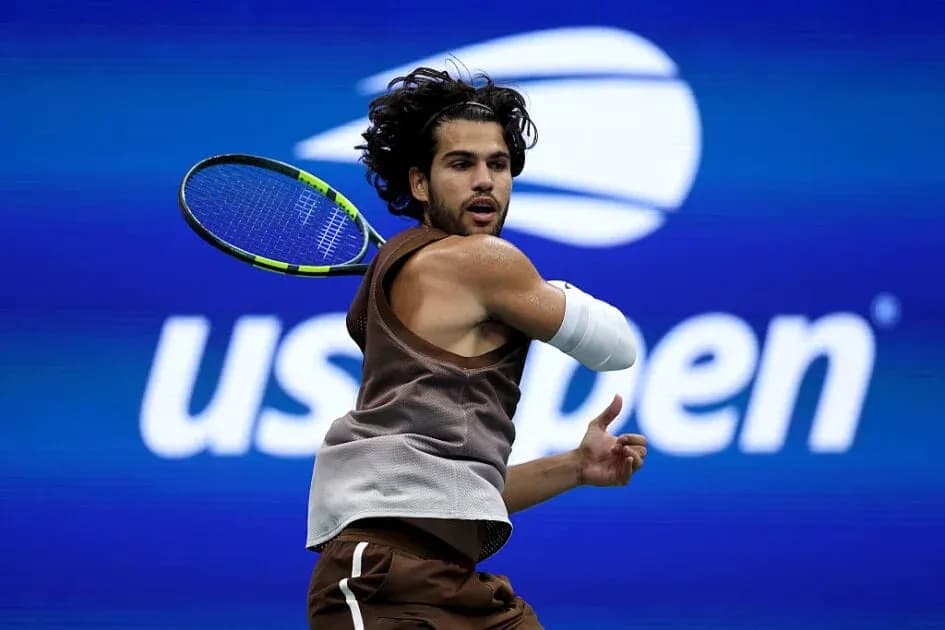
Also at 7 p.m. ET, Ben Shelton meets Carlos Alcaraz in a men’s quarterfinal that promises raw power against relentless brilliance. Shelton’s serve can blow open any match in a handful of games. Alcaraz, the second seed and one of the sport’s defining forces, brings the full arsenal: speed, touch, and the ability to turn defense into attack in a heartbeat.
Beyond singles, the grounds will be busy with men’s and women’s doubles, plus mixed doubles and qualifying action. It’s one of those days at Flushing Meadows when every court tells a story.
Where to watch in the US
For viewers in the United States, ESPN remains the home of the US Open. The network holds exclusive rights, with coverage spread across ESPN, ESPN2, the ESPN app, and select matches airing on ABC. Checking the official schedule is essential, as marquee matches can move between channels.
Cord-cutters still have plenty of ways to follow every point:
- DirecTV: The base package starts at $59.99 for the first month and includes ABC and ESPN+.
- ESPN Unlimited: Offers live sports and archived ESPN programming from $29.99 per month.
- Fubo: Its Sports plan, at $65.99 per month, carries ABC, ESPN, and ESPN2, with a quarterly billing option also available.
- Sling: The Essentials plan includes ESPN and ESPN2 for $19.99 per month. For a short burst of tennis, a Sling TV Day Pass at $4.99 can cover a single day’s action.
- YouTube TV: The Sports Plan includes ABC, ESPN, and ESPN2 at $64.99 per month.
Each of these services brings the full US Open experience without a traditional cable subscription, as long as the right package is in place.
How to watch for free
For those trying to avoid a long-term commitment, free trials are the key.
DirecTV, FuboTV, and YouTube TV all offer trial periods that, if timed right, can cover a crucial stretch of the tournament. Sign up, stream the tennis, and decide later whether to keep the service.
Outside the US, the options look very different. In Australia, 9Now will stream the 2026 US Open for free. That’s a powerful draw for viewers around the world who are willing to use a virtual private network (VPN) to access geo-restricted content.
A VPN can route your connection through another country, unlocking broadcasts that would otherwise be blocked. ExpressVPN, for example, is widely used for location spoofing and has servers across multiple regions, including Australia.
To watch via 9Now using a VPN:
- Subscribe to a streaming-friendly VPN such as ExpressVPN.
- Download the VPN app on your device.
- Connect to a server located in Australia.
- Go to 9Now and start streaming.
Most premium VPNs are paid services, but many offer free trials for first-time users. Used smartly, that can turn the US Open into a free watch.
One final viewing tip: enabling your TV’s motion-smoothing option can make fast-paced tennis appear smoother and easier to track. Just remember to switch it off afterward, or your movies and series will inherit that unwanted “soap opera” look.
A three-week New York tennis marathon
The 2026 US Open stretches across three intense weeks in late August and early September, all staged at the USTA Billie Jean King National Tennis Center in Queens, New York. This year’s tournament runs from Sunday, August 23, to Sunday, September 13.
The schedule is layered and relentless:
- Qualifying events: August 24–27
- Men’s and women’s singles main draw: August 30–September 13
- Mixed doubles: August 24–26
- Men’s and women’s doubles: September 3–12
- Junior events: September 3–12
- Wheelchair events: September 8–12
The closing weekend is loaded with finals. The Women’s Doubles Final lands on Friday, September 11. Saturday, September 12, brings the Women’s Singles Final and the Men’s Doubles Final. On Sunday, September 13, the Men’s Singles Final closes the curtain on the tournament.
First contested in 1881, the US Open stands as the second-oldest Grand Slam event, trailing only Wimbledon. History hangs over every court, but the tournament’s energy remains distinctly modern: night sessions, roaring crowds, and a city that never really switches off.
Who’s in the hunt in 2026?
This year’s field is stacked with pedigree. Seventeen former Grand Slam singles champions are in the draw, 10 of them past US Open winners. Experience is everywhere, and so are storylines.
On the men’s side, the landscape shifted before a ball was struck. Jannik Sinner has been ruled out through injury, removing one of the leading contenders and reshaping the top of the draw. That absence pushes Alexander Zverev into the No. 1 seed role, with Carlos Alcaraz at No. 2, both now carrying the burden of expectation.
In the women’s draw, Aryna Sabalenka leads the field as the top seed, backed up by Elena Rybakina at No. 2 and American Jessica Pegula at No. 3. Between them, they bring power, precision, and contrasting styles that could define the latter stages of the tournament.
The United States has a particularly strong presence this year, with 28 players in the main draw, more than any other nation. Beyond Pegula, the home hopes rest on a core of rising and established names: Emma Navarro, Coco Gauff, Frances Tiafoe, Alex Michelsen, and Ben Shelton all remain alive in the singles competitions.
Some will ride the New York crowd. Some will try to block it out. All of them know what’s at stake.
The quarterfinals begin to separate contenders from pretenders. By the end of this week, the draw will be stripped down to a handful of names, each one a step from history. Who will still be standing when the lights go down on that final Sunday in Queens?