Stan Wawrinka’s US Open Farewell: A Champion’s Last Roar
Stan Wawrinka walked off Grandstand for the final time at a major with his eyes shining and his heart on his sleeve. The scoreboard said straight-sets defeat to Matteo Berrettini. The noise said something very different.
At 41, the three-time Grand Slam champion is playing out the last weeks of his career. On this New York evening, the US Open gave him the kind of goodbye that belongs to a player who never did anything by halves.
He very nearly stretched the story out a little longer.
Wawrinka held set points in each of the opening two sets against the 2021 Wimbledon finalist. One chance in the first. Three more in the second. Each time, Berrettini held his nerve, saved the danger, then tightened the screw. By the third set, the Italian was in full flow, punishing every short ball and sprinting away with the match.
The result, though, felt secondary. This night was about the man on the other side of the net.
A wildcard, a dash across the Atlantic, and a full house
Remarkably, Wawrinka almost wasn’t here. Tournament organisers initially overlooked him for a wildcard, a decision that jarred with his status as the 2016 champion and one of the defining figures of his era.
Only when American Patrick Kypson withdrew did the door open. Wawrinka got the call on Wednesday — back home in the Swiss mountains, having already left New York two days earlier. Retirement was looming, but so was a chance to say goodbye properly.
He didn’t hesitate. Travel plans were ripped up, a return flight booked, and the veteran was soon back across the Atlantic, chasing one last night under the lights at Flushing Meadows.
The response justified every bit of the scramble. Grandstand, with its 8,000 seats, filled early. Fans queued long before first ball, knowing this might be the final time they saw that trademark one-handed backhand at a Slam. They came not just for nostalgia, but to salute a player who built a career on stubborn resistance and spectacular shot-making.
A contest, then a curtain call
On court, Wawrinka did what he has always done: he fought. He went after his shots, took on the lines, and refused to let Berrettini settle. The chances were there. They just slipped away.
Once the last point was done and the handshake completed, the evening shifted. Berrettini stepped back and led the applause, acknowledging the man who had spent two decades punching holes in tennis’ established order.
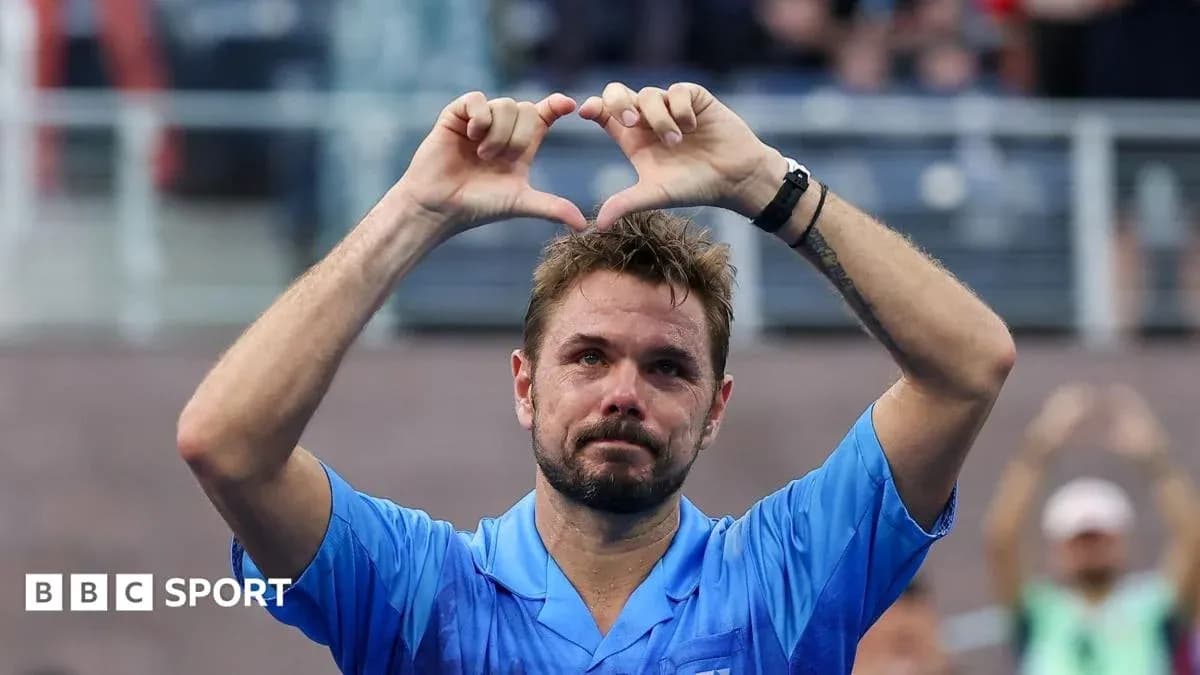
The crowd rose as one. Wawrinka responded in kind, tracing heart shapes with his fingers, then pressing his hand to his chest. The roar only grew louder. He urged them on, waving his arms, soaking in the sound, then sent balls arcing into the stands as souvenirs of a career that always felt a little bit raw, a little bit real.
From the side of the court, chief executive Craig Tiley presented him with a photo montage of his 2016 US Open triumph, a visual reminder of the night he broke Novak Djokovic’s resistance and claimed the title in Arthur Ashe Stadium.
“One of the reasons I played until 41 was to live these moments,” Wawrinka told the crowd, thanking them for the years of backing and the late wildcard that allowed him to close the circle in New York, exactly a decade after his Grand Slam breakthrough here.
The legacy of a fighter
Wawrinka’s résumé is clear enough: Australian Open 2014, Roland Garros 2015, US Open 2016. A former world number three. A backhand that coaches still slow down on video to show young players what a clean strike looks like.
But it was his attitude that defined him. He spoke afterwards of feeling “super grateful” for the farewell and for what the reaction in the stands told him about the way he went about his work — always turning up, always pushing, always willing to go to the edge physically and emotionally.
“It’s showed me that I did the right thing all those 20 years by always trying to fight, always showing up, always trying to do my best, and always trying to push myself to the limits,” he said. “This is what for me was the most important thing – what I get from the fans when I play.”
On Grandstand, those fans answered him with one last ovation. Not for perfection, not for an easy genius, but for a career built on defiance and grit.
The wins are already written into the history books. The image that will linger from this US Open is different: a 41-year-old champion, heart in his hand, walking slowly away from the court that helped make his name, leaving behind a noise that said everything about what he gave the sport.