Siniakova and Townsend Win US Open Women's Doubles Title
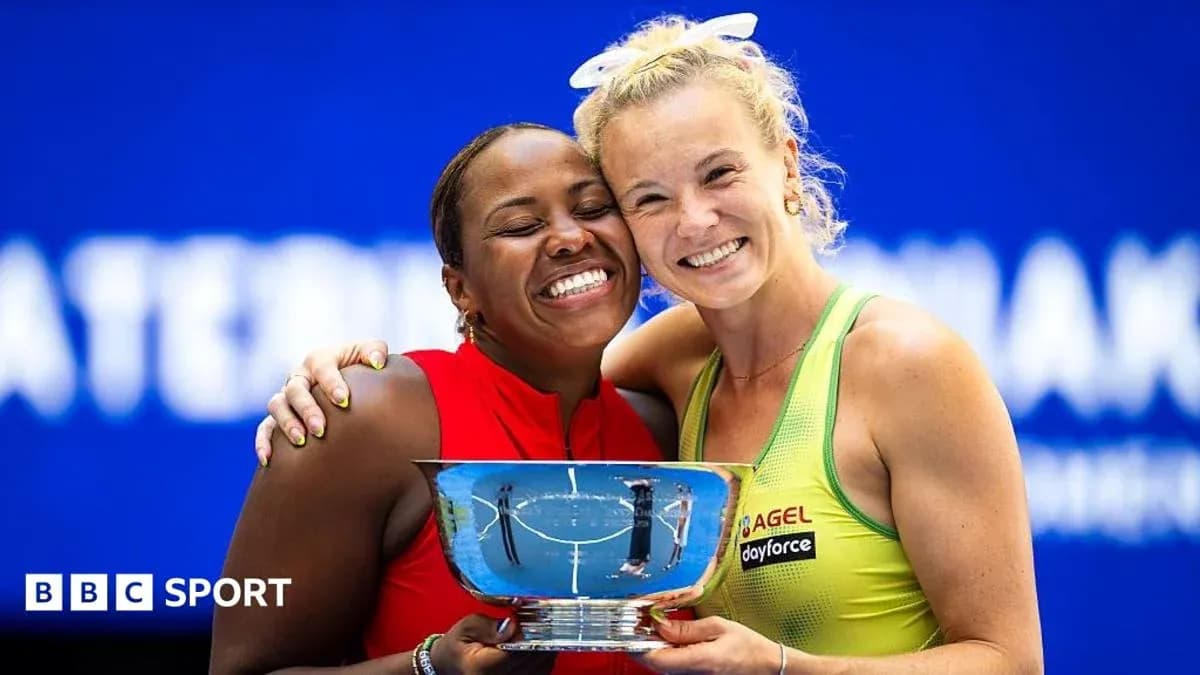
Katerina Siniakova and Taylor Townsend stood on the baseline in Arthur Ashe Stadium, one game from history, and never blinked.
The top seeds completed a career doubles Grand Slam as a team on Sunday, coming from a set down to defeat American wildcards Ashlyn Krueger and Robin Montgomery 5-7, 6-0, 6-2 and claim the US Open women’s doubles title at Flushing Meadows.
They have now swept the sport’s biggest stages together: Wimbledon in 2024, the Australian Open in 2025, Roland Garros this year, and now New York. Four majors, four different environments, one partnership that has learned how to solve almost every problem the tour can throw at it.
Siniakova in rare air
For Katerina Siniakova, this trophy carries an extra layer of history. It is her 12th Grand Slam doubles title, a number that puts her among just eight women in the Open era to have reached a dozen or more.
It also completes a unique double. The Czech becomes the first player ever to complete a career doubles Grand Slam with two different partners, having already done it alongside Barbora Krejcikova. That earlier run cemented her as one of the defining doubles players of her generation; this one with Townsend underlines her versatility, longevity, and competitive stubbornness.
At 30, she is no longer the young disruptor on the doubles circuit. She is the benchmark. If she finishes this season as the world No. 1 in doubles, it will be the sixth time she has ended a year on top, a mark that would move her past Martina Navratilova for the most year-end No. 1 finishes in WTA history. That is not just a statistic. It is a statement about sustained excellence.
Townsend’s New York redemption
For Taylor Townsend, this title lands closer to the heart.
Twelve months ago, she walked off this court with a runner-up plate, beaten in the final alongside Siniakova by Gabriela Dabrowski and Erin Routliffe. The loss stung. Players don’t often admit it, but doubles specialists know how rare these chances can be.
This time, the American finished the job. At 30, she finally owns a US Open doubles crown, and she did it in front of a home crowd, with the same partner by her side and the same aggressive, front-foot tennis that has become her signature.
The symmetry is striking: last year’s disappointment in New York, followed by a sweep of the majors with Siniakova across three different continents, ending right back where the hurt began. Only now, Townsend leaves with the trophy that eluded her.
From wobble to domination
Until the final, Siniakova and Townsend had not dropped a set all tournament. They had moved through the draw with the authority of top seeds who knew exactly where their level sat.
Then came a jolt.
Serving at 5-6 in the opening set, Siniakova faltered. Three double faults in the final game handed Krueger and Montgomery the set and a surge of belief. For a few minutes, the match teetered. The favourites suddenly looked human.
The response was ruthless.
Siniakova and Townsend tore through the second set 6-0, winning 23 of 27 points after the opening game. They tightened their first serves, swarmed the net, and turned returns into outright statements. The Americans barely had time to reset between points before another volley flashed past or a return dipped at their feet.
Once the match flipped, it stayed flipped.
An early break in the deciding set gave the top seeds a 3-1 lead, and they never loosened their grip. They consolidated with calm holds, picked their moments on return, and forced Krueger and Montgomery to keep hitting low-percentage shots just to stay in rallies. The scoreboard pressure grew heavier with every changeover.
By the final game, there was no drama left. Just execution.
A partnership that travels
What makes this run so striking is the range of surfaces and scenarios they have mastered together. Grass at Wimbledon. Hard courts in Melbourne and New York. Clay in Paris. Different balls, different bounces, different winds swirling through different stadiums.
The constant has been their chemistry.
Townsend’s left-handed aggression, her willingness to take the ball early and crowd the net, meshes with Siniakova’s court coverage, touch, and tactical clarity. When one dips, the other usually rises. When both click, as they did for most of this fortnight, they look almost untouchable.
This US Open final briefly exposed their nerves, then showcased their response. That may be the truest measure of a great doubles team: not how they play when everything flows, but how quickly they can slam the door once it starts to creak.
They did that in New York, and walked away with a slice of history that will follow them for the rest of their careers.
The question now is not whether Siniakova and Townsend belong among the elite. It is how long they intend to stay there, and how many more majors this partnership can bend to its will.