Roger Federer Inducted into International Tennis Hall of Fame
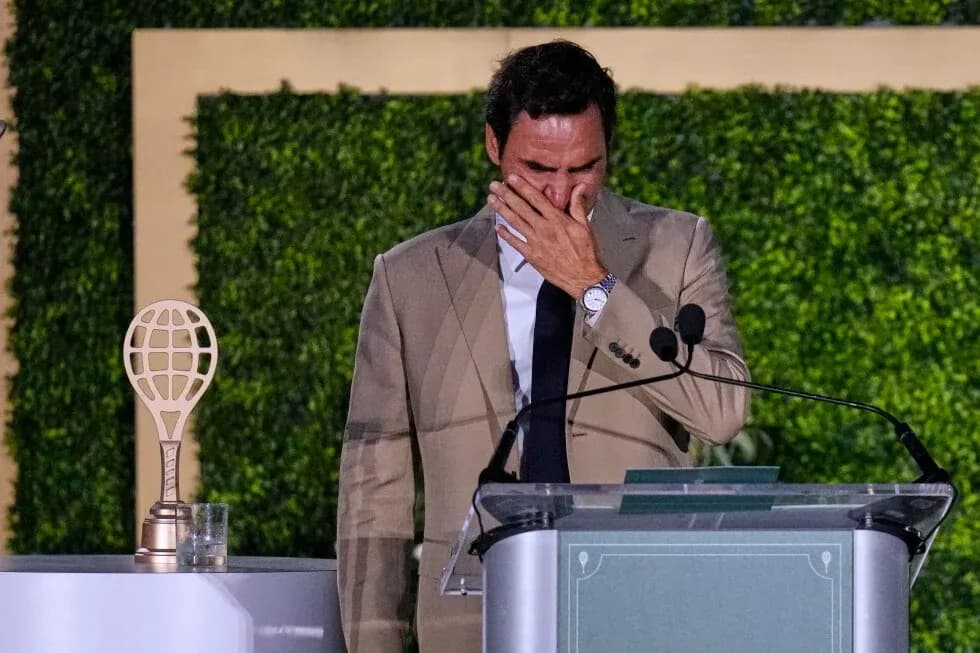
NEWPORT, R.I. — As the sun slid down behind the old horseshoe of grass in Newport, Roger Federer walked toward the stage in a tan suit and suddenly looked very small for a man with 20 Grand Slam titles.
He kissed and hugged Mirka, his wife, who had just introduced him as the 272nd inductee into the International Tennis Hall of Fame. Then the reality of the moment hit.
“Oh man,” he began, voice already tight. “This is very high level and a tough act to follow.”
The “Swiss Maestro” has spent a career making impossibly hard things look easy. This wasn’t one of them.
Tears, jokes, and a lifetime on court
Federer tried to lean on humor, as he often did under pressure on court.
“I don’t know if you have been practicing secretly,” he quipped to Mirka, drawing a warm laugh from the Newport crowd. He admitted he was “a little stressed to be honest,” a revealing confession from the man who once held the world No. 1 ranking for a record 237 consecutive weeks.
The speech ran close to half an hour. The composure did not.
He choked up several times, the emotion catching him mid-sentence, like a low skidding return at his feet. The turning point came halfway through, when he spoke about his childhood hero, Stefan Edberg. The tears came, and he tried to frame them.
“These are happy tears,” he said.
They kept coming.
He broke again when he mentioned longtime coach Severin Luthi, a central figure in the second half of his career. Then came the part he had clearly been dreading.
“Now the Mirka part,” Federer said, stopping, eyes already wet. “Oh gosh, this is such a mess.”
He tried to joke his way out of it, but the emotion overran him.
“I need tissues and sunglasses, everything to protect me right now,” he told the crowd, fighting for control.
For a player whose game was built on balance and timing, this was something different: raw, unvarnished, unguarded.
From Wimbledon lawns to Newport grass
Federer, who turned 45 three weeks ago, walked into Newport already one of the sport’s most decorated champions. Eight Wimbledon titles. Six Australian Opens. Five consecutive U.S. Open crowns from 2004-08. A lone but vital French Open in 2009 to complete the career Grand Slam, joining a select group of just eight men.
He reached 10 straight Grand Slam finals at his peak, winning eight of them. The fluid footwork, the quick glide to the net, the one-handed backhand that stayed both elegant and lethal deep into his thirties — all of it now part of the permanent record inside these walls.
On this night, though, he used that old champion’s instinct one more time. Just as he had so often turned a tight fifth set into a statement, he gathered himself and finished strong, turning the closing of his speech into a thank-you to the overlooked figures of the sport.
He made a point of recognizing the ball kids, the ones who chased down the shots that made him famous, and urged today’s players to keep pushing tennis to “new levels.”
“I’m thrilled to have made the journey here,” Federer said. “It’s amazing to see yourself in a place like this. To immerse yourself in the history of the sport means a lot to me.”
The Hall of Fame, he suggested, is not just a museum of trophies and photographs. It is a living reminder of what the game can be.
Carillo joins as a voice of the sport
Federer did not go in alone. Mary Carillo, former player and one of the defining voices of tennis broadcasting, was also inducted in Newport as a contributor.
Presented by Hall of Famer Billie Jean King, Carillo entered the Hall already a member of the Sports Broadcasting Hall of Fame, recognition of a career that has stretched far beyond the baseline.
“She has earned her spot in sports journalism and she has earned her spot in Newport,” King said, summing up a body of work that helped shape how millions watched and understood the sport.
Carillo, 69, stood before a cluster of Hall of Famers and let the scene sink in.
“To walk through these gates here in the company of you people, that was beyond my dreams,” she said.
On a quiet summer evening in Rhode Island, the sport honored both the man who defined an era with his racket and the woman who narrated so much of it with a microphone. The grass in Newport has rarely carried more history — or more emotion — in a single night.