Roger Federer: A Unique Perspective on Numbers in Tennis
Roger Federer has always treated numbers differently. The sport counted his 20 majors, his 310 weeks at world No. 1, his eight Wimbledon titles. On this night, he chose a different ledger.
“Not the obvious stats like the number of majors or number of weeks at number one,” he said, smiling. He wanted the details that coloured in the outline of a 24-year professional career.
Between 1998, when he first stepped onto the ATP tour, and his retirement in 2022, Federer calculated that he wore more than 5,000 headbands. “That’s more than [Bjorn] Borg and [John] McEnroe combined,” he quipped, a playful nod to the icons who came before him.
The numbers got even more absurd. “And if you think that’s impressive, I wore probably over 7000 pairs of socks,” he added. “That’s probably twice as many as most of my opponents, because I doubled them up.” It was classic Federer: self-aware, lightly mocking himself, letting the room laugh with him rather than at him.
Then the tone shifted.
“But really, there’s no way to measure what it means to be here. It’s hard to put it into words,” he said, the statistician giving way to the sentimentalist. This was a man tracing a straight line from a 13-year-old ballboy at an ATP tournament in Basel to the International Tennis Hall of Fame, from picking up towels to lifting trophies.
He turned directly to the next generation doing the same unseen work he once did.
“I really want to thank every ball kid who ever stood through my matches or all our matches, for that matter, for hours on end,” Federer said. “I see you. I thank you. I was you.” In a sport obsessed with stars, he shone the light back on the children chasing stray balls and folding towels in the shadows.
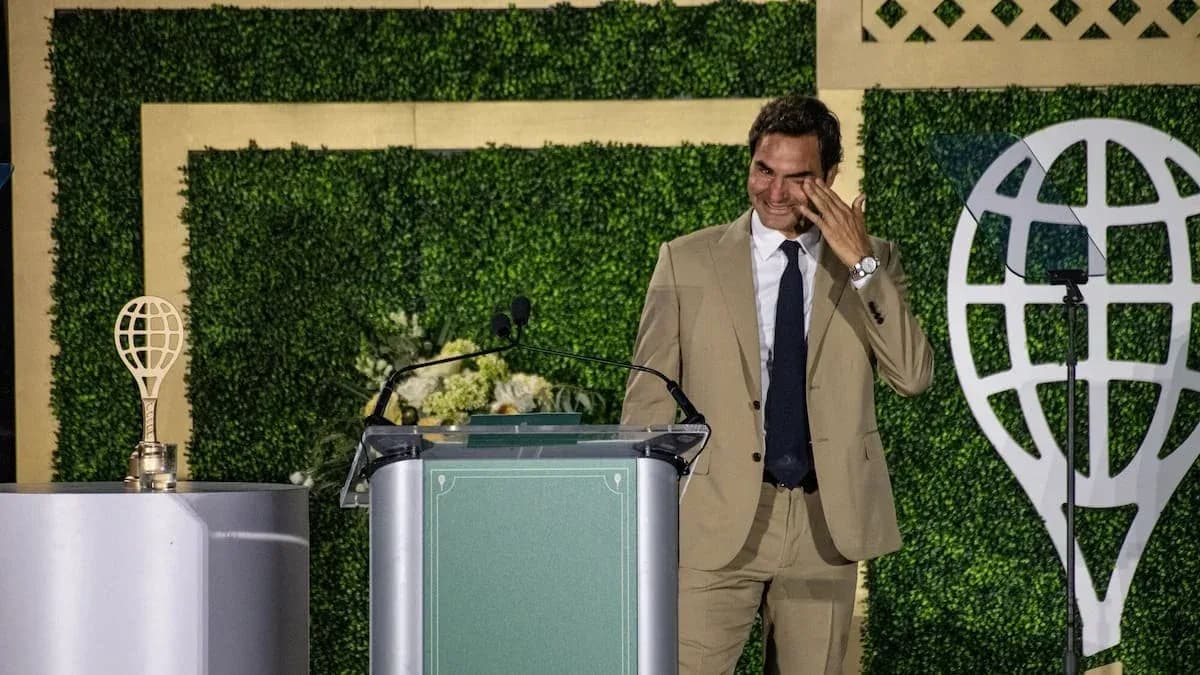
The emotion caught him. Federer, so often the picture of composure on Centre Court, had to pause and wipe away tears as he name-checked his idol Stefan Edberg, a roll call of fellow tennis greats, and the family and support staff who had carried him through the grind and the glory.
“I need tissues and sunglasses and everything to protect me right now,” he joked, trying to steady himself. “This is such a mess.” The crowd laughed, but the crack in his voice told its own story.
“It’s been an incredible journey,” he said, the phrase landing heavier than its simplicity suggested. For Federer, the Hall of Fame did not feel like a museum door closing behind him. “For me, the International Tennis Hall of Fame provides a great opportunity to look back, but also to look ahead.”
That was the key. This was not a farewell tour speech. It was a bridge.
“As you can tell, I’m still writing my love letter to tennis,” Federer said. “My time as a player is done, but tennis will always stand at the intersection of everything I care most about: my family, our friendships, the past 40 years, the future we’re building. Tennis for me is responsible for it all.”
The headbands and socks can be counted. The rest of it — the boy from Basel, the champion at Wimbledon, the Hall of Famer still in love with the game — will live in a different kind of record.