Ramla Ali Becomes First Somali World Champion with Two Titles
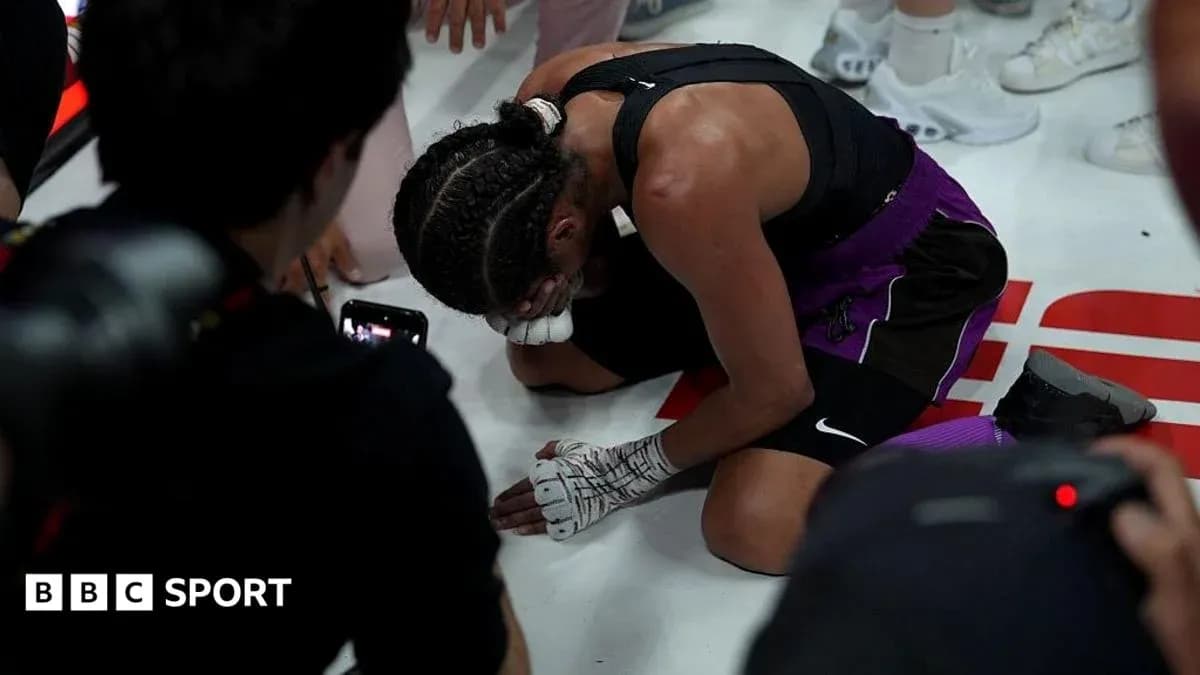
Ramla Ali sank to her knees in the centre of the ring, tears streaking down her face in Arlington, Texas. At 36, after a life spent outrunning war, doubt and defeat, she finally had what she had chased for years: a world title. Two of them.
The Briton, who fled Somalia as a baby and rebuilt her life in London, edged past American Mikiah Kreps via split decision to become WBO and IBF super-bantamweight champion. The scorecards – 97-92, 96-93 and 91-98 – told the story of a tight, bitterly contested fight. The reaction told you everything else.
Ali buried her face in her gloves as the verdict was read, then looked to the sky. This one was for her father, who died in May. She had said it in the changing room. She said it again through sobs after the fight. Every round, every step off the stool, every punch when her lungs burned, she dragged herself forward with one thought: do it for him.
This was the night the narrative flipped. Two years ago, Yamileth Mercado had swept Ali aside in her first world-title shot, exposing gaps and prompting whispers that the storybook career had finally met its sporting ceiling. She was the Olympian, the activist, the author, the model. A face on magazine covers. A voice for young women through her Sisters Club non-profit. But a world champion? Many had stopped believing.
They will have to recalibrate now.
The fight itself was messy, intense, and, for long spells, fought on Kreps’ terms. The previously undefeated American pressed forward relentlessly, throwing in volume, forcing Ali to work at a pace that threatened to break her.
The key moment came early. In the third round, Kreps walked straight onto a sharp, perfectly timed left hook. The punch snapped her head and sent her glove brushing the canvas as she tried to steady herself. She protested the knockdown call, but the replay left little room for argument. It was a heavy shot, and the 10-8 round would loom large.
Ali, though, could not turn that breakthrough into control. Kreps reset and surged back, her work rate suffocating. She outlanded Ali 115 punches to 78, including 91 power shots to Ali’s 70. One judge saw the American as a clear winner and scored it 98-91 in her favour.
The numbers backed Kreps. The belts went with Ali.
What swung it? The knockdown, for one. But also the rounds where Ali, exhausted and under siege, found just enough accuracy and ring craft to nick the margins on two of the cards. She later admitted that every break in the action felt like a crisis.
“I remember going to the corner every round and I remember saying ‘I’m so tired, I can’t do this’,” she said. Her coach had one answer, over and over: think about your dad. Get up. Go again. Ali described boxing “out of my skin” just to stay with a pace she called “next level”.
Kreps, devastated at the final bell, believed she had done enough. The statistics gave her case substance. But championship boxing lives in the grey area where damage, control and big moments collide. Ali had the knockdown, the cleaner shots in key spells and, crucially, the sympathy of two judges when it mattered.
For Ali, this was not just a win. It was vindication.
Since turning professional in late 2020, she had been clear about her ambition: become a world champion. That conviction took a brutal hit in 2023 when she was knocked out in her ninth fight. The setback emboldened those who already questioned why she continued to fight at all when she had a flourishing life outside the ropes.
She did not walk away. She rebuilt. Quietly. Without the noise of hype, but with the same stubborn belief that had carried her from a refugee childhood to the Olympic stage, where she became the first Somali boxer to represent the country at Tokyo 2020. Before that, she had already made history as the first Muslim woman to win an English amateur title.
Now she stands as Somalia’s first professional world champion, a symbol as much as a fighter. “I can’t put into words what this means to me and what this means to all of Somalia,” she said. She spoke of inspiring “young girls and boys” to dream big. That has always been her mission, she insisted. The belts are the proof that the dream is not just a slogan.
All this comes as a biopic of her life hits screens, a cinematic retelling of a journey that, for a long time, seemed destined to fall just short of its sporting climax. Reality caught up with the script in Texas.
There is already talk of what comes next. On the undercard, Australia’s Skye Nicolson retained her WBC title against Japan’s Miyo Yoshida by unanimous decision. Like Ali, Nicolson is signed to Jake Paul’s Most Valuable Promotions. A unification bout between the two would be a marketer’s dream and a purist’s intrigue: Nicolson’s slick southpaw boxing against Ali’s rangy, increasingly seasoned style.
That can wait. Ali has earned the right to linger in this moment.
From a baby carried out of war-torn Somalia, to a refugee girl settling in London, to an Olympian, trailblazing amateur, activist and now unified world champion, her life has defied the limits others tried to place on it. The doubters were loud after Mercado. Louder still after the knockout in 2023.
On a tense night in Arlington, with her legs heavy and her lungs on fire, Ramla Ali answered them the only way that counts in boxing: with her hands, her heart, and two world title belts draped over her shoulders.