Rafael Nadal's ATP Finals Puzzle: The Missing Trophy
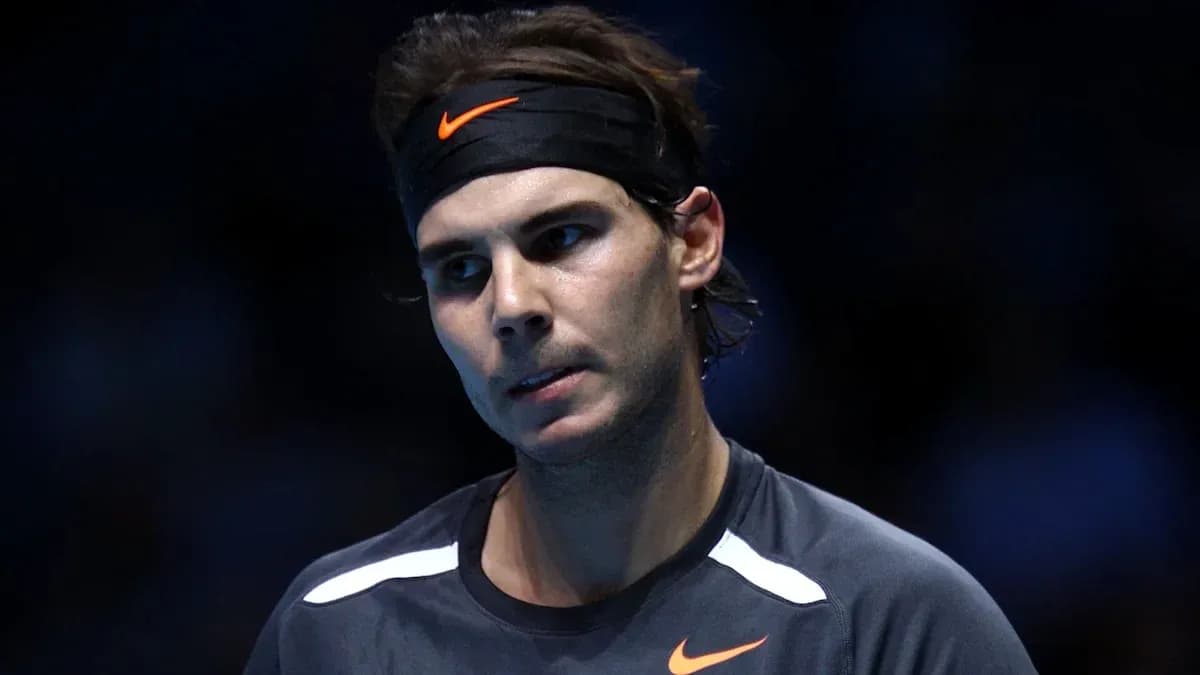
Rafael Nadal conquered almost everything tennis could offer him. Clay, grass, outdoor hard, Olympic podiums, Davis Cup ties in hostile arenas. Twenty-two Grand Slam titles, 36 Masters 1000 crowns, world No.1, singles gold in Beijing, doubles gold in Rio. A career built on solving problems that were supposed to be unsolvable.
Yet one puzzle remained unsolved to the very end: the ATP Finals.
The missing trophy
For 17 seasons, Nadal did enough across the year to qualify for the elite year-end event. Only 11 times did his body allow him to actually show up. Not once did he leave with the trophy.
It is the great statistical wrinkle in an otherwise overwhelming résumé, made starker by the achievements of his two biggest rivals. Between them, Novak Djokovic and Roger Federer stacked up 13 ATP Finals titles. Nadal, the third pillar of the era, never lifted one.
The story began in 2005, when it did not really begin at all. Nadal qualified as a teenage phenomenon but a foot injury ruled him out. His debut had to wait.
In 2006, he finally walked into the season-ending showpiece. The Mallorcan fought his way out of the group, beating Nikolay Davydenko and Tommy Robredo despite a loss to James Blake. It felt like the start of a long relationship with the tournament.
Federer intervened. He stopped Nadal in the semi-finals and set a pattern that would repeat.
Federer’s indoor hold
No player caused Nadal more trouble at the ATP Finals than Federer. The Swiss beat him four times at the event, more than any other opponent there, and did it on a surface and under conditions that tilted the court in his favour.
Their 2010 final captured the dynamic perfectly. Nadal, having navigated the group and knockouts to reach his first championship match at the tournament, ran into Federer at full flow. The Swiss took it 6-3, 3-6, 6-1. Nadal had pushed through to the last Sunday, only to watch the title slip away indoors once again.
Three years later, he returned to the final. This time Djokovic stood across the net. Different rival, same outcome. The Serb closed him out in the 2013 championship match and tightened his own grip on the tournament Nadal could not quite bend to his will.
Between those peaks came the low point. In 2009, Nadal endured his bleakest ATP Finals campaign. Three round-robin matches, three straight-sets defeats. He did not win a single set. For a player who built his legend on resistance, it was a brutal week.
A champion at odds with the surface
The common thread was obvious. Indoors, on hard courts, Nadal was operating in his least comfortable environment.
His topspin-heavy game, so devastating in the heat and bounce of clay and outdoor hard, lost some of its bite under a roof. The low, skidding conditions, the quick courts, the precision required on serve and return – all of it nudged the balance toward flatter hitters and aggressive shot-makers. Players who, across the season, he routinely beat.
Nadal never hid his frustration with that imbalance. In 2013, at the height of his powers, he spoke openly about the need for change – not for himself, but for those who would come after.
"I know it's not going to happen for my generation," he said then. "I'm talking for the future generations, something that will be a little bit fairer for the players. And I think for the fans it will be interesting to change the surface every year to the surfaces we qualified on for the (ATP Finals).
"A good player has a chance to qualify for the (ATP Finals) four or five times in his career, so if during this four years you have a different surface every year, a minimum one time he will have the chance to play on his favourite surface."
It was a simple argument: if the ATP Finals exists to showcase the season’s best, why should it consistently favour one style?
Tradition, turf and Turin
History did not help his case. For its first 26 years, the event lived mostly on carpet, with a one-off grass edition in 1974. From 2007 onwards, the tournament settled into a new identity: indoor hard courts, every year.
That decision has held firm. London embraced it. Turin, which took over in 2021, has done the same. There is no sign of a rotating surface, no hint that Nadal’s vision will come to pass any time soon.
By the time he made his final appearance at the ATP Finals in 2022, the story had hardened into something close to inevitability. Nadal lost to Felix Auger-Aliassime and Taylor Fritz in the round-robin stage and exited early once more. The great competitor, still swinging, still searching, but again undone by the conditions that never quite suited him.
The numbers tell their own tale: 17 qualifications, 11 campaigns played, two finals reached, no titles. Twelve different players beat him at the ATP Finals. Federer and Djokovic among them, but also a long list of names who rarely troubled him in the biggest outdoor arenas.
It is not a stain on his legacy. It is a reminder that even the giants of the sport have blind spots shaped by surface, schedule and physiology.
Nadal spent two decades bending tennis to his will. The ATP Finals, perched indoors at the end of a long season, refused to bend back.