Premier League Transfer Tax: The New Economics of Football
There was a time when the premium was on the passport. If you were English, you cost more. Now the surcharge is something different: it’s simply being a Premier League player.
As the latest summer window slammed shut, English football rewrote the record books again. The average fee for a player moving from one Premier League club to another hit £39.4m. For imports from abroad? £20.2m. Same sport, same market, two very different economies.
Kieran Maguire, professor of football finance at the University of Liverpool, has a blunt name for it: “a Premier League tax”.
This is not a quirk of one mad window. It’s a structural shift. Premier League clubs have become increasingly relaxed about selling to one another, even to rivals they’ll face three or four times a season. The really big money is now circulating inside the league’s own ecosystem.
Yes, more overall cash still flows out to clubs beyond England’s borders. But look at the deals that make eyes water. The domestic market is now outmuscling the rest of Europe at the top end.
The £40m club is getting crowded
High-value moves – those at £40m or more – have exploded. In 2022-23 there were 13 such deals. This summer? Twenty-seven.
Two years ago, seven of those 13 blockbusters involved clubs on the continent. Six were trades between Premier League sides.
Fast forward to this summer and the picture is stark. Nine £40m-plus transfers involved European clubs. Inside England, that number trebled to 18. The total domestic spend more than doubled.
The Premier League is no longer just the buyer of Europe’s best. It is its own marketplace, with its own internal inflation.
Maguire believes one major driver is how aggressively English clubs now scout abroad.
“We’ve got a new tranche of clubs, sort of the algorithm kids, who are recruiting from the international markets,” he said. They identify talent early, take the risk, and turn them into proven Premier League operators.
Then the heavyweights move in.
Brighton’s Carlos Baleba is a textbook case. Signed from Lille for £23m three years ago, he left for Manchester United last week for £70m. Brighton took the gamble. United paid the Premier League tax.
“It has effectively created a recruitment area, sort of a petri dish, to determine which of the overseas players can deliver in the Premier League, and then it’s a win-win for all the parties,” Maguire added.
But the numbers now being paid raise a different question: who else on the planet would pay these prices?
A bubble of its own
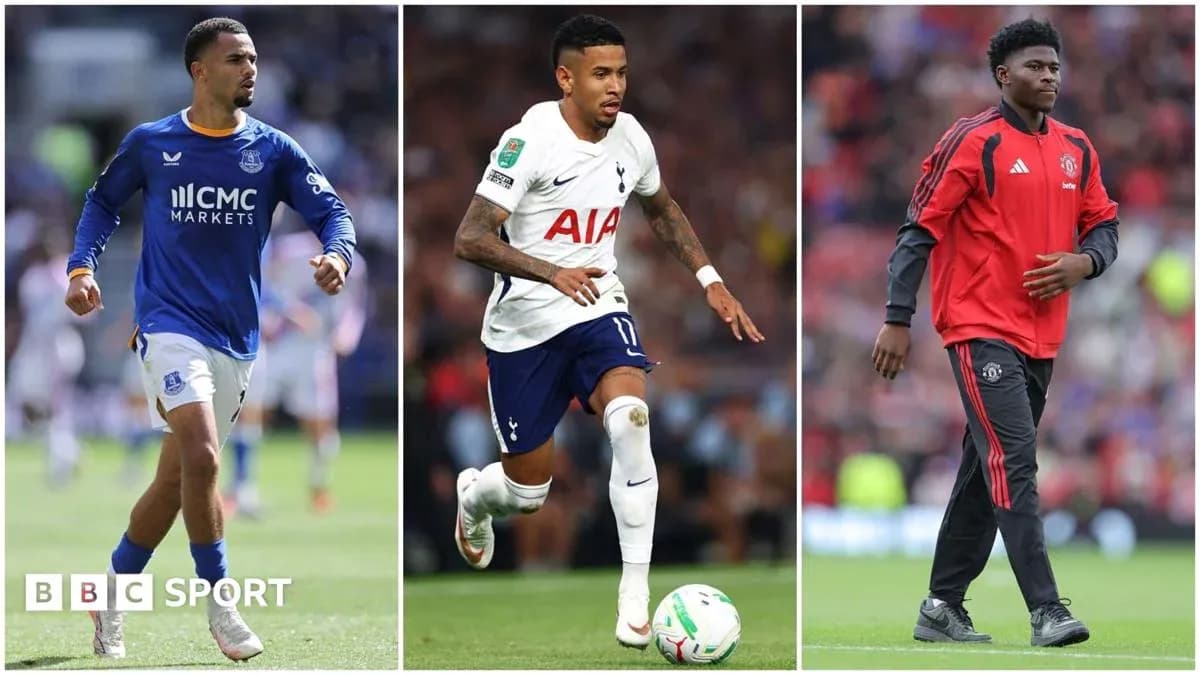
Would any European club have wired Manchester City the £75m Tottenham spent on Savio? Would anyone outside England have gone to £65m for Iliman Ndiaye from Everton? Or matched the £85m West Ham banked from Spurs for Mateus Fernandes?
The answer, bluntly, is almost certainly no.
Across the whole of Europe this summer, there were only seven transfers of £40m or more between clubs on the continent. Every single one involved Barcelona, Bayern Munich or Paris St-Germain.
Trevor Watkins, the former Bournemouth chairman turned sports lawyer, sees a league operating on its own financial planet.
“The revenues dwarf what other leagues generate,” he told BBC 5 Live Breakfast. “And what you see this year is a lot of deals between clubs in England.
“A lot of money going down to lower leagues, but also between Premier League sides because, to be honest, they’re probably the only ones that will pay the wages or pay the fees.”
The market has become a contest of spreadsheets as much as scouting reports. The question isn’t just “How good is he?” but “What does he do to our books?”
When profit matters more than goals
On the surface, profit on a player looks simple: sell higher than you buy. In Premier League accounting, it’s anything but.
Take Elliot Anderson. Nottingham Forest bought him from Newcastle for £35m. They then sold him to Manchester City for £116m. Straight maths says an £81m profit.
The rulebook says otherwise.
Transfer fees are amortised – spread over the length of a player’s contract. When Forest sold Anderson, around £21m of his original fee was still on their books. For accounting purposes, the profit wasn’t £81m. It was £95m.
Under the league’s new squad cost ratio (SCR) rules, that £95m isn’t a one-off windfall. It’s averaged over three years – about £31.67m per season for Forest.
The days of flogging one star to fix a single window or dodge an immediate breach of financial rules are gone. Clubs can’t just pull a one-sale lever and expect instant freedom.
Which is why those headline fees have become so vital. The bigger the sale, the bigger the profit line that can be smoothed over multiple years. SCR, calculated season by season, pushes clubs to chase higher and higher transfer values.
And that, inevitably, favours the giants.
The rich write the rules
The so-called ‘Big Six’ – Arsenal, Chelsea, Liverpool, Manchester City, Manchester United and Tottenham – spent £1.658bn on players in the last window. Their commercial muscle gives them a different starting point to everyone else.
“Those clubs have future-proofed themselves by trying to generate more income,” Maguire said. “Spurs is a classic example. Spurs now have a multi-function, multi-sport stadium, of which the football club is the biggest part.
“It is a reward for those clubs that have expanded their stadiums, or thought outside of the box in terms of trying to generate additional revenues.”
For the other 14 Premier League clubs, who collectively still managed to spend £1.833bn, survival at this level increasingly depends on smart player trading. Buy low, sell high, and do it again and again.
Aston Villa and Newcastle are the new poster clubs for this model. Between them they completed five deals worth £40m or more this summer – but only after cashing in hundreds of millions in sales to create the room to spend.
As the internal market swells, less money washes out across the continent. Yet the ripple effect is felt everywhere.
Europe watches the tide rise
La Liga’s corporate general director, Javier Gomez, did not mince his words this week. He attacked what he called the “loss-making model which is an issue exclusive to the Premier League”.
“It has other consequences,” Gomez said. “It inflates the entire sector – it inflates the Premier League, the Bundesliga, the French League, and eventually us as well.”
Some of Europe’s traditional heavyweights already know that feeling. Clubs that once dictated the market now find themselves priced out when English sides arrive.
“With the exception of some of the global brands within football, and I think you’d look at Real Madrid, Barcelona, PSG and Bayern Munich, the Premier League can outspend anyone and everyone,” Maguire said.
The latest Deloitte Money League backs that up. Fourteen of the world’s 30 biggest clubs by revenue are from the Premier League. Real Madrid, Barcelona, PSG and Bayern Munich top the list, with Liverpool leading six English sides in the top 10.
For clubs outside that elite, the game has changed entirely.
Andre Villas-Boas, president of FC Porto, knows exactly where his club now sits in the food chain.
“For Porto, it means we are competing for talent not with Man City or Liverpool but with (the likes of) Coventry and Brentford, without any disrespect,” he told BBC Sport.
“The fact that they have this spending power makes it difficult for us.
The Premier League is set apart from all the rest, which means English clubs are becoming more and more dominant of European competitions.”
Last season underlined that dominance in bold ink. Aston Villa won the Europa League. Crystal Palace lifted the Conference League. Arsenal reached the Champions League final before falling to Paris St-Germain.
On the pitch and in the market, the same pattern emerges: England first, everyone else scrambling behind.
The Premier League’s transfer bubble has been forecast to burst for more than a decade. Each summer, it swells a little more, its clubs trading eye-watering sums among themselves while Europe watches from the outside.
The question now is not whether the bubble exists. It’s how long the rest of the game can live in its shadow.