Israel vs Republic of Ireland: A Charged Nations League Match
On Sunday, an elite European international will be played in front of almost nobody, in a country neither team calls home, with a television broadcast stripped back to the bare minimum. No away fans. No pundits. No half-time chat. Just 22 players, a ball, and a storm of politics raging around them.
This is Israel v Republic of Ireland in the Uefa Nations League. On paper, a routine group fixture. In reality, one of the most charged games European football has staged in years.
A vote to play – or not to play
The match very nearly never made it this far.
When the Nations League draw in February dropped the Republic of Ireland into a group with Israel, Austria and Kosovo, the Football Association of Ireland walked straight into a political minefield. Calls for a boycott came quickly and loudly, fuelled by Israel’s military offensive in Gaza and Ireland’s increasingly outspoken support for Palestinians.
The pressure did not come only from the terraces. Politicians, campaign groups and public figures pushed the FAI to refuse to play. The association, wary of both the moral and sporting consequences, put the decision to a vote of its delegates in July.
Seventy-five voted to fulfil the fixtures. Thirty-two voted to boycott.
It was a stark split. The FAI warned that refusing to play could bring Uefa sanctions, jeopardise future participation and cost Irish football millions of euros. The delegates sided with participation – but not without leaving a clear record of dissent.
So the games go ahead. Just not in any normal sense.
Neutral grounds, empty stands
On Sunday, the Republic travel to Debrecen in eastern Hungary for what is officially an “away” match against Israel. There will be no Irish fans in the stands. Only a small allocation has been made available to Israeli supporters, as has been the pattern for Israel’s recent “home” games in Hungary.
Hungary has become Israel’s de facto host in European competition, its government willing to provide the policing and security infrastructure that many other nations, amid fierce public debate, have been reluctant to guarantee.
The return fixture, scheduled for 4 October, will be even more surreal. Ireland’s “home” game will not be in Dublin, or anywhere on Irish soil, but in Backa Topola – a small, remote town in Serbia.
The FAI announced in the summer that it would move the home match to a neutral venue, citing “operational challenges that could impact on the delivery of the game on home soil”. Reports suggested deep concern that large-scale protests in Dublin could disrupt or even prevent the match from taking place.
No official explanation has been given for the choice of Backa Topola. The logic, though, is obvious enough. A quiet town. Far from major Irish population centres. Easier to police. Harder to protest.
Serbia’s political relationship with Israel also matters. Foreign minister Marko Duric described Israel in 2025 as one of Serbia’s “closest friends and strategic partners”, and Serbia has purchased Israeli drones and missiles in recent years. For the FAI and Uefa, that means a host government willing to stage the game and manage the fallout.
Silence on the airwaves
The strangeness will not be confined to the stadiums.
Irish public broadcaster RTE will show the matches, but only because it is contractually obliged. The coverage will be stripped back: no studio, no pundits, no commentary, no half-time analysis. Just pictures and sound from the ground.
RTE has also opted out of taking any advertising or sponsorship revenue linked to the games. It is as close to a televised act of reluctance as a broadcaster can get while still honouring a contract.
Tickets for Irish fans are off the table for both fixtures. This is international football without the usual colour, noise and travel culture that follow a national team. It is sport played in a vacuum, by design.
A federation under fire
If the FAI hoped that neutral venues and limited fan access would cool tempers, the past weeks have offered little comfort.
Supporters’ groups at various Irish clubs have staged protests during domestic fixtures, unfurling banners and voicing opposition to the games going ahead. On Monday, more than 160 Irish athletes signed an open letter under the banner of Irish Sport for Palestine, urging a boycott of the fixtures. The signatories include high-profile names such as boxer Tyrone McKenna and former European champion middle-distance runner Ciara Mageean.
Inside the association, there is little sense of ease. FAI CEO David Courrell revealed that Uefa had rejected a request to keep Israel and Ireland apart in future draws, leaving the federation braced for more of the same if the teams cross paths again.
Director of football John Martin described the situation as “very uncomfortable for everyone”. That discomfort has spilled into the technical area as well.
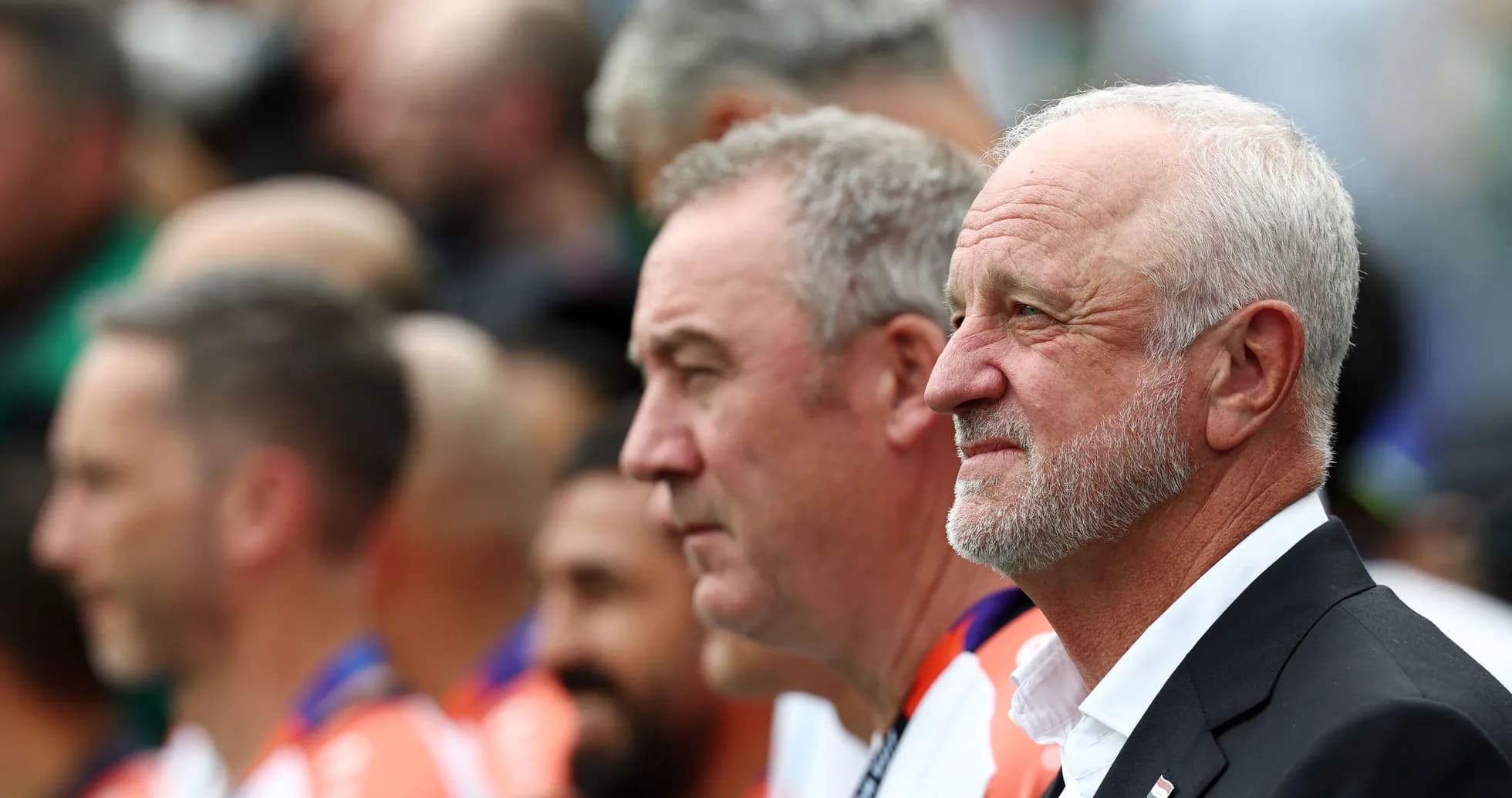
Manager Heimir Hallgrimsson has been drawn directly into the moral debate. He has been clear that, in his view, playing the match does not legitimise what he called Israel’s “genocide” in Gaza.
“We’re not playing with genocide, we’re playing against genocide,” Hallgrimsson said. “We’re playing against Israel, we’re not playing with Israel.”
The words landed hard. The Israel Football Association fired back, accusing Hallgrimsson of “ignorance, hypocrisy and stupidity”. For a Nations League tie, the rhetoric is astonishingly fierce.
A football match in the shadow of Gaza
This is not the first time Irish teams have had to confront the question of whether to face Israel since the war in Gaza escalated in October 2023. The Republic’s women’s basketball side played Israel in EuroBasket qualifiers last autumn and earlier this year, but only after what was described as “extensive deliberations”.
The broader political context is impossible to ignore. Ireland has become one of Europe’s most vocal critics of Israel’s actions in Gaza. The Hamas-run health ministry in the territory says more than 73,000 people have been killed in Israeli attacks since October 2023, figures considered reliable by the United Nations.
In May 2024, Ireland joined Spain and Norway in formally recognising a Palestinian state. Later that year, it joined South Africa’s genocide case against Israel at the International Court of Justice.
The stance has not been confined to diplomacy. Ireland has boycotted Eurovision since 2025 over Israel’s continued participation, became the first EU country to ban goods from Israeli settlements in the occupied West Bank, and has imposed travel bans on Israeli government ministers.
On Monday, Irish foreign minister Helen McEntee was blunt.
“Ireland’s view is clear – international law is being breached. We are seeing an attempt to erase a population,” she said.
Israel insists its campaign in Gaza is an act of self-defence, launched in response to the Hamas attacks of 7 October 2023, in which about 1,200 people were killed and 251 hostages taken.
That clash of narratives now bleeds directly into a Uefa competition that was designed to tidy up friendlies, not test the moral resolve of national associations.
When the whistle blows
So on Sunday in Debrecen, two national teams will line up on neutral turf, watched by a sparse crowd and a muted broadcast audience. The usual flags and songs of an Irish away day will be absent. The game will be played in a kind of enforced quiet.
Yet nothing about it will feel quiet.
Every tackle, every anthem, every handshake will unfold under the weight of a conflict that has reshaped Ireland’s foreign policy and polarised its sporting community. For the players, it is a Nations League group match. For many watching, or choosing not to watch, it is something far bigger.
And when the final whistle goes, the questions will not be about tactics or formations, but about where football draws its line – and whether this is the last time the Republic of Ireland agrees to cross it.