Novak Djokovic's Shocking First-Round Loss at the U.S. Open
NEW YORK — The night Novak Djokovic had spent a career outrunning finally found him.
On Arthur Ashe Stadium, in the city where he has so often bent time and logic to his will, the most reliable constant in men’s tennis collapsed in real time. Djokovic, the man who had turned first rounds at Grand Slams into a formality for nearly two decades, lost in one. And not to a fellow titan, but to Mariano Navone, a gritty Argentine who had never before shared a stage quite like this.
Navone beat him 7-6(5), 5-7, 4-6, 6-2, 6-1 in four hours and 36 minutes, snapping a streak of 77 consecutive first-round wins at majors and dragging Djokovic into a confrontation with his own sporting mortality that he could no longer delay.
Djokovic is 39. On Sunday night, for long stretches, he looked every day of it.
A Giant Unravels
The opening told a familiar story. Three aces in his first two service games. A 3-0 lead. The old patterns, the old authority. For a few minutes, Ashe felt like it always has when Djokovic steps under the lights: inevitable.
Then the match turned strange.
Navone, a top-50 regular who has built his reputation on clay, began to dig in. The rallies lengthened. Djokovic had to hit one ball more, then one more again. On a humid but hardly brutal New York night, he started to look uncomfortable, then unwell.
Rain came seven games in, the roof slid shut, the air conditioning kicked in. Conditions moved into Djokovic’s wheelhouse: indoor, at night, on hard court, where he has long been close to untouchable. The script should have tightened around Navone’s throat.
Instead, it tightened around Djokovic’s body.
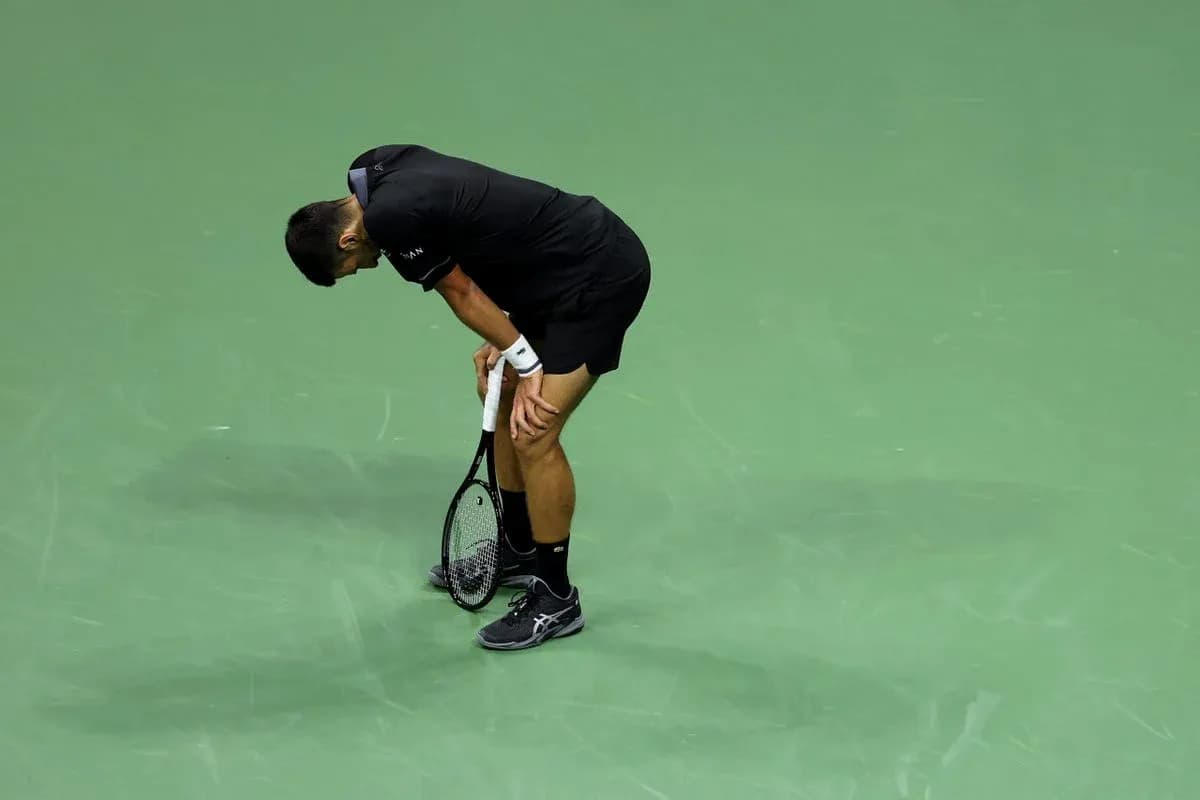
By the middle of the third set, the unraveling was visible and hard to watch. In the seventh game, he bent over a courtside bin and vomited mid-game. Between points that stretched beyond six or seven shots, he rested on his knees, trying to pull air and energy from somewhere he no longer seemed able to find it.
Short points, he dominated. Anything decided in four shots or fewer usually went his way. But when Navone dragged him into the trenches, the balance flipped. Every extended rally bled Djokovic a little more.
“The back just gave up in the end, and the shoulder,” he said afterward, standing outside the locker room, hollowed out. “An awful feeling on the court for me. It’s something that I’ve been carrying unfortunately pretty much every match this year. Vomiting, throwing up, a serious issue there. And then my whole body, you know, starts to collapse. Cramping, pain.”
He said the struggle began as early as the fourth game. He did not want to strip credit from Navone, calling him “a nice guy, a fighter.” But he also did not know if the medical problem that has stalked him for years can be fixed.
“I’m trying, man, I’m trying,” he said. “Let’s, let’s see.”
The Long Shadow of Age
What made the night so jarring was how it clashed with recent memory. Seven weeks ago, Djokovic was in the Wimbledon semifinals, having produced a vintage five-set comeback against Félix Auger-Aliassime. He still looked like a man who could bend best-of-five to his will when it mattered most.
He arrived in New York as the greatest hard-court player of the modern era, the owner of 101 titles, four of them on this very court. Navone, by contrast, had made his living on clay, winning his lone ATP title there. This was just his third U.S. Open main draw. He had won a single match at this tournament in his career. He had never played on Ashe.
If Djokovic could have chosen a first-round opponent to ease into the event, Navone would not have been far from the top of the list.
Yet the larger pattern has been building. Djokovic has spoken repeatedly in recent seasons about how punishing best-of-five has become. He talks in terms of hours now, as if his body holds a finite reserve he must ration carefully through a fortnight. Too many long matches early, and he pays for it later.
On Sunday, he never got the chance to test that theory in week two. By the time the match reached its final act, the tank was empty.
The Match Within the Match
For all the drama around Djokovic’s body, Navone refused to become a footnote.
He took the first set in a tiebreak, something that used to feel almost impossible against Djokovic on a big stage. When Djokovic snatched the second and then the third, the night seemed to be returning to its familiar orbit. The favorite was two sets to one up, and even a compromised Djokovic has spent his career suffocating opponents from that position.
Navone didn’t fold.
Early in the third, he had saved two break points to stay level. Early in the fourth, after Djokovic broke and brought the finish line into view, Navone hit back immediately, breaking him twice as Djokovic’s body finally rebelled. The Serb took a medical timeout before the fifth set, a trainer working on his lower back, trying to ready him for one last surge.
It never came.
In the second game of the decider, Navone drove the knife in. He dragged Djokovic around the court, then pulled him forward. As Djokovic moved in, Navone lashed a backhand down the line. Djokovic lunged, tried to half-volley, and failed. He staggered, then limped through the next games, looking suddenly, brutally old.
From there, the scoreline turned harsh: 6-1 in the fifth. By the fifth game, tears ran down Djokovic’s face. The stadium, sensing the scale of what it was witnessing, grew quieter, almost reverent. The energy shifted from expectation to something closer to mourning.
Courtside, his wife Jelena and children Stefan and Tara watched him fade, their faces sinking with every lost point.
A Summer of Warning Signs
The alarms had been sounding, even if few wanted to hear them.
After losing in straight sets to Jannik Sinner in the Wimbledon semifinal — to a player he once mentored — Djokovic looked shaken. Late in that match, when a fan tried to tell him he could still hang with the new world No. 1, he muttered, “Maybe 10 years ago.”
He then disappeared. Vacation. Family. Tennis reduced to hitting balls with his wife and kids. The hard-court grind could wait.
When he resurfaced in Cincinnati earlier this month, he looked unready and brittle in the heat, losing his first match to Thiago Tirante. He spoke vaguely of a medical condition he had been managing “the last couple of years,” but declined to elaborate.
In New York, before the tournament, he insisted the early loss had given him time.
“Two weeks, to really train and get my body and mind into the right state, prepared for what’s coming up,” he said. “If you ask me if I’m prepared, I feel like I am, you know, as best as I can be, but it’s different training and then getting out on the Arthur Ashe Stadium and playing best of five. You don’t normally play best of five in practice sessions.”
He also acknowledged how tricky these early rounds had become.
“Hopefully I can overcome, you know, the first hurdle and build from there,” he said.
That hurdle became a wall.
Even if he had somehow survived Navone, the way his body buckled midway through the third set suggested this run was heading for an early exit anyway. The only question was when.
The Wolf in Winter
Djokovic has been bracing for this moment, at least in his mind. Earlier this summer, he released a documentary titled “The Wolf in Winter,” a portrait of a champion refusing to bow to the cold edge of the end.
On Sunday night, winter felt closer than ever.
As the match slipped away, the themes of the past two seasons crystallized: the shrinking margin for physical error, the limited reserves, the need to manage every hour, every set. He has been trying to outrun time in a sport that demands more from the body at the very stage of life when it offers less.
When it ended, there was no rage, no smashed racket, no grand gesture of defiance. Just a man drained, apologizing to a crowd he has had a complicated relationship with for years.
He said he was sorry he had not played as well as he wanted, echoing the night five years ago when he fell one match short of a calendar Grand Slam here and produced one of his poorest performances of that season. That day, the New York crowd roared for him like never before, and he wept on his chair.
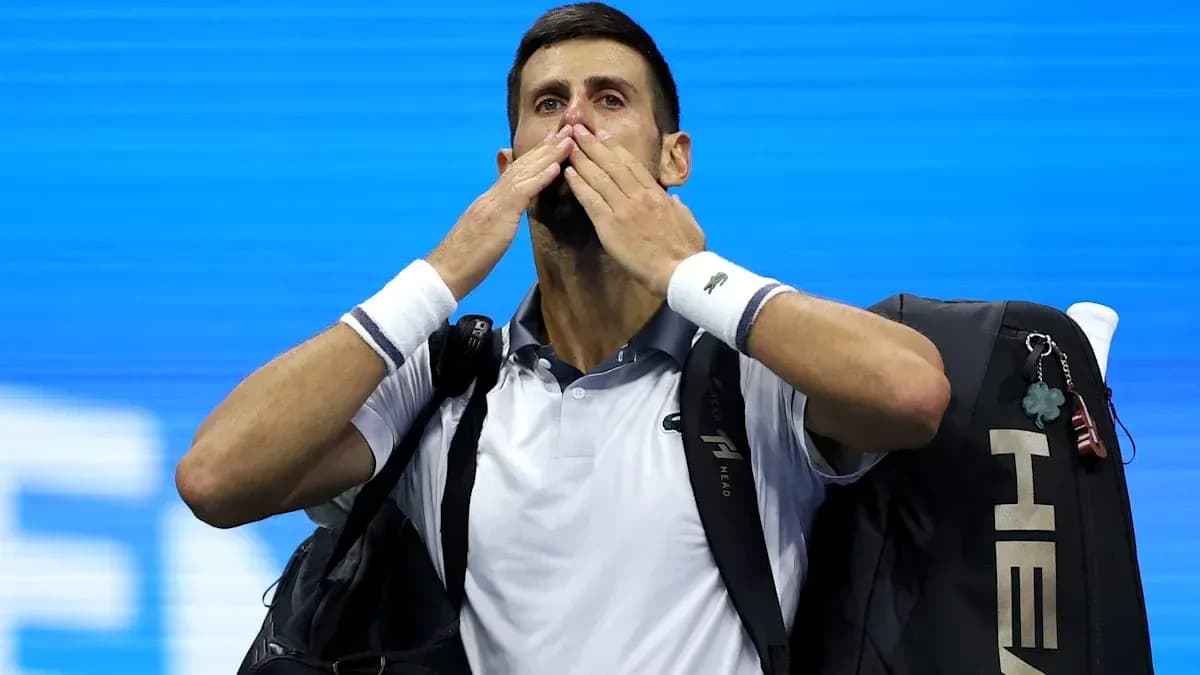
This time, as he walked off, he turned to each side of Ashe and formed a heart with his fingers, sending it into the stands.
Navone celebrated the win of his life. Djokovic walked toward something else entirely — a future that, for the first time in a long time, he cannot read, and a question he can no longer avoid: how many more nights like this can the greatest hard-court player of his era endure?