Nick Kyrgios Accepts One-Month Ban After Cocaine Test
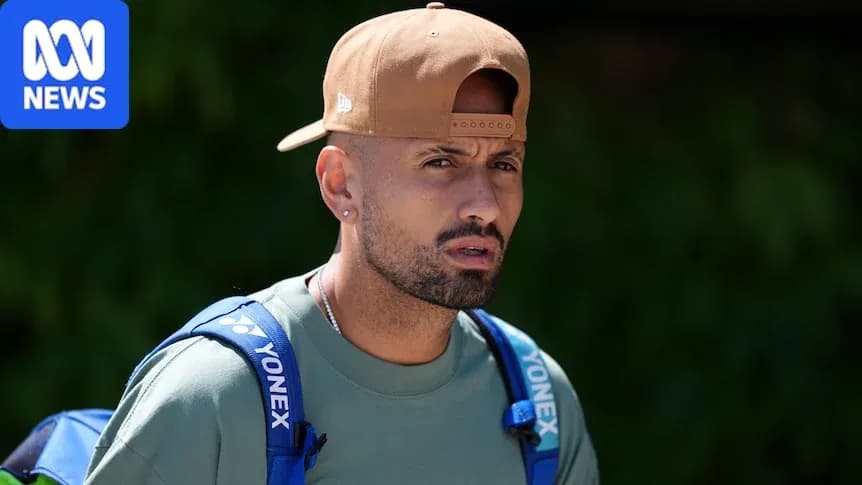
Nick Kyrgios has entered a treatment program and accepted a one‑month ban after testing positive for cocaine, drawing a stark new line in one of tennis’s most turbulent careers.
The 2022 Wimbledon finalist is free to return to competition from Friday, his provisional suspension backdated and sharply reduced after he agreed to seek help. The punishment could have been far heavier: under anti‑doping rules, Kyrgios faced anything from a baseline three‑month ban to as long as four years.
The failed test came at an ATP 250 event in Mallorca, where Kyrgios lost in the first round to fellow Australian Adam Walton and earned 6,570 euros in prize money. That cheque is gone. So, for the past month, has he.
When the International Tennis Integrity Agency (ITIA) first notified him of the positive test for benzoylecgonine — a cocaine metabolite — Kyrgios admitted what he later called a “huge mistake”. He told ITIA investigators the drug use happened on a night out, socially, days before he was due to compete in Spain.
The ITIA turned to an independent scientific expert at a World Anti-Doping Agency (WADA)‑accredited laboratory. The expert concluded that Kyrgios’s account tallied with the levels detected in his sample. The agency accepted that the cocaine use occurred out of competition, a crucial distinction under WADA’s code.
For this type of breach, the default sanction is three months. That can drop to one if the player commits to an approved treatment program. Kyrgios took that route. He did not appeal his provisional suspension. He chose to own it.
The 31‑year‑old, whose career‑high ranking peaked at world No.13, had already laid much of this bare in a lengthy Instagram post last month. He confirmed the failed test, apologised directly and repeatedly, and tried to explain the emotional terrain he has been walking.
“I made a huge mistake and I take full responsibility for it,” he wrote, before addressing fans, family, sponsors and, pointedly, the children who idolise him. “I know the example this sets and I’m deeply disappointed in myself.”
The words carried the weight of a player who has been fighting more than just opponents across the net. Kyrgios has played only four official singles matches on the ATP Tour this year, his body breaking down under the strain of knee and wrist injuries. The physical damage has accelerated a reality he has all but admitted: his days as a serious singles contender are close to over.
“The last couple of years of injuries have taken a huge toll on me, both physically and mentally,” he wrote. “My body hasn’t been able to do what my mind expects it to do, and coming to terms with being near the end of my career has been harder than I ever imagined.”
The conflict is familiar to anyone who has watched him. A player who insists “I didn’t choose tennis — tennis chose me,” now finds himself wrestling with how to let go of the sport that has defined his life. He described feeling helpless. Alone. Then cut himself off.
“None of that excuses what I did.”
The ITIA’s ruling underlines that separation. Kyrgios has been banned from playing, coaching or even attending tournaments sanctioned by the ATP, WTA or national bodies in Australia. His last appearance came in the men’s doubles at Wimbledon on July 2, where he and Alexander Bublik exited in the first round.
From there, the spiral became official. The positive test was confirmed by a WADA laboratory on July 17. The provisional suspension followed on August 4. The countdown to his return now rests not on a training block or a protected ranking, but on a 28‑day stretch he has chosen to dedicate to treatment and silence.
“The good news is that this has given me a wake up call,” he wrote. He promised to step away from social media and public life for those 28 days, asking for privacy for himself and, pointedly, for his family. “I’m sorry. I’ll do the work and come back better.”
Whether his body, and the sport, will be waiting for him in the way he imagines is another question entirely.