Frances Tiafoe's Epic Comeback Against Alex Michelsen
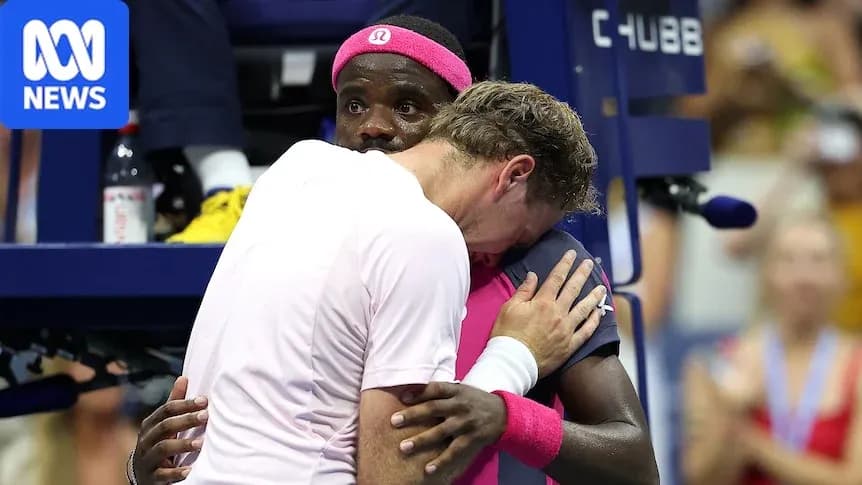
Frances Tiafoe had every right to roar. Instead, he wrapped Alex Michelsen in a hug.
On a sweltering night at Arthur Ashe Stadium, the 11th seed dragged himself back from the brink, overturning a two-set deficit to beat his close friend and compatriot 5-7, 3-6, 7-5, 6-3, 7-6(10/6) and reach the US Open semifinals for the third time. The match lasted four hours and 38 minutes. The embrace at the end lasted only a few seconds, but said just as much.
“As soon as I hugged him I saw he was crying already,” Tiafoe told ESPN. “I was like, ‘Man I know. I've been there twice, lost in five.’ … He's young and he hasn't been there.”
This was Michelsen’s coming-out party and heartbreak all at once. Unseeded, ranked No. 46 in the world, and playing his first major beyond the second round at his home slam, the 22-year-old had Tiafoe cornered. He led by two sets. He led by a break in the third. He served for the match at 5-4.
Then the match turned. Violently.
Tiafoe, who had looked flat and strangely disconnected through two and a half sets, suddenly caught fire. He ripped through seven straight games, stealing the third set 7-5 and racing to a commanding lead in the fourth. The noise inside Arthur Ashe rose with him, every forehand winner pulling the crowd closer to the edge of their seats.
“I slowly, slowly started getting my rhythm there,” Tiafoe said. The understatement fit the scoreline but not the surge. Once he found his range, he bullied rallies, took the ball early, and dragged Michelsen into longer, more physical exchanges.
The fourth set went quickly, 6-3 to Tiafoe, and for a moment it looked like the veteran of deep New York runs would simply roll through the decider.
Michelsen refused to accept that script.
He came out swinging in the fifth and stormed to a 3-0 lead, showing the same fearless hitting that had carried him past the fourth round for the first time at a major—his previous best a run to the last 16 at the 2025 Australian Open. His serve, so reliable all fortnight, cracked down 21 aces on the night and produced 55 winners. On many evenings, those numbers win you the match.
But the tally that haunted him was different: 61 unforced errors. On this stage, against this opponent, that was a heavy bill to pay.
Still, he pushed Tiafoe all the way to a 10-point tiebreak. The tension inside Ashe tightened with every mini-break, every second serve hanging in the air a fraction too long. Tiafoe, who had “lost in five” twice at this tournament, knew the territory. This time, he refused to blink.
At 9-6 in the breaker, he saw one last opening. Michelsen approached the net; Tiafoe drilled a forehand passing shot down the line, clean and brutal. Match over. Great escape complete.
The initial reaction was pure release. A shout, arms raised, the familiar surge of a player who has stared down the exit and walked back toward the light. Then Tiafoe turned, saw his friend across the net, and the celebration stopped.
“We're super tight. We've always had a great relationship. We laugh and joke all the time. He's one of my good buddies on tour,” Tiafoe said. “I know how much that hurts. I know how much he wanted that today. It's something that you dream about.
“I just told him, ‘You're going to be here so many more times, man. And I'm going to be in a rocking chair when you do.’”
Michelsen, eyes red, buried his face in Tiafoe’s shoulder. When he finally walked off Arthur Ashe, a towel draped over his head, he still lifted an arm to acknowledge the ovation. He had flown under the radar for most of this run, but he left the biggest court in American tennis with the crowd firmly on his side.
“He's also an unbelievable guy and a very good friend of mine,” Michelsen had said earlier in the tournament. On this night, that bond softened the blow, but didn’t erase it.
For Tiafoe, the road only gets steeper. Next up is either eighth seed Ben Shelton, the booming lefty who electrized New York last year, or defending champion Carlos Alcaraz, the standard-bearer of the new generation. Tiafoe admitted Michelsen “easily could have won today.” He knows he cannot afford another slow start.
But this was more than a comeback. It was a snapshot of American men’s tennis in one frame: the established star clinging on, the rising talent pushing him to the edge, both meeting at the net with respect and raw emotion.
One moves on to chase the title. The other walks away with a scar—and the feeling he’ll be back on this stage sooner than anyone thinks.