Elena Rybakina Becomes World Number One After US Open Victory
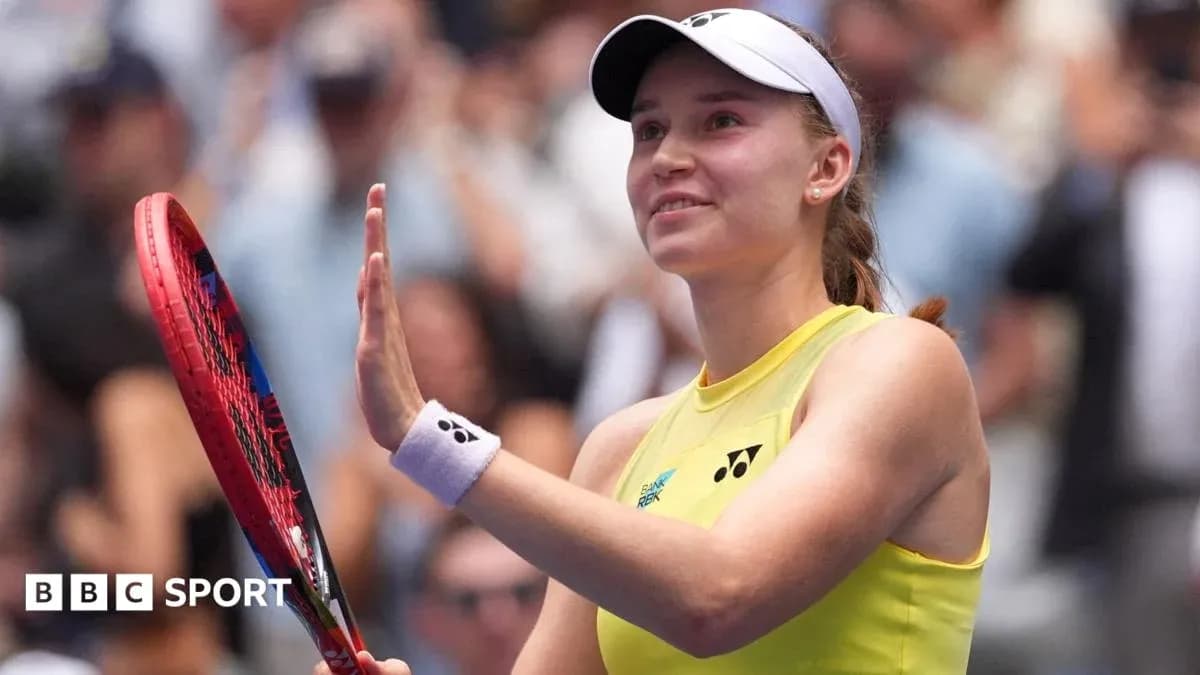
After 99 weeks, women’s tennis finally has a new name at the summit. Elena Rybakina has climbed all the way to the top.
The 27-year-old sealed her rise to world number one with a gritty US Open quarter-final victory over Zheng Qinwen, coming from a set down to win 3-6 6-1 6-4 and booking her place in the last four in New York. The result guarantees she will replace Aryna Sabalenka at the head of the WTA rankings on Monday.
She is the first player from Kazakhstan, man or woman, ever to sit at number one in singles. A landmark for her. A landmark for her country. A shift in the balance of the women’s game.
A number one born in the grind
This was not the smooth, untouchable march of a player cruising to the top. For the first time in this US Open, Rybakina dropped a set. Zheng came out swinging, attacking the Rybakina second serve, taking the opener and briefly rattling the usually unflappable Kazakh.
The response was ruthless. Rybakina tore through the second set 6-1, tightening her baseline game and finding her first serve with familiar, heavy rhythm. The match tightened again in the decider, Zheng pushing hard and even earning a break point that would have turned the set on its head.
Rybakina shut the door. She saved it, held, and then closed out the match with the kind of cold clarity that has defined her last 12 months.
The reward is more than just a semi-final. It is the throne Sabalenka has occupied since 21 October 2024, a 99-week stay that ranks as the sixth-longest run at number one in WTA history.
Chasing down Sabalenka
This ascent has been a long pursuit, not a sudden surge.
Rybakina arrived in New York as one of three women with a realistic shot at dethroning Sabalenka, alongside home hopes Jessica Pegula and Coco Gauff. All three challengers, though, needed almost everything to go right: win the title and hope Rybakina stumbled before the semi-finals.
She didn’t blink. They ran out of road.
Her charge towards the summit really began at the back end of 2025. After losing to Sabalenka in the Wuhan Open quarter-finals last October, she hit back immediately, lifting the Ningbo Open title a week later. The real statement came at the season-ending WTA Finals, where she beat Sabalenka to take the biggest trophy of her year.
That momentum spilled into 2026. In Melbourne, Rybakina met Sabalenka again, this time in a major final, and outlasted her in three tense sets to win the Australian Open – her second Grand Slam crown, almost four years on from her breakthrough at Wimbledon.
The rivalry has swung back and forth since. Sabalenka struck back at Indian Wells in the final and again in the Miami Open semi-finals. Rybakina answered with the Stuttgart title on clay, capitalising as Sabalenka’s form wavered.
The season has not been a straight climb. Early exits at Roland Garros and Wimbledon stung. A run to the final in Toronto steadied things, though she fell in straight sets to Iga Swiatek. Then came another blow: a left ankle injury forced her to retire from her Cincinnati Open quarter-final against Swiatek last month, her movement compromised, her serve stripped of its usual explosive push-off.
She later admitted the ankle had “bothering me for a long period of time” but insisted she had it “under control”. Even so, her build-up to the US Open was far from ideal. She could barely train for much of the week before the tournament and conceded her preparation “wasn’t great”.
Yet here she is, in the semi-finals, ranked number one. One target already hit. One still looming.
“It’s just a number right now”
For all the symbolism, Rybakina herself has tried to downplay the ranking milestone.
“It’s just a number right now. My goal is to win the tournaments which I play,” she said, underlining that the trophy in New York still matters more than the mathematical confirmation of her status.
She knows how fragile rankings can be, how quickly a bad month or an injury can drag a player back into the pack. The top spot is an achievement. Staying there is a different battle.
That battle could soon run straight through Sabalenka again. The pair, who contested this year’s Australian Open final, remain on a collision course for the US Open title match. Rybakina will face either Coco Gauff or Mirra Andreeva in Thursday’s semi-finals, while Sabalenka meets Jessica Pegula in the other.
A rematch in the final would frame the season: the new number one against the woman she has finally dislodged.
A partnership tested and restored
Behind Rybakina’s rise stands a familiar figure: coach Stefano Vukov.
They have worked together, on and off, for almost seven years. Their first spell ran from 2019 to 2025, a period in which Rybakina transformed from talented prospect into Grand Slam champion. Then came the split, followed by controversy.
Later in 2025, Vukov was banned from the WTA Tour for breaching its code of conduct after an independent investigation into his behaviour towards Rybakina. He denied wrongdoing. Rybakina publicly stated she was never mistreated by him.
She pushed for his return. At the start of 2025 she sought to bring him back into her team, and after a successful appeal, Vukov resumed coaching her in August last year.
The impact was immediate. At their first tournament back together, Rybakina reached the US Open fourth round for the first time in her career. From there, she built the late-season surge that carried her to the WTA Finals title, the Australian Open crown, and now the top of the sport.
Seven years, a split, a ban, a reunion – and now a world number one forged from that complicated, enduring partnership.
The ranking is secured. The history is written. The only question left in New York is whether Elena Rybakina leaves as the best player in the world on paper, or the US Open champion with the trophy to prove it.