Elena Rybakina Withdraws from WTA Finals Due to Illness
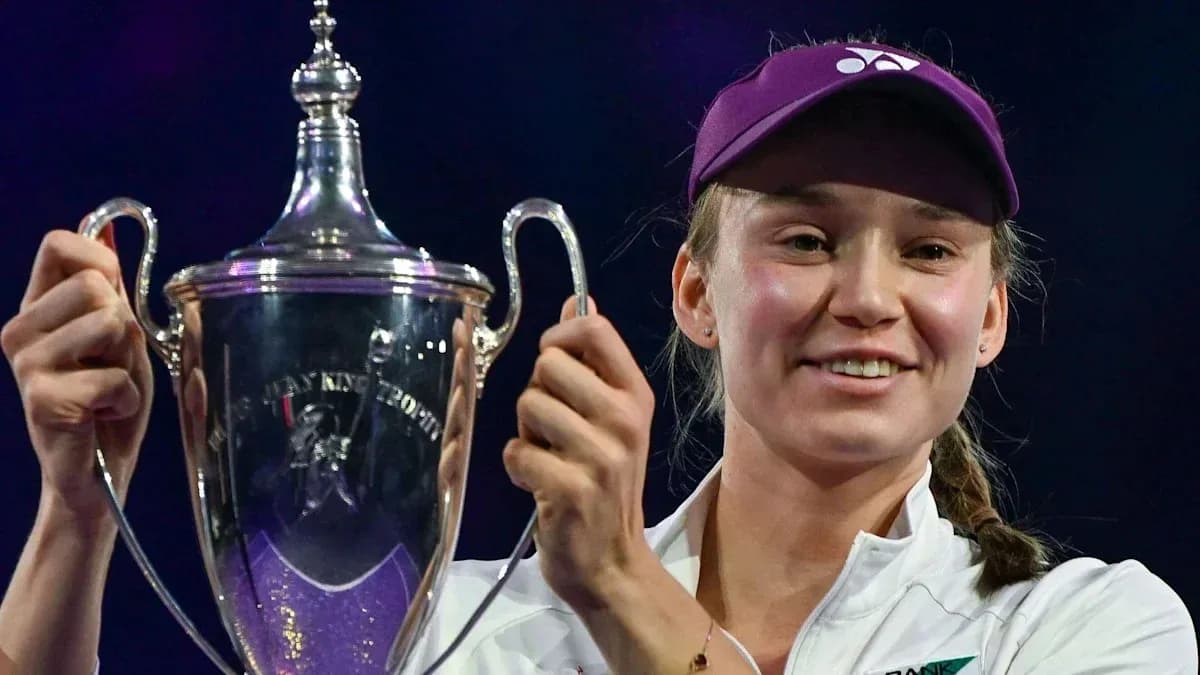
Elena Rybakina’s season ends not with a final statement of dominance, but with a silence she did not choose.
The world number one has withdrawn from the WTA Finals in Indian Wells on the eve of the tournament, forced out by a viral illness just as she stood on the brink of another slice of history.
A champion stopped at the door
Rybakina arrived at the end-of-year showpiece as the undisputed force in the women’s game. Australian Open champion. US Open champion. Year-end world number one for the first time. The player who finally broke Aryna Sabalenka’s near two-year grip on the top ranking.
She was set to open her campaign on Sunday, chasing a rare double: back-to-back WTA Finals titles. No woman has managed that since Serena Williams in 2014. The stage was built for a statement week in the desert.
Instead, the defending champion never makes it to the line.
“I am really sad to inform all my fans and supporters that I unfortunately have to withdraw from the WTA Finals this year,” the 27-year-old Kazakh said, confirming that her body simply would not let her compete after a punishing, brilliant year. “I've had an incredible season but my body is just not physically ready to compete. I'm going to spend some time resting and recovering at home and getting myself ready for the 2027 season.”
For the tournament, it is a major loss. For the locker room, it removes the player nobody wanted to see on the other side of the net this week.
A year of ruthless numbers
Rybakina’s withdrawal lands with extra weight because of what she has produced in 2026.
She claimed the Australian Open in January, then the US Open in September, finally adding hard proof to the feeling that her Wimbledon title in 2022 was the start, not the peak. In between and around those majors, she lifted trophies in Stuttgart and Ningbo, and reached finals at Indian Wells and Toronto.
Her consistency has been relentless. She closes the season with a 54–14 record, winning 17 of 19 matches at Grand Slams. On the biggest courts, under the brightest lights, she has been almost immovable.
The numbers behind that dominance are as stark as they are simple. No one served better. Rybakina fired 438 aces this season, a tour-leading figure and 140 more than second-placed Sabalenka. Her serve didn’t just start points; it crushed resistance, set the tone, and gave her the freedom to swing.
But she did not live on serve alone. She led the tour with 1,775 winners, an avalanche of first-strike aggression that turned rallies into target practice. When the opposition stiffened, she raised the level again: 10 victories over fellow top-10 players, more than anyone else on tour.
That combination — the most destructive serve in the game and the most punishing baseline firepower — is what carried her past Sabalenka in the US Open final, a result that snapped the Belarusian’s 99-week stay at number one and formally handed Rybakina the crown.
She sealed the year-end top ranking in Tokyo in October. By then, the argument about who ruled the women’s game was over.
A surge two years in the making
The viral illness that has cut short her season arrives at the end of a sustained surge rather than a sudden spike.
Since last October, Rybakina has won six of her 15 career titles, finally backing up that breakthrough Wimbledon win after nearly four years of waiting for a second major. The gap between promise and proof has closed, replaced by a steady accumulation of silverware and a growing aura of inevitability.
What once looked like potential now feels like structure: a game built on heavy, flat power, a temperament that rarely flickers, and a results sheet that keeps filling up.
That is what makes this withdrawal sting. The WTA Finals were not just another event on her schedule. They were a chance to stamp her authority on a year she has already owned, to walk into the off-season as champion of almost everything that mattered.
Instead, the field in Indian Wells opens up overnight. One of the sport’s most intimidating presences disappears from the draw, leaving rivals both disappointed by her absence and quietly aware that an enormous obstacle has been removed.
Eyes on 2027
Rybakina, though, has earned the right to think beyond one lost week.
At 27, with two hard-court majors in her pocket this year and the number one ranking secured, she steps away from the Finals not as a player in doubt, but as the clear standard-setter heading into 2027.
Her own plan is simple: rest, recover, reset. The numbers she has posted in 2026 suggest that if her body allows it, the question next season will not be whether she can win more, but how much more she intends to take.