Elena Rybakina Claims US Open Title and No 1 Ranking
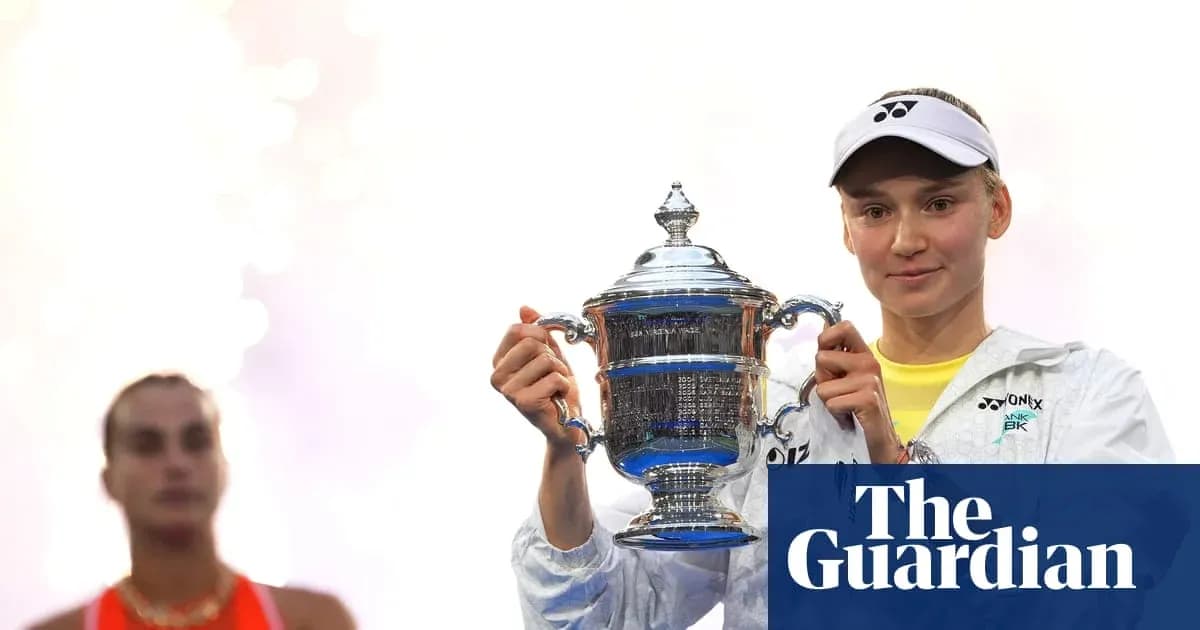
For years, Elena Rybakina lived in the strange limbo reserved for the almost-acknowledged greats. A Wimbledon champion. A destroyer of serves and rallies on every surface. A nightmare draw for anyone. Yet always filed just below the true ruling class of her era, behind those deemed tougher, steadier, more complete.
She walks out of New York with that argument closed.
Rybakina leaves Flushing Meadows as the undisputed No 1, both on the rankings sheet and in the reality of the women’s game, after ripping the crown from Aryna Sabalenka’s head and keeping it for herself. Having already taken Sabalenka’s top ranking during the tournament, she then took her title, outlasting the Belarusian 6-4, 5-7, 6-2 in a gripping US Open final to end the champion’s two-year reign.
This was not just a trophy run. It was the most ruthless mental campaign of Rybakina’s career.
In the days before the tournament, an achilles injury threatened to keep her out altogether. She arrived unsure if she would even step on court, then spent two weeks told exactly what she needed to do to become world No 1. Every round came with a calculator and a warning. Every match in the second week brought a major or Olympic champion across the net. Four in a row. Four times she walked through the fire without blinking.
Final Against Sabalenka
That hardening showed in the final against the one opponent who has consistently matched her power and presence on the biggest stages. Sabalenka, the top seed and two-time defending champion, came in scarred by a turbulent summer but still swinging for history. She left with her aura dented and her throne gone.
Rybakina did not even start with her best weapon.
Her first serve, the most feared delivery in the sport, was a mess in the opening set. She landed just 27% of first serves, only eight of 30 attempts finding the box. For most players, that is a death sentence against Sabalenka. For Rybakina, it became a showcase of how complete her game has become.
She simply took the match in her hands from the baseline. Her return chewed into Sabalenka’s serve. The rallies were played on her terms, heavy, flat, ruthless. The backhand, so often the barometer of her confidence, was immaculate. Sabalenka, struggling to find any comfort, was squeezed out of space and out of rhythm.
The tension showed early. At 2-3 in the first set, Sabalenka double-faulted to surrender the decisive break, then lashed a ball into the crowd and collected a code violation. The frustration never really left her. Even when Rybakina’s first serve kept misfiring, Sabalenka could not properly punish the second serve, the kind of missed opportunity that gnaws at a player in a major final.
Yet she refused to go quietly. The pressure eventually turned, as it so often does in these heavyweight contests.
Sabalenka steadied her own serve in the second set and finally found some rhythm. Rybakina’s first delivery improved, but the ground game lost a fraction of its precision. The rallies lengthened, the errors crept in, and the dynamic shifted. At 5-4, with Rybakina serving for the title and the weight of the moment settling on her shoulders, Sabalenka pounced.
She cracked a backhand return winner down the line to reach double set point, her first break points of the entire match. Rybakina offered up two second serves. Sabalenka could not convert, but the pattern had changed: the Kazakhstani second serve was finally under sustained assault. At 6-5, Sabalenka muscled her way to a third set point and this time did not hesitate, drilling another backhand return winner to drag the final into a decider.
The stadium roared for the champion mounting her charge. Rybakina barely flinched.
She walked to her chair, reset, and came out for the third set serving with the clarity of someone who knows exactly who she is and what she wants. The serve that had deserted her suddenly snapped back into its familiar, brutal groove. Aces flew. Free points returned. Her early service games in the decider were brisk, almost casual, and they sent a clear message: keep up, or get left behind.
Sabalenka could not. She has spent the past two seasons bullying most of the tour off hard courts, but here she found herself chasing a player who now owns the surface.
By winning in New York, Rybakina completes a hard-court triple that leaves no room for debate. She now holds the Australian Open, the US Open and the WTA Finals, the three biggest titles on the surface. Sabalenka’s claim as the queen of concrete has gone the same way as her ranking.
This third major title also moves Rybakina into rare company. She joins Lindsay Davenport, Jennifer Capriati, Ash Barty, Angelique Kerber and Virginia Wade as a three-time grand slam champion. Her Wimbledon triumph in 2022 announced her. The 2026 Australian Open confirmed her. This US Open crowns her.
Only Roland Garros now stands between her and the career grand slam.
The significance of this final stretched beyond the numbers. It was only the second time in the 38 years since both the Australian Open and US Open moved to hard courts that the same two players contested both finals in a season. It was a meeting of the top two players in the world with the No 1 ranking guaranteed to change hands when it was over. The stakes were obvious. The level matched them.
Rybakina and Sabalenka have now played three major finals. Three times they have produced matches that feel like reference points for their generation. They began this one at a furious pace, trading blows with a quality and intensity that has become their default when the trophies come out. The difference, in the end, was who held their nerve when the match flipped for a final time.
Rybakina did not just hit through Sabalenka. She outlasted her. She absorbed the storm of the second set, walked back into the fire in the third and imposed her game again, this time with the serve as sharp as the rest of her arsenal. Once she found that gear, the contest tightened around Sabalenka, as it has around so many others over the past year.
The rankings now say what the tennis has been hinting at: Elena Rybakina is the standard in the women’s game. She has the hardware, the head-to-heads, the hard-court empire. She has turned questions about her mentality into a fortnight-long answer.
The only real unknown left is how quickly she can turn this era into something even more daunting for the rest of the field.