Elena Rybakina Advances to US Open Final with Comeback Victory
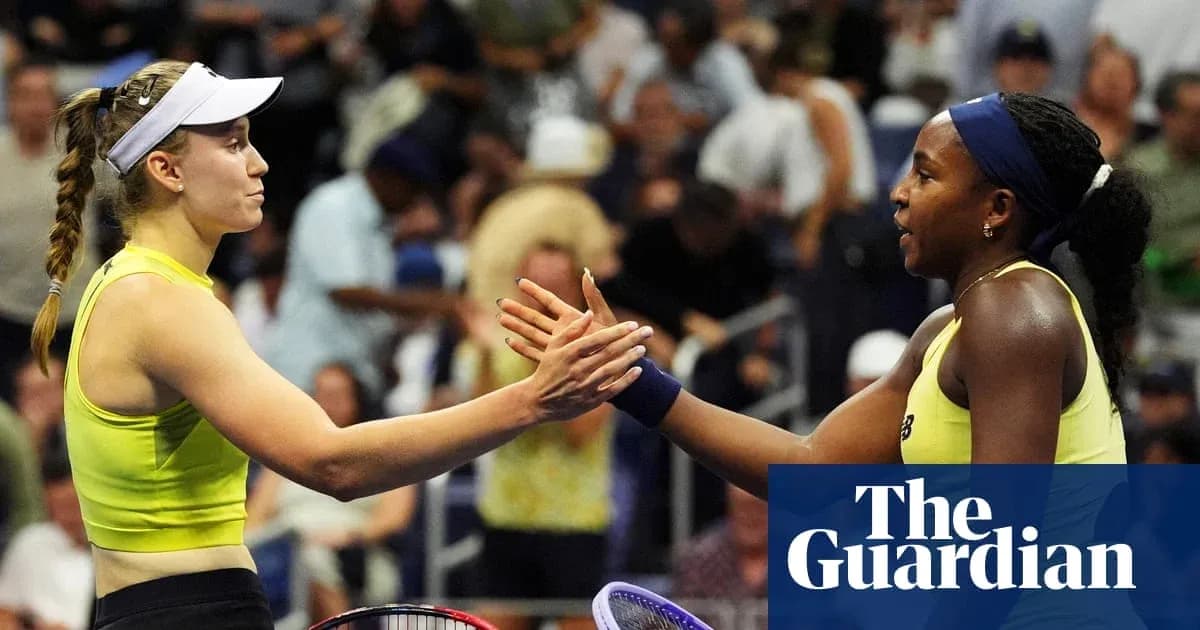
Elena Rybakina walked out for her first US Open semi-final looking as if the occasion might swallow her whole. One set in, it almost had.
Coco Gauff owned Arthur Ashe Stadium in that opening act. She flew across the acrylic, hunted down every ball, and rode a wall of sound from 22,000 fans who wanted Rybakina’s scalp. The Kazakhstani’s forehand sprayed, her backhand leaked errors, and the serve that has terrorised the tour went missing. Gauff took the first set 6-3 and looked as if she might run away with it.
Rybakina, though, is built for problem-solving on bad days. She steadied, recalibrated, and then imposed herself with brutal clarity, turning a chaotic start into a 3-6, 6-4, 6-4 victory and a place in her first US Open final.
This fortnight in New York has never really seen her at full flight. Not once. Yet here she is, six matches in, still standing, still surviving, and now thriving. That says everything about the harder edge that has crept into her game and her mentality.
This will be her fourth grand slam final. Since that breakthrough Wimbledon title in 2022, her major runs have increasingly been carved out on hard courts, the surface that now defines her. She waited four years to claim a second slam; now she has the chance to complete a two-major season.
She arrived in New York with a tantalising prize in reach: world No 1. The path was clear enough, the opportunity obvious. The preparation, less so. An Achilles scare in the build-up, a poor record at Flushing Meadows, and a draw that offered no softness. She pushed through all of it.
The ranking landmark came first, sealed in a tense, nerve-fraying quarter-final against Zheng Qinwen. Many players would have exhaled and drifted after that kind of milestone. Rybakina did the opposite. She made it clear the number next to her name meant little without the trophy to go with it. The job, in her mind, was barely underway.
Now comes a final that fits the scale of her season. Aryna Sabalenka, the departing No 1, waits across the net. It is a rematch of the Australian Open final that Rybakina won, a rivalry that has framed the year and will now shape its biggest hard-court conclusion.
For Gauff, this night will sting because it exposed the shot she has worked hardest to repair. Twelve months ago, her serve reduced her to tears on this same court. Over the past year, that weakness has been transformed into a weapon and, in this semi-final, it largely held up.
Her forehand did not.
Under the weight of Rybakina’s relentless pace, the Gauff forehand collapsed, coughing up 15 unforced errors and breaking down at the worst possible moments. The shot that needed to survive the storm simply couldn’t.
The stage itself carried history. For the first time in 51 years, all four top seeds reached the US Open women’s singles semi-finals. It had not happened at any major since Wimbledon in 2009. Rather than a shock, it felt like confirmation of the depth and steel at the top of the women’s game.
Most of these players now know each other’s patterns almost too well. Yet Rybakina and Gauff, the second and fourth seeds, have largely circled one another from afar. Before this summer, they had met only once. Their clash in Canada last month, another three-set comeback win for Rybakina, hinted at a matchup with layers. New York added another.
Gauff stepped into the semi-final still carrying the scars of her quarter-final escape against Mirra Andreeva, when 12 double faults nearly dragged her out of the tournament. She needed reassurance from her serve. In the first set, she got it.
She landed big first serves when she needed them, defended with supreme athleticism, and coaxed error after error from a flustered Rybakina. The crowd roared with every scramble, every hold. The scoreboard, and the mood, tilted fully in Gauff’s favour.
Then the match flipped.
Rybakina opened the second set with a clear tactical shift. She started to stretch the court, using wider angles, especially off the backhand. Those trademark, skidding cross-court backhands began to drag Gauff out of her comfort zones. The errors didn’t vanish overnight, but the ball-striking grew cleaner, the patterns more defined.
She sprinted to a 4-1 lead. The set itself was messy from both players, a patchwork of winners and wild misses, but it revolved around Gauff’s increasingly fragile forehand. At 4-5, serving to stay in the set, the American produced her worst game of the night: three forehand errors and a double fault. Rybakina did not need a second invitation.
By the decider, the match demanded that Rybakina’s greatest weapon finally show up. It did.
Her serve roared to life early in the third, two booming aces sealing a hold for 2-1 and setting the tone. With that rhythm restored, her service games became quick, ruthless marches. Gauff suddenly had to match that standard just to cling on.
At 2-3, facing two break points, Gauff looked on the brink. She dug in, found a pair of big serves, and clawed her way to 3-3. It felt like a turning point. It wasn’t. Serving at 3-4, she cracked again. Rybakina pounced, broke, and stepped up to serve for the match.
Gauff refused to go quietly. She launched one last surge, saving match points and breaking back for 4-5 with a blistering backhand pass at 3-5, 30-30 that lit up Ashe and briefly revived belief. The stadium shook; Rybakina barely blinked.
She reset instantly, forced herself inside the baseline, and attacked the return game with cold precision. Gauff’s resistance finally broke. One last flurry from Rybakina, one last forehand drive, and the comeback was complete.
From a set down, in a hostile arena, without her best tennis, she had muscled her way into a US Open final that will pit two world No 1s against each other.
Now the question is simple: can anyone stop her finishing the year as the woman who bent the hard-court season to her will?