Elena Rybakina Claims First US Open Title and World Number One Ranking
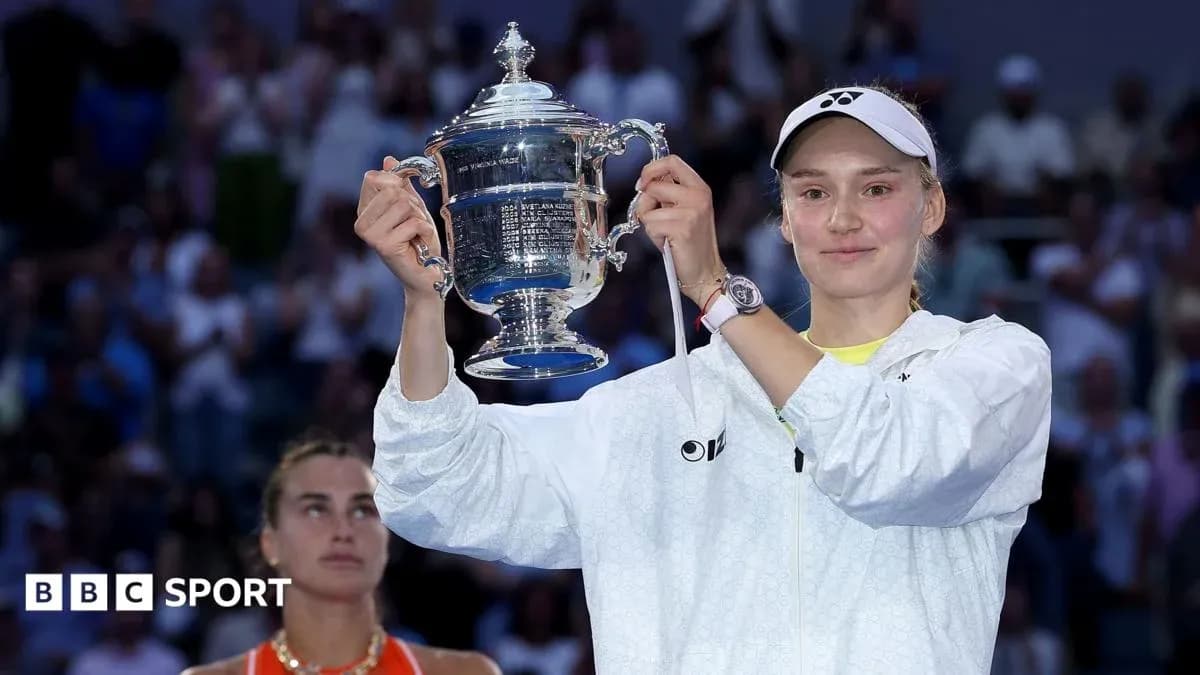
Elena Rybakina walked into New York already assured of the number one ranking. She left with something far heavier in her hands – her first US Open title and the clearest possible statement that, right now, she is the standard in the women’s game.
On a hot, tense afternoon at Flushing Meadows, the 27-year-old from Kazakhstan dismantled two-time defending champion Aryna Sabalenka 6-4 5-7 6-2, ending the Belarusian’s reign and seizing a third Grand Slam crown to sit alongside Wimbledon 2022 and the Australian Open earlier this year.
The new world number one beat the one she will replace. That felt symbolic.
Ice versus fire
This rivalry has always been about contrasts. Sabalenka, all roar and raw emotion, pacing between points, raging at errors. Rybakina, a still photograph by comparison, barely a flicker of expression, her inner turbulence hidden behind a flat stare and economical movement.
On this stage, that difference decided the match.
Rybakina’s first serve misfired early. For most players, that’s a crisis. For her, it became an adjustment. She held her nerve, leaned on a savage returning game and turned Sabalenka’s power back on her. The defending champion grew increasingly agitated as Rybakina picked off second serves and dragged errors from her racket.
The opening set went to the Kazakh 6-4, not because she was at her absolute peak, but because she stayed calm while Sabalenka frayed.
The second set twisted. Sabalenka’s groundstrokes finally found their range, her forehand thundering through the court. Rybakina’s level dipped just enough to invite trouble. The tension grew with every service game, each point a small war from the baseline.
At 6-5, Sabalenka swarmed all over Rybakina’s second serve, stepping inside the court and unloading. On her third set point, she broke, snatching the set 7-5 and forcing a decider. The defending champion roared; the crowd sensed a shift.
The reset
Just as Sabalenka seemed to have the momentum, the loose swings crept back in. So did the self-criticism, the negative body language, the looks towards her box.
Rybakina, by contrast, shrank the occasion to its basics: see ball, hit ball, hold shape.
Her returns in the third set were brutal. Deep, flat, unrelenting, they pinned Sabalenka to the baseline and robbed her of the time she needs to wind up. At 1-1, Rybakina broke for 2-1, and from there the match tilted sharply in her direction. Every clean strike from her racket seemed to grow her presence, while Sabalenka’s shoulders sagged under the weight of her own errors.
The incoming number one surged to 5-2, serving for the championship with the composure of someone who has been here before – because she has.
There was one final test. On her first championship point, Rybakina double-faulted, a rare crack in the façade. The crowd gasped. She didn’t dwell. She stepped back to the line, reset, and drilled an ace to seal the title.
No scream. No collapse to the court. Just a brief, almost shy smile – a flash of emotion from a player who usually keeps everything locked away. Her second major of 2026, her third overall, and perhaps the most satisfying of the lot.
A city that finally yielded
This was not the Slam many had pencilled in for Rybakina. Her game – a penetrating serve, flat, thunderous groundstrokes, first-strike tennis that can rip the racket out of any opponent’s hands – looks tailor-made for hard courts. Yet New York had stubbornly refused to yield.
For a decade she had come to the US Open and left disappointed. The surface suited her. The city did not. The noise, the chaos, the swagger of Flushing Meadows never quite felt like her arena.
“I was coming here for the last 10 years and it was never successful. I’m falling in love with New York more and more,” she said afterwards. The smile that accompanied those words told its own story.
What makes this run even more remarkable is that a few weeks ago, she wasn’t sure she would be walking onto Arthur Ashe Stadium at all.
In Cincinnati, she injured her ankle in the quarter-finals and, for several days, could not walk. Her US Open campaign hung by a thread. The plan became brutally simple: take it day by day and see if the joint would hold.
It did more than that.
She cruised through her first four matches, her serve so dominant that opponents could barely get a foothold in rallies. Then came the real tests – Zheng Qinwen and home favourite Coco Gauff. In both matches she dropped the first set, was dragged into deep waters and forced to prove she could suffer as well as strike.
She did. Those comebacks hardened her for Sabalenka.
A champion with more to chase
Against the two-time defending champion, Rybakina stitched both sides of her tennis together. She bullied from the baseline when she had the opening. She dug in when she had to, defending with patience and clarity. The win leaves her one title – a French Open – away from the career Grand Slam.
“Some magic is happening. I was unlucky with injury and just going day by day,” she told Sky Sports. “We didn’t know how it was going to be so I’m super happy and still can’t believe it.”
Magic, perhaps. But also something more old-fashioned: resilience, clarity under pressure, and a game that now travels to every surface and every city.
New York finally belongs to Elena Rybakina. The question now is how much of the sport she intends to claim next.